Quick Picks
Short on time? Here are the best robot window cleaners for 2026:
- ECOVACS WINBOT W2S PRO Window Cleaning Robot (~$320) — Best overall
- ECOVACS WINBOT MINI Window Cleaning Robot (~$120) — Best budget
- ECOVACS WINBOT MINI 2 Compact Window Cleaning Robot (~$240) — Best for small windows and edges
- ECOVACS WINBOT W2 PRO OMNI Portable Window Cleaning Robot (~$300) — Best for windows without outlets
- ECOVACS WINBOT W3 OMNI Robot Window Cleaner (~$700) — Best premium (self-cleaning station)
- HOBOT-2S Window Cleaning Automatic Robot (~$300) — Best with a remote control
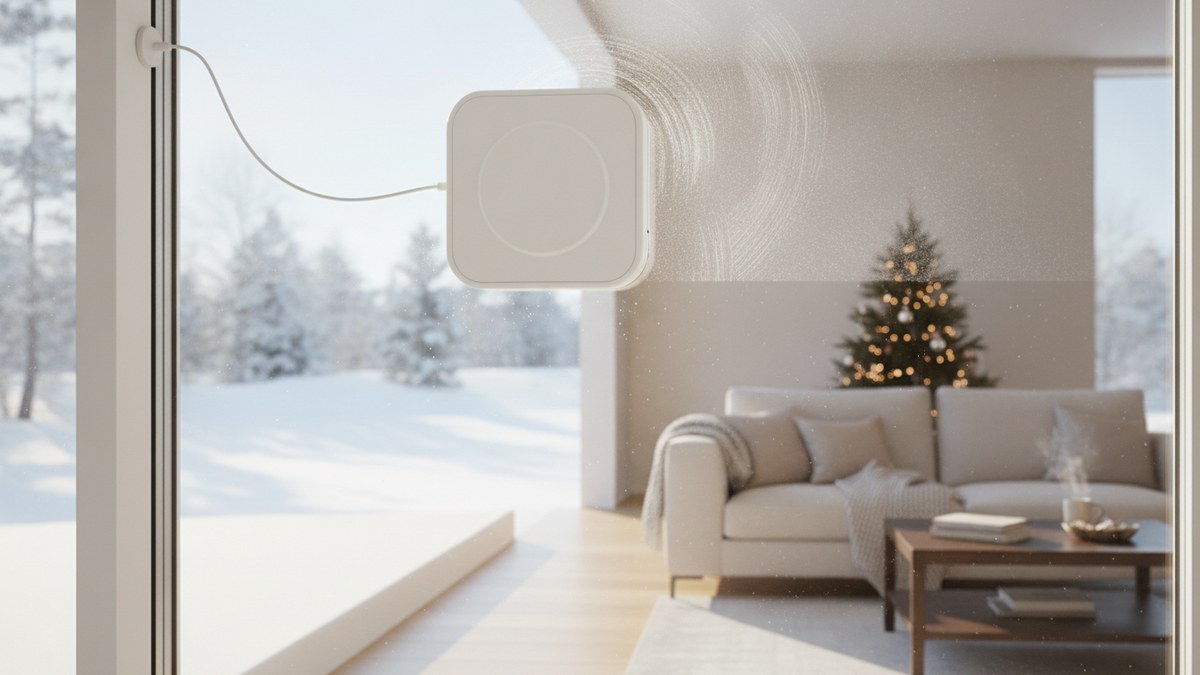
Cleaning windows is one of the most avoided chores in any home. It’s slow, it leaves streaks, and the windows that need it most are usually the hardest to reach: tall living room glass, a stairwell window, the sliding door the dog presses its nose against every day. A robot window cleaner takes most of that work off your plate. You stick it on the glass, press a button, and it wipes the whole pane in a neat pattern while you do something else.
These robots hold onto the glass with suction, a small fan that creates a vacuum seal against the window. They spray a fine mist of water or cleaner, wipe with a microfiber pad, and use sensors to find the edges of the window so they don’t drive off. Every good model also has a safety tether and a backup battery to keep it stuck to the glass if the power goes out.
Late fall is a great time to buy one. You’ll want clean windows before holiday guests arrive and while the low winter sun shows every streak. A window robot is also a fun gift for anyone who already loves their robot vacuum. We picked six models from about $120 to $700, and we checked every Amazon listing to make sure it’s the exact model we describe.
How Robot Window Cleaners Work
Suction keeps them on the glass. A fan pulls air out from under the robot, pressing it against the window. Higher numbers (measured in pascals, or Pa) mean a stronger grip. The picks here range from about 7,500 to 10,000 Pa.
Spray and wipe. Most robots spray a fine mist ahead of themselves. Some use ultrasonic spray, which turns water into very tiny droplets so the glass gets damp, not soaking wet. A microfiber pad underneath does the wiping. You wash the pad after each session.
Path planning. Sensors detect the window frame (or the edge of frameless glass), and the robot cleans in a zigzag or S-shaped pattern from top to bottom. ECOVACS calls its system WIN-SLAM. Higher-end models clean closer to the edges and corners.
Safety systems. Robots monitor their suction constantly. If something goes wrong, a backup battery keeps the fan running long enough for you to grab it, and the tether catches it if it ever falls. Always attach the safety tether, especially on an exterior window or a high pane.
Power. Most window robots run on a power cord, since spinning a suction fan takes a lot of energy. A few, like the WINBOT W2 PRO OMNI, have a battery station so you can clean windows that are far from an outlet.
What to Look For
Window size and type. Check the minimum window size. Compact robots like the WINBOT MINI 2 handle smaller panes, while larger robots need bigger glass. Most robots work on framed and frameless glass, mirrors, and glass doors, but not on curved, cracked, or textured glass.
Edge cleaning. Basic robots leave a strip of dirt along the frame. Newer models use edge brushes or side wings to get much closer, which saves you from touching up by hand.
Corded or battery. Corded robots can run as long as you need. A battery station lets you clean balcony doors, bathroom glass, or windows without a nearby outlet.
App or remote. ECOVACS robots use the ECOVACS HOME app to pick cleaning modes. HOBOT includes a physical remote as well as an app. A remote is handy when you want to steer the robot to a dirty spot without opening your phone.
Self-cleaning. Only the most expensive pick here washes its own pads. It’s a nice luxury, but most people are fine rinsing a pad by hand.
The Best Robot Window Cleaners for 2026
ECOVACS WINBOT W2S PRO Window Cleaning Robot — Best Overall
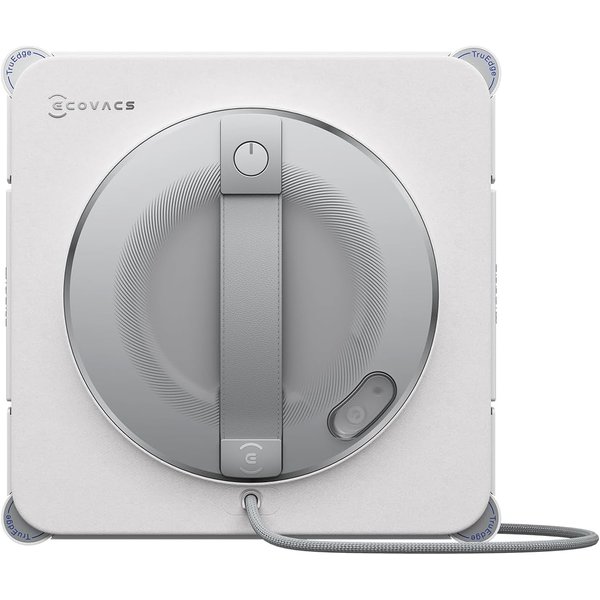
ECOVACS’s WINBOT line is the best-known name in window robots, and the W2S PRO is the one we’d recommend to most people. It has the strongest suction here at 10,000 Pa, which helps it grip floor-to-ceiling glass and sliding doors confidently, and it costs a lot less than the flagship W3 OMNI.
Cleaning uses three spray nozzles that mist the glass ahead of an ultra-fine microfiber pad. ECOVACS says it handles dust, pollen, water spots, fingerprints, smudges, and pet nose prints. Its TruEdge 2.0 system adds four edge brushes with dense felt bristles that reach along the frame and into corners, the part of the window older robots always missed.
Navigation comes from WIN-SLAM 4.0, which detects the window’s edges and obstacles and plans an efficient path. You get six cleaning modes: Fast, Thorough, Edge, Heavy-Duty, Deep, and Zone. That’s a useful range, from a quick touch-up to a deep clean on a window that hasn’t been done all year.
For safety, it has a 10-stage protection system that combines hardware fall protection with smart safeguards, plus a safety tether. The W2-series listing is rated 4.0 stars from about 390 reviews.
Pros:
- Strongest suction here (10,000 Pa)
- Triple-spray nozzles
- TruEdge 2.0 edge brushes for cleaner corners
- Six cleaning modes
- Much cheaper than the flagship
Cons:
- No battery station like the OMNI version
- Reviews are shared across the W2 family, so model-specific feedback is thinner
ECOVACS WINBOT MINI Window Cleaning Robot — Best Budget
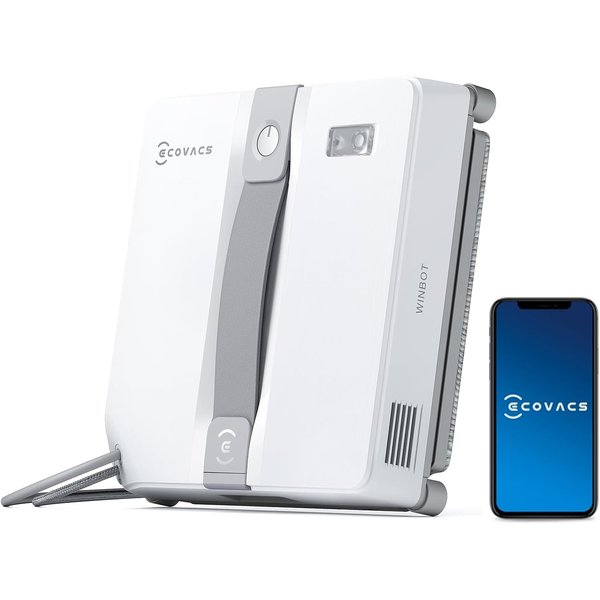
The WINBOT MINI is the easiest way to try a window robot without spending much. At around $120, it’s the cheapest pick here, and it’s also the highest-rated, at 4.2 stars from about 470 reviews.
It’s small and slim, about 8.5 inches square and 2.2 inches thick, so it fits windows and tight spaces that larger robots can’t reach. Despite the size, it has 7,500 Pa of suction, a 9-stage safety system, and a safety rope.
It’s simple to use. No app or Wi-Fi is needed for basic cleaning: plug it in, press the button, and it plans its own path. If you want more control, the ECOVACS HOME app adds Fast, Deep, and Spot cleaning modes. An ultrasonic spray system with a 60 ml water tank mists the glass automatically, and a bumper-free design lets it clean closer to edges than older robots. When it’s done, it heads back toward where it started and alerts you.
The pad is washable and reusable. ECOVACS notes the MINI is for flat, smooth glass and isn’t suitable for curved, cracked, uneven, or very small windows, and it needs to stay plugged in while cleaning.
Pros:
- Lowest price and highest rating here
- Compact, fits small and tight windows
- Works without an app
- Ultrasonic spray with a built-in tank
- Returns near its starting point when done
Cons:
- Less suction than the larger models
- Small 60 ml tank
- Corded only
ECOVACS WINBOT MINI 2 Compact Window Cleaning Robot — Best for Small Windows and Edges
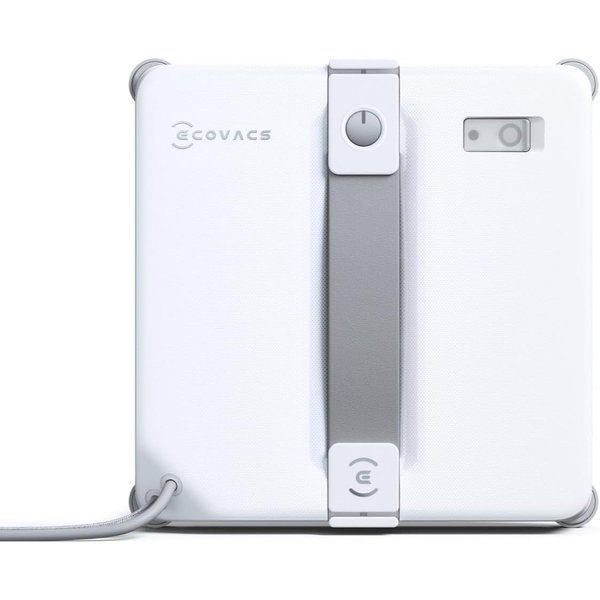
The MINI 2 keeps the compact 8.46 by 8.46 by 2.17 inch body of the original but does a much better job along the edges. ECOVACS calls it its most compact WINBOT, and it works on panes as small as 8.66 by 9.84 inches, so it’s the pick for divided-light windows, small bathroom windows, and glass cabinet doors.
For edges, it uses four high-density corner brushes and ultra-thin side wings that guide the pad to within 1 mm of the frame. ECOVACS claims up to 90% edge coverage, and there’s a dedicated Edge Clean mode for a finishing pass.
Other upgrades over the original: suction rises to 8,000 Pa, protection goes to 10 tiers, and the backup system keeps it attached for more than 30 minutes if the power cuts out. The included safety rope is rated to 1,600 N. The ultrasonic spray makes droplets as small as 10 microns to avoid over-wetting, and an enlarged microfiber pad presses on the glass with consistent pressure.
It uses WIN-SLAM 4.0 to map the window and plan its route. In the ECOVACS HOME app you get five modes (Fast, Thorough, Deep, Spot, and Edge Clean), plus Bluetooth directional control when you’re nearby to steer it manually. It’s rated 4.1 stars from about 245 reviews, shared with the 2026 version of the original MINI.
Pros:
- Fits panes as small as about 8.7 by 9.8 inches
- Corner brushes and side wings for edge cleaning
- 30-minute backup protection
- Five app modes plus Bluetooth steering
- Works on mirrors and glass doors too
Cons:
- About twice the price of the original MINI
- Small body takes longer on big picture windows
ECOVACS WINBOT W2 PRO OMNI Portable Window Cleaning Robot — Best for Windows Without Outlets
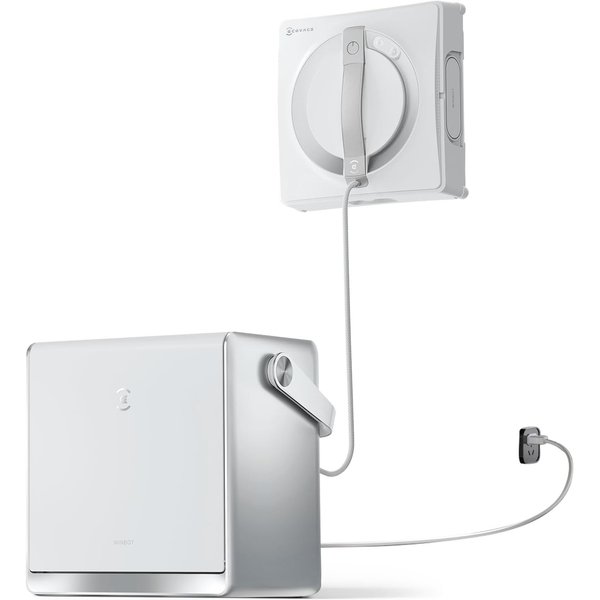
Most window robots need to be plugged in, which is a problem for balcony doors, bathroom glass, or windows across the room from the nearest outlet. The W2 PRO OMNI solves this with its portable station, which has a built-in battery.
It has two power modes. In battery mode, ECOVACS says it cleans for up to 110 minutes, about 55 square meters (roughly 590 square feet) of glass on one charge. In plugged-in mode, it runs continuously for big glass walls. The 6-in-1 station works as a control panel, charger, stabilizer, and storage case, so the robot, cord, and accessories all live in one box between cleanings.
Cleaning uses a three-nozzle wide-angle spray with a wet cloth. ECOVACS says water pressure is doubled compared to earlier models. A brushless motor and WIN-SLAM 4.0 path planning improve efficiency and edge detection, and safety comes from a 12-stage protection system. ECOVACS also includes insurance protection with the robot. It’s rated 4.0 stars from about 390 reviews across the W2 family.
Pros:
- Battery mode, up to 110 minutes
- Station doubles as storage and stabilizer
- Triple-nozzle spray
- 12-stage protection
- Insurance protection included
Cons:
- Station adds bulk to carry around
- Older design than the W2S PRO
ECOVACS WINBOT W3 OMNI Robot Window Cleaner — Best Premium
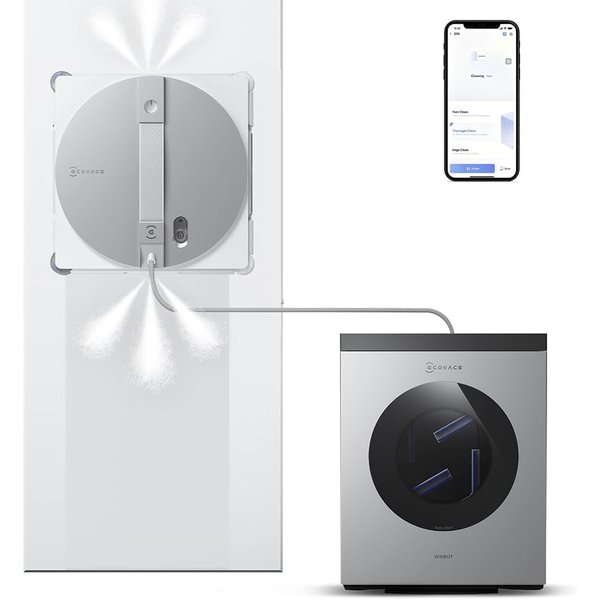
The W3 OMNI is ECOVACS’s flagship, and it does something no other robot here can: it washes its own pads. After a session, the station’s Vortex Wash system uses 16 high-pressure nozzles to clean the wiping pads in about one minute. There’s also an optional self-cleaning function for the station itself. If you’ve owned a self-emptying robot vacuum, this is the window version of that convenience.
Cleaning gets an upgrade too. TruEdge uses a scrubber that lowers along the edges and spins at 200 RPM to clean into corners, then retracts so it doesn’t spread dirt around. Navigation moves up to WIN-SLAM 5.0, with dynamic obstacle avoidance at 1 mm precision. Modes include Fast, Intensive, and Zone cleaning, and a triple-nozzle wide-angle spray handles big glass panels. Safety comes from 12-level protection.
It’s rated 4.1 stars from about 300 reviews. At around $700, it costs more than twice as much as the W2S PRO, so it’s for people who clean a lot of glass and want the most hands-off experience.
Pros:
- Self-cleaning station washes pads automatically
- Spinning TruEdge scrubber for edges and corners
- WIN-SLAM 5.0 navigation
- Triple-nozzle spray
- 12-level protection
Cons:
- Most expensive pick by far
- Large station to store
- Overkill for a home with a few small windows
HOBOT-2S Window Cleaning Automatic Robot — Best with a Remote Control
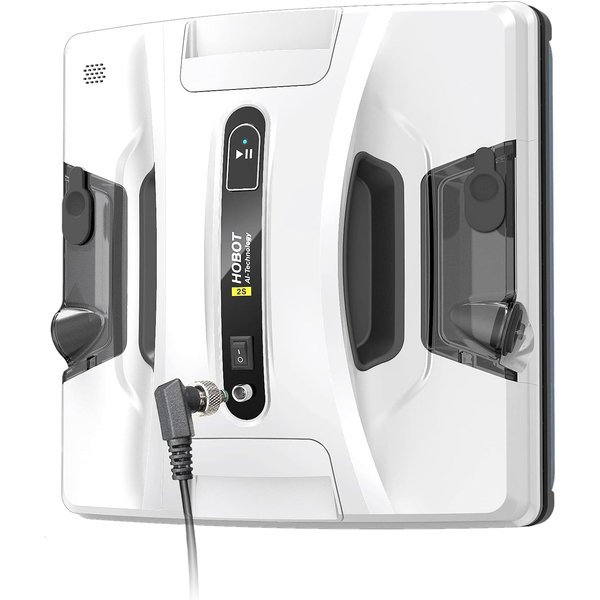
HOBOT is the main alternative to ECOVACS, and the HOBOT-2S stands out for its controls. You can run it from the HOBOT app or with an included remote, and it gives voice prompts while it works. The app sends notifications, such as when a window is done, and the robot gets over-the-air firmware updates.
It uses ultrasonic spray from dual replaceable water tanks and a large 9.5 by 9.5 inch cleaning cloth with extended corner coverage. HOBOT rates its vacuum at 7 kg of holding force. An auto-adjustable pneumatic pad balances the grip between its treads and the cloth, and AI route planning moves it in a zigzag pattern horizontally and vertically, which works on frameless windows.
Safety features include a 15-foot safety rope, a built-in backup power supply (UPS), and an edge-leakage sensor that detects air leaks from a lifted window seal or the edge of frameless glass. It has 3 automatic cleaning programs and returns to its starting point when it’s done.
The downsides are worth knowing. It’s rated 3.7 stars from about 60 reviews, lower than the ECOVACS picks, and it only works plugged in. HOBOT also says not to use it on frames with rounded edges. On the plus side, if a spray nozzle clogs, you can swap the tank or nozzle with a standard screwdriver.
Pros:
- Remote control plus app
- Voice prompts and app notifications
- Dual replaceable water tanks
- Edge-leakage sensor
- Large cleaning cloth
Cons:
- Lower rating and fewer reviews
- Corded only
- Not for frames with rounded edges
Robot Window Cleaner Comparison
| Model | Suction | Spray | Edge Cleaning | Control | Power | Approx. Price |
|---|---|---|---|---|---|---|
| WINBOT W2S PRO | 10,000 Pa | Triple nozzle | TruEdge 2.0 brushes | 6 modes | Not specified | ~$320 |
| WINBOT MINI | 7,500 Pa | Ultrasonic | Bumper-free | Button or app | Corded | ~$120 |
| WINBOT MINI 2 | 8,000 Pa | Ultrasonic | Corner brushes + wings | App + Bluetooth | Corded, 30+ min backup | ~$240 |
| WINBOT W2 PRO OMNI | Not listed | Triple nozzle | Edge detection | Station panel | Battery or corded | ~$300 |
| WINBOT W3 OMNI | Not listed | Triple nozzle | Spinning TruEdge scrubber | Fast/Intensive/Zone | Station | ~$700 |
| HOBOT-2S | 7 kg holding force | Ultrasonic, dual tanks | Extended corner cloth | App + remote | Corded | ~$300 |
Tips for Better Results
Always use the safety tether. Tie it to something solid inside the room, like a heavy piece of furniture or a door handle, before the robot goes on the glass. This matters most for exterior windows and anything above the ground floor.
Start with a damp, wrung-out pad. Most manufacturers recommend wetting the pad and wringing it out well before each session. A dry pad can skip; a soaking pad leaves streaks.
Do very dirty windows twice. A window that hasn’t been cleaned in a year may need a deep mode, then a second quick pass with a fresh pad.
Skip outdoor cleaning in freezing weather. Spray can freeze on cold glass, and suction is less reliable on frosty or wet windows. Do inside panes in winter and save exterior glass for a mild, dry day.
Use the right solution. Plain water or the manufacturer’s recommended cleaner works best. Strong or soapy cleaners can leave residue and clog ultrasonic spray nozzles.
Remember the floor. A robot that sprays and wipes the window may leave a little moisture on the sill. A cordless wet-dry vacuum makes quick work of the sill and the floor underneath.
How to Choose
Pick the WINBOT W2S PRO if you want the best all-around window robot with strong suction and good edge cleaning.
Pick the WINBOT MINI if you want to try a window robot for the lowest price.
Pick the WINBOT MINI 2 if you have small panes, divided-light windows, or care most about clean edges.
Pick the WINBOT W2 PRO OMNI if your windows or glass doors aren’t near an outlet.
Pick the WINBOT W3 OMNI if you have lots of glass and want a station that washes the pads for you.
Pick the HOBOT-2S if you prefer a physical remote and voice prompts.
If you’re building out a cleaning-robot team, pair a window robot with a robot vacuum and mop combo for floors. Pool owners can do the same outside with a robot pool cleaner. Shopping for someone else? See more ideas in our smart home gift guide.
Frequently Asked Questions
Are robot window cleaners safe on high windows?
Yes, as long as you use them correctly. Every pick here has a safety tether and a backup system that keeps the robot attached if the power fails. The WINBOT MINI 2, for example, stays attached for more than 30 minutes during an outage. Always tie off the tether before you start, and supervise the robot while it works.
Can a window robot clean both sides of the glass?
It cleans one side at a time. For the outside of a window you can open, you place the robot on the exterior glass with the tether secured inside. For windows that don’t open, you’ll only be able to clean the inside, unless you can safely reach the outside.
Do window cleaning robots leave streaks?
They leave fewer streaks than most people do by hand, especially models with ultrasonic spray, which uses very fine mist. Streaks usually come from a pad that’s too wet or dirty, or from strong cleaners. Use a clean, well-wrung pad and plain water or the recommended solution.
Will a window robot work on mirrors and shower doors?
Many will. ECOVACS lists mirrors and glass doors as suitable surfaces for the WINBOT MINI 2. Avoid textured, frosted, curved, or cracked glass, and check the minimum size for your model.
How often should I clean the pads?
After every session. Rinse or machine wash the microfiber pad so dirt doesn’t get spread onto the next window. The WINBOT W3 OMNI does this for you with its self-cleaning station.
The Bottom Line
The ECOVACS WINBOT W2S PRO is the best robot window cleaner for most people in 2026, with the strongest suction here, triple spray nozzles, and edge brushes that clean close to the frame. If you just want to try one, the WINBOT MINI costs about $120 and is the highest-rated pick. The WINBOT MINI 2 is best for small panes and clean edges, the W2 PRO OMNI cleans glass far from an outlet, and the W3 OMNI is the luxury pick that washes its own pads. Whichever you choose, get your windows clean before the holiday guests show up, and let the robot do the climbing.