
Quick Picks
Short on time? Here are our top smart AC controller picks for 2026:
- Sensibo Air PRO (~$149) — Best overall, full smart climate control with built-in air quality sensor and HomeKit
- Sensibo Air (~$125) — Best for Apple HomeKit households, certified HomeKit support and 60-second install
- Cielo Breez Max Smart AC Controller (~$124) — Best for mini-splits, AHR Product of the Year with AI-based scheduling and no subscription
- Sensibo Sky (~$99) — Best mid-range Sensibo, the original Wi-Fi AC controller that started the category
- Cielo Breez Lite (~$68) — Best budget pick, all the core features for under $70 with no monthly fees
- Tado Smart Air Conditioner and Heater Controller (~$65) — Best simple controller, compact design with Alexa support and geofencing
If you have a ductless mini-split, a window air conditioner, or a portable AC, you already know the pain points. The remote disappears between the couch cushions. You forget to turn the unit off when you leave the house and come home to a freezing apartment and an angry electric bill. You want to schedule the AC to start cooling the bedroom 20 minutes before bedtime, but the unit’s built-in timer only handles “on for 4 hours.” And if you have multiple units across the house, you have multiple remotes, no central control, and no way to ask Alexa to turn anything on.
A smart AC controller fixes every one of those problems for less than the cost of replacing the unit. These devices are small Wi-Fi-connected gadgets that learn your AC’s infrared remote codes and replay them on demand from an app, a voice assistant, or an automation. Mount one on the wall in line of sight with the AC, plug it in, point your remote at it once to teach it your AC’s signal, and you suddenly have a smart, schedulable, voice-controlled climate system on a unit that was never sold as smart.
The catch is that the category has gotten crowded, with prices ranging from under $70 to nearly $200, and the differences between models actually matter — Apple HomeKit support, on-device temperature and humidity sensors, geofencing, scheduling intelligence, air quality sensing, and subscription fees all vary widely. We tested and researched the best options on Amazon right now and narrowed it down to six picks that cover every use case from “I just want a basic Alexa-controlled mini-split” up to “I want the AC to learn my schedule and my preferences automatically.”
Our Top Smart AC Controller Picks
Sensibo Air PRO - Air Conditioner Smart Controller & Air Quality Sensor — Best Overall
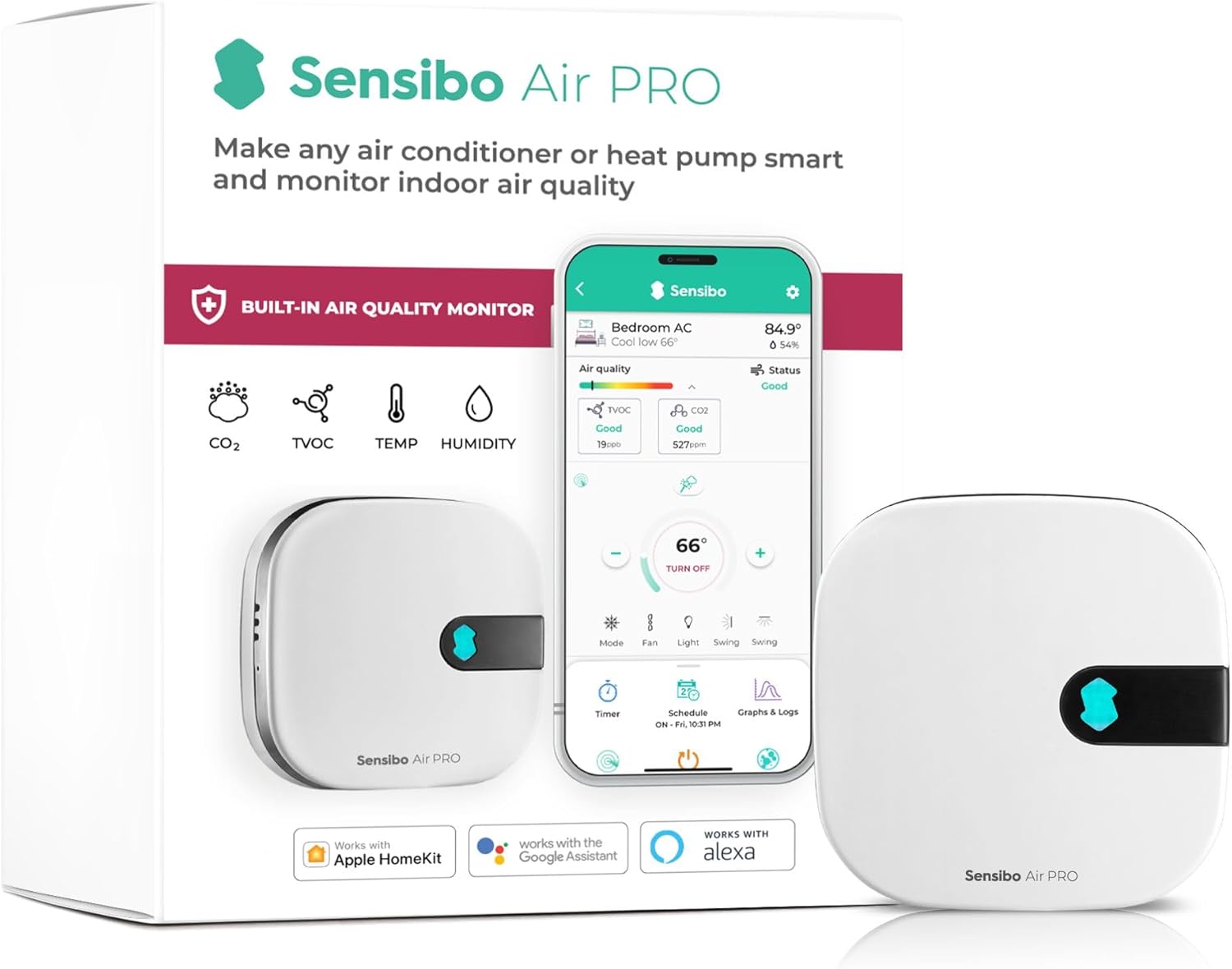
The Sensibo Air PRO is the most complete smart AC controller you can buy without stepping into commercial-grade hardware. It does everything the regular Sensibo Air does — Wi-Fi control of any infrared mini-split, window, or portable AC; Alexa, Google, and Apple HomeKit support; temperature and humidity sensing — and adds a built-in air quality sensor that monitors VOCs, carbon dioxide, and particulate matter. That extra layer is the difference between “my AC turns on at 75 degrees” and “my AC turns on when the room is hot AND the air quality is dropping,” which is the actually-smart version of climate control.
Setup is genuinely simple. The PRO mounts to a wall (or sits on a shelf) within line of sight of your AC. You plug in the included USB-C power, connect it to your phone over Bluetooth and Wi-Fi, and either pick your AC model from Sensibo’s massive library of pre-loaded IR codes or teach it a few buttons from your remote if your model is older or imported. From that point, every function on the original remote is mirrored in the Sensibo app: mode, temperature, fan speed, swing direction, and turbo or eco modes if your AC supports them.
The features that justify the higher price all live in the Sensibo app. The “Climate React” automation kicks the AC on or off based on temperature, humidity, or now air quality thresholds — set it once and forget it. Geofencing automatically turns the AC off when you leave home and back on when you are 10 minutes away. The 7-day scheduler handles weekday/weekend differences without thinking. And the air quality sensor pushes alerts to your phone when CO2 builds up or VOCs spike, which is genuinely useful for stuffy bedrooms or apartments without great ventilation.
For households on Apple HomeKit, the PRO adds a HomeKit-native climate sensor and accessory tile so the air quality and humidity readings show up in the Home app alongside your other sensors. That is a level of integration that most $300 smart thermostats do not offer.
Pros:
- Built-in air quality sensor (VOCs, CO2, particulate matter) that no other pick on this list includes
- Apple HomeKit, Alexa, Google Assistant, and Siri all supported natively
- Climate React automation triggers on temperature, humidity, or air quality
- Geofencing built in — AC turns off when you leave home automatically
- Massive IR code library covers virtually every AC brand including imports
- No subscription required for any core feature, ever
Cons:
- The most expensive pick on this list at around $150
- Air quality sensor is solid but not as accurate as a dedicated $200 air quality monitor
- Some advanced features (energy usage graphs, multi-user accounts) live in a paid Sensibo Plus tier, though the controller works fully without it
Sensibo Air - Smart Air Conditioner Controller — Best for Apple HomeKit
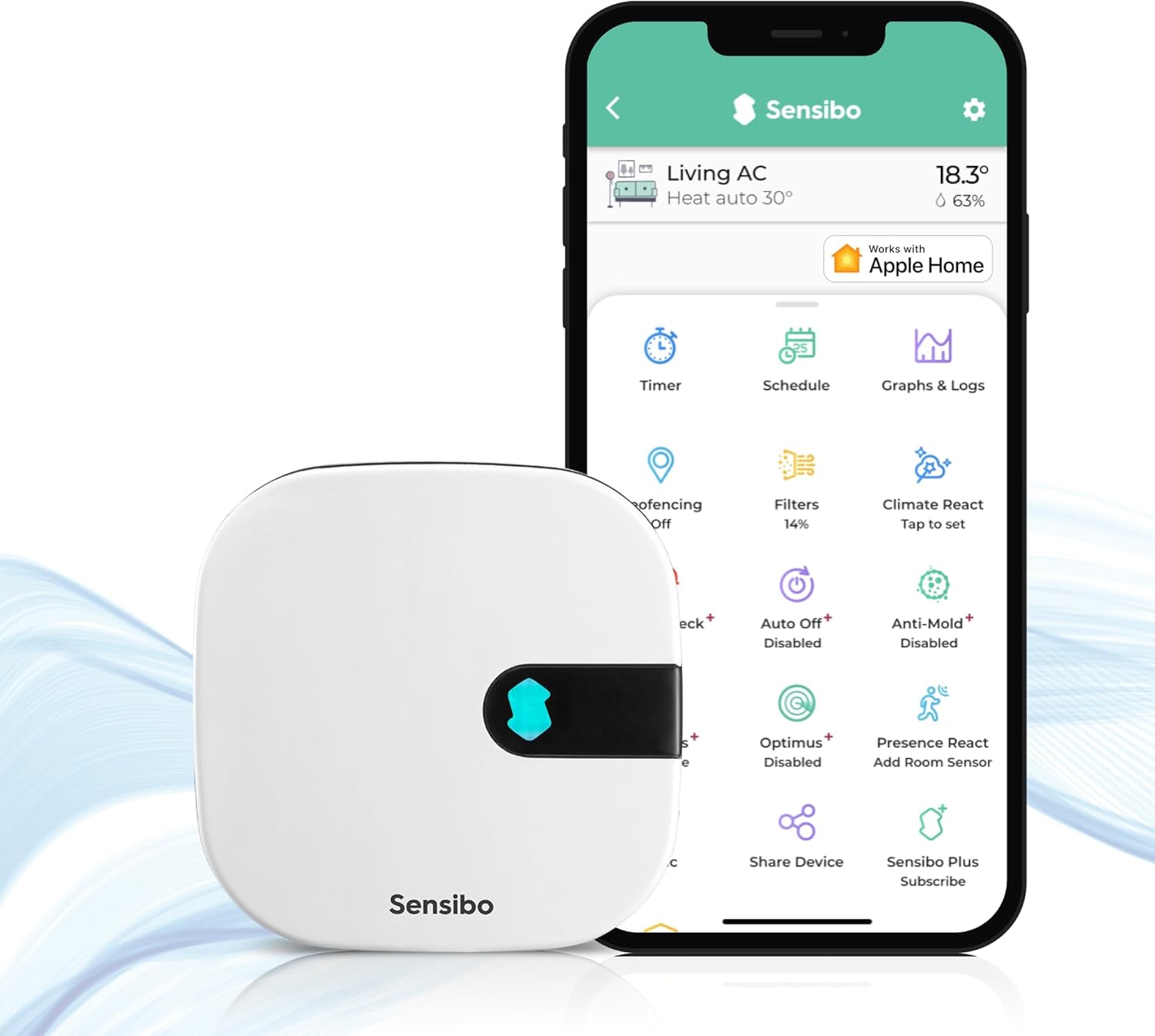
The Sensibo Air is the regular sibling of the PRO and the right pick for almost anyone who does not specifically need the air quality sensor. You get the same Apple HomeKit certification, the same support for Alexa, Google Assistant, and Siri, the same Climate React automation, the same geofencing, and the same enormous IR code library — for about $25 less. If you live in a HomeKit household and you want one of your AC units to show up in the Home app as a real, native climate device, this is the cleanest way to do it.
The 60-second installation Sensibo advertises is not marketing fluff. The unit ships with double-sided wall tape and a USB power adapter. You stick it to a wall in line of sight with the AC, plug it in, open the Sensibo app, and walk through a 4-step setup wizard that finds your AC model in a database of over 10,000 brands. If the database does not have your model, the app walks you through manually teaching it the on/off, mode, temperature, and fan speed buttons from your existing remote.
Once it is paired, every original remote function is mirrored in the app and exposed to your smart home platform. Set schedules, build automations that link the AC to your other smart devices (turn on the AC when the door sensor detects you got home), and use voice control without setting up routines on your assistant. HomeKit users get a thermostat tile in the Home app, room temperature and humidity sensors, and full Siri integration without lifting a finger.
What you give up versus the PRO is the air quality sensor and slightly more refined temperature accuracy. For a bedroom, living room, or office where the room temperature alone is the trigger you care about, the regular Air is the smarter buy.
Pros:
- Native Apple HomeKit certification, no bridge or hub needed
- Same massive IR code library as the PRO — covers nearly every AC made
- Genuinely fast 60-second physical install with included tape and USB adapter
- Climate React, scheduling, and geofencing all included with no subscription
- Works with Alexa, Google Assistant, Siri, and SmartThings
- Smaller and slightly less obtrusive on the wall than the PRO
Cons:
- No air quality sensor (if that matters, step up to the PRO)
- Temperature sensor accuracy is good but not lab-grade
- Like all IR controllers, the unit must have line of sight to the AC
Breez Max Smart AC Controller — Best for Mini-Splits
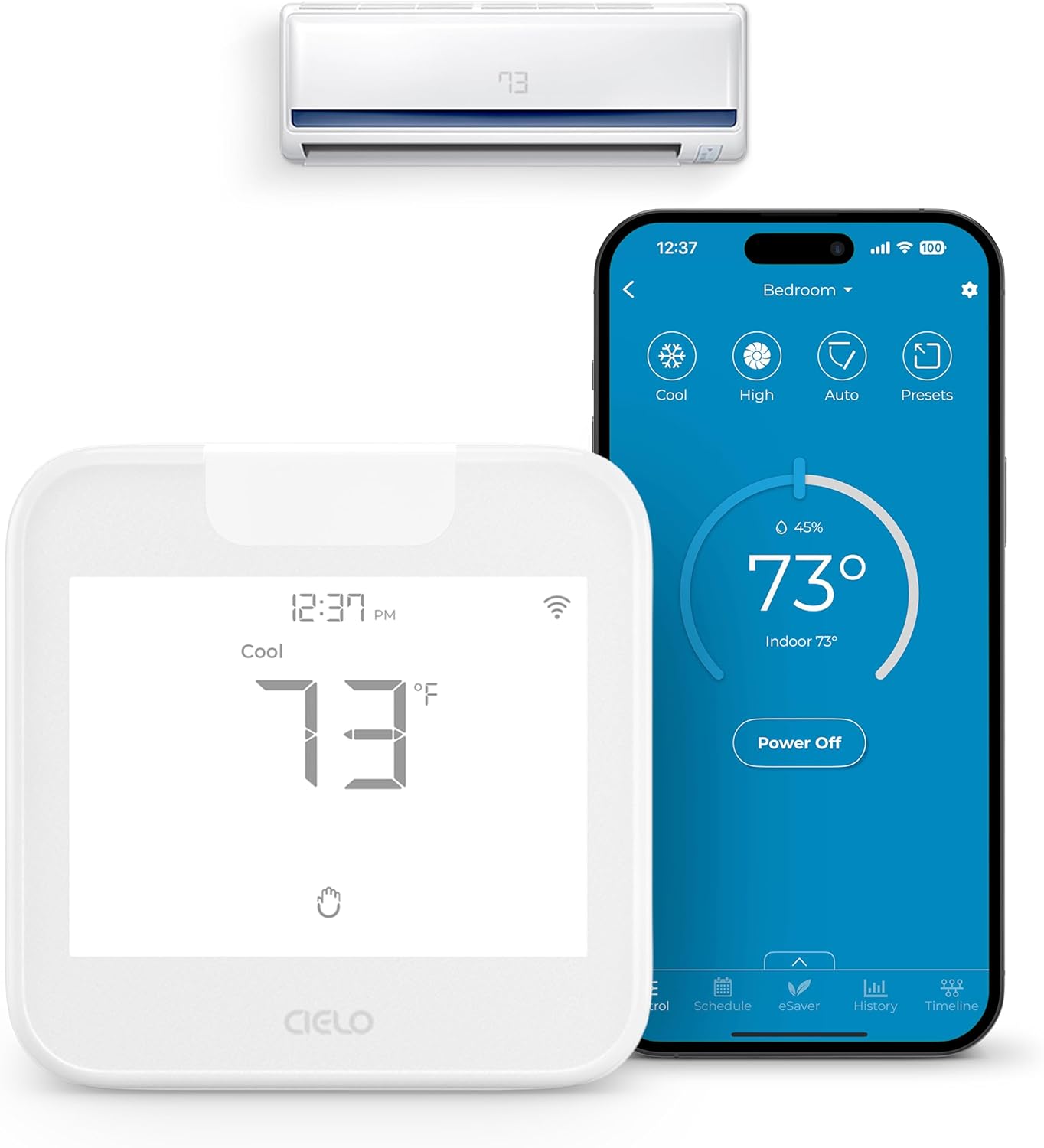
Cielo’s Breez Max is the most thermostat-like smart AC controller on this list, and it is the one to pick if your priority is a permanently mounted mini-split system that you treat like a real central HVAC system. Unlike the puck-style Sensibos, the Breez Max has a real LCD display on the front showing current room temperature, target temperature, mode, fan speed, and humidity — so you can see and adjust the AC at a glance without opening an app or finding the remote.
It won AHR Product of the Year for a reason. The Breez Max packs in features that the Sensibos charge extra for or do not include at all: AI-based scheduling that learns when you are typically home and at what temperature you are most comfortable, multi-zone management for households with several mini-splits, weekly and daily scheduling with up to 10 events per day, and detailed usage statistics in the Cielo Home app. There is no subscription required for any of this — you pay once for the hardware and use it forever.
The on-board sensors monitor temperature and humidity in the room where the controller is mounted (which is what you want — temperature at the wall, not at the AC unit’s intake). The unit supports Alexa, Google Assistant, IFTTT, SmartThings, and Siri Shortcuts. It does not support Apple HomeKit natively the way the Sensibos do, so HomeKit households should look elsewhere — but Alexa, Google, and SmartThings users get a more polished and AC-specific experience here than they will from a HomeKit-first device.
The one thing to be aware of with the Breez Max is that it is wired to permanent USB-C power. It is designed to live on a wall, not to sit on a shelf and move around. If you want a portable controller you can move between an upstairs bedroom AC and a downstairs window unit, the Sensibos are a better match.
Pros:
- Full LCD display shows current and target temperature without opening the app
- AI-based scheduling that adapts to your patterns over time
- AHR Product of the Year — built specifically for mini-split, window, portable AC, and heat pumps
- No subscription required for any feature, ever
- Weekly schedules with up to 10 events per day
- Detailed energy and usage analytics in the app
Cons:
- No native Apple HomeKit support (works with Siri Shortcuts only)
- Wall-mount design is permanent — not great for moving between rooms
- Slightly larger and more visible than puck-style competitors
Sensibo Sky, Smart Wireless Air Conditioner Controller — Best Mid-Range Sensibo
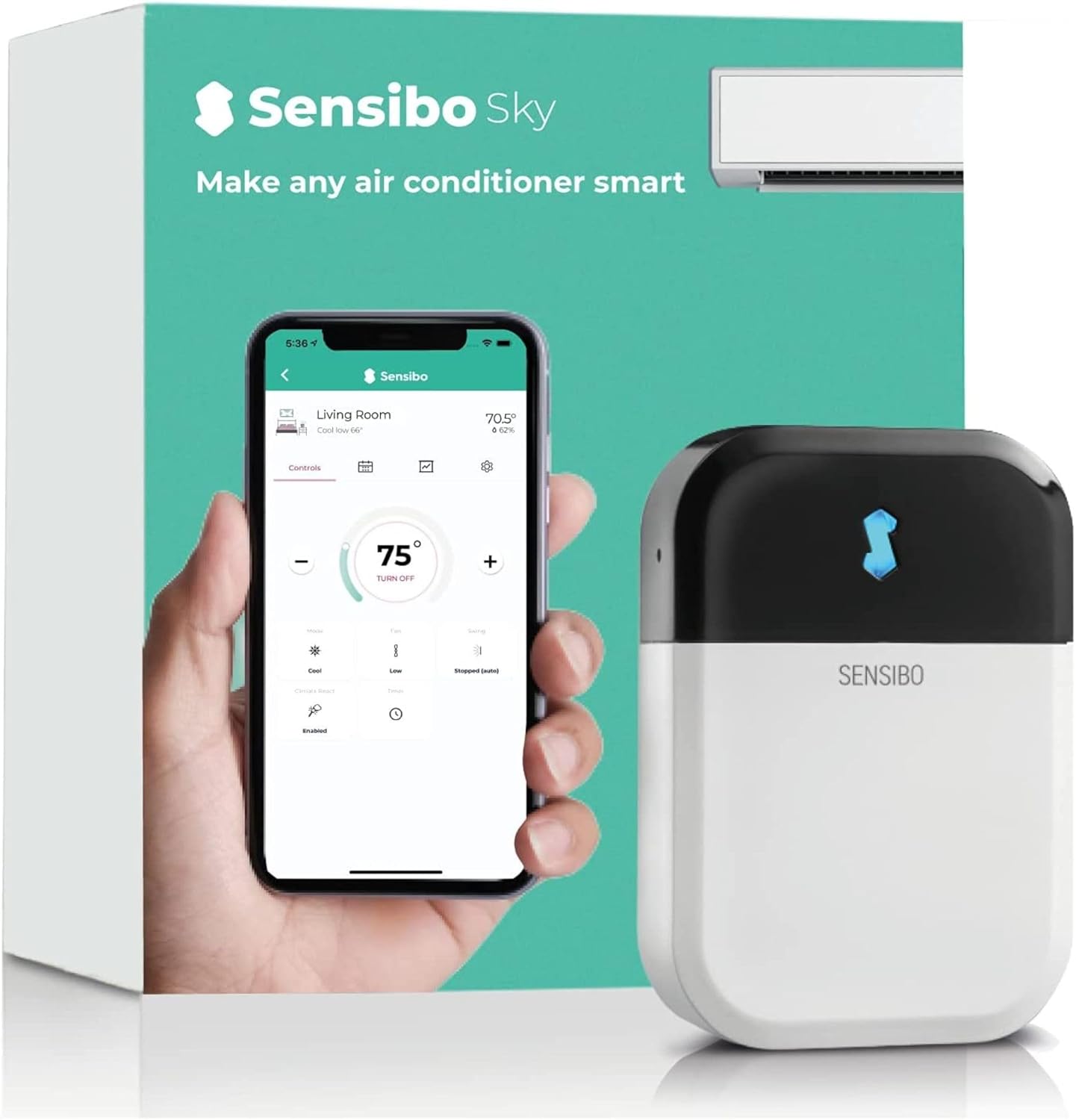
The Sensibo Sky is the original — the device that essentially created the smart AC controller category — and it is still in production for around $100 because the core hardware does the job well. It is a small disc the size of a hockey puck that mounts on the wall (or sits on a shelf) and turns any infrared-controlled AC into a Wi-Fi smart device controllable from the Sensibo app, Alexa, Google Assistant, and Siri Shortcuts.
What you get with the Sky versus the newer Air is essentially the same software experience minus Apple HomeKit certification. You still get Climate React automation, 7-day scheduling, geofencing, the full IR code database, and integration with most major smart home platforms. The temperature sensor is on board and accurate enough for room-level scheduling. If you do not have an Apple HomeKit setup and do not need air quality sensing, the Sky is functionally the same product as the more expensive Air for a chunk less money.
The Sky is also the easiest pick to recommend if you want to control multiple AC units across a house. Buy a Sky for each room, name them in the Sensibo app (Bedroom AC, Living Room AC, Office AC), and you have whole-home AC control for what you would have paid for one premium model from a competitor. The app handles unlimited devices on one account at no additional cost.
The reason to spend more on the Air or Air PRO is HomeKit support and the air quality sensor — if neither of those matter, save the money and get the Sky.
Pros:
- The proven, mature platform — Sensibo has been refining this exact product since 2014
- Same Climate React, geofencing, and scheduling features as the more expensive Air
- Excellent for multi-room households — buy one Sky per AC unit, control all from one app
- Works with Alexa, Google Assistant, Siri Shortcuts, IFTTT, and SmartThings
- Smaller and lighter than the wall-mounted competitors
- No subscription required for core features
Cons:
- No native Apple HomeKit certification (Siri Shortcuts only)
- No air quality sensor
- Older industrial design — looks slightly less polished than the newer Air
Breez Lite — Best Budget
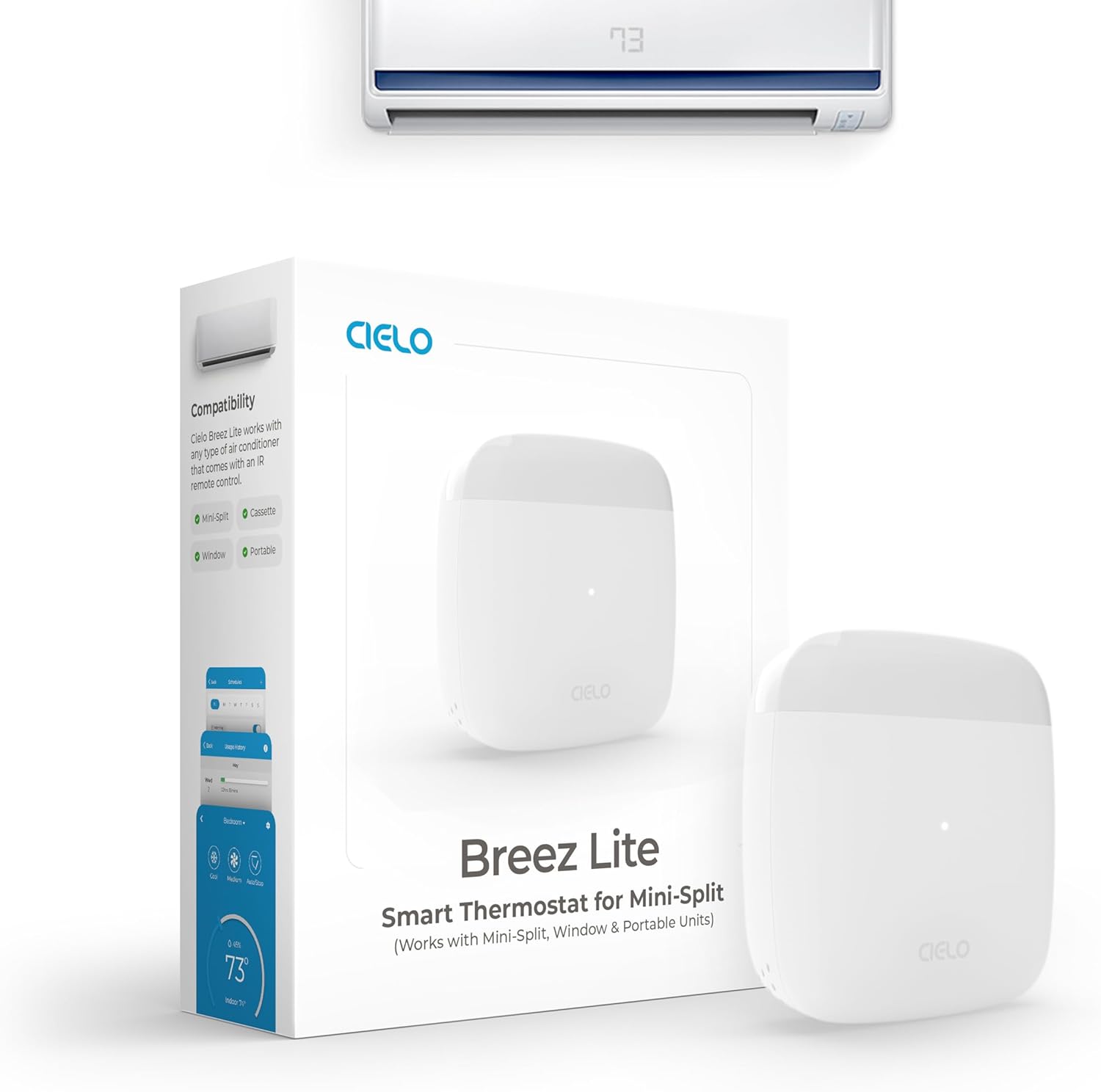
If you want to put a smart controller on your AC for under $70 and you do not need an LCD display or HomeKit, the Breez Lite is the right call. It is the stripped-down sibling of the Breez Max — same Cielo Home app, same controller for mini-splits, window AC, portable AC, and heat pumps, same Alexa and Google support — just without the front-facing LCD and AI scheduling.
The Lite still does the things people actually use a smart AC controller for. You can turn the AC on and off remotely, change the mode and temperature from anywhere, set a 7-day schedule, and use voice commands through Alexa, Google Assistant, Siri Shortcuts, SmartThings, and IFTTT. The Cielo Home app shows current room temperature and humidity from the Lite’s built-in sensors, and the scheduling system supports the same 10-events-per-day granularity as the Max.
What you give up at this price is the on-device display (you will need your phone or voice to see what the AC is doing), AI scheduling, and energy use analytics. None of these are dealbreakers if you mostly use the controller via voice or app and you do not need to glance at the wall to see the room temperature.
For renters, college dorms, second bedrooms, or anyone who just wants one mini-split or window AC made smart without spending three figures, the Breez Lite is the easy pick. It is also the cheapest way to get a Cielo-grade controller, which is a step up in app polish from generic Tuya-based controllers in the same price range.
Pros:
- The cheapest fully-featured smart AC controller from a reputable brand
- Same Cielo Home app as the more expensive Max — polished and AC-specific
- Built-in temperature and humidity sensors
- Works with Alexa, Google Assistant, Siri Shortcuts, SmartThings, and IFTTT
- 7-day scheduling with up to 10 events per day
- No subscription required
Cons:
- No on-device display — you need the app or voice to see status
- No AI-based scheduling (Max only)
- No native Apple HomeKit support
- No energy usage analytics
Tado Smart Air Conditioner and Heater Controller — Best Simple Controller
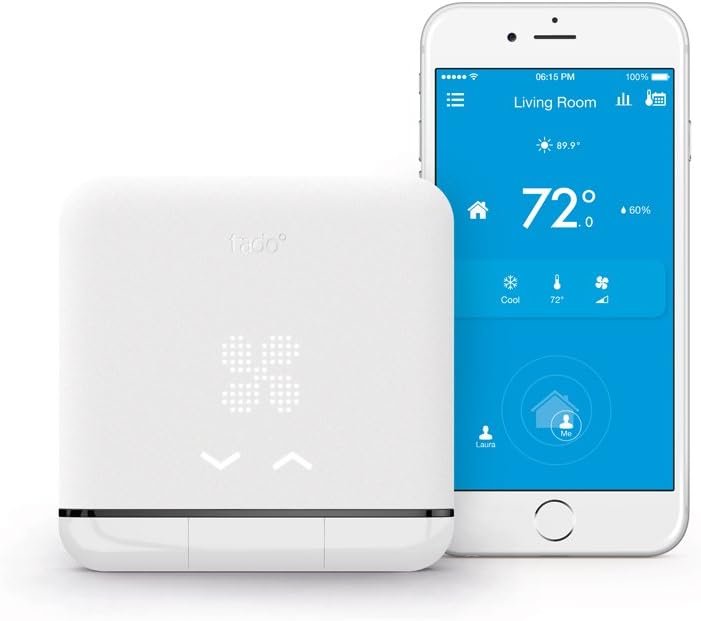
The Tado controller is the simplest, most low-profile pick on this list and the one to consider if you want a smart AC controller that just works without learning a complicated app. Tado is a European smart climate brand that originally built whole-home smart thermostats — this AC controller brings their geofencing-first philosophy to ductless mini-splits and window units. Mount it, point your existing AC remote at it once to learn the codes, and you are done.
The Tado app is built around a single core idea: the AC should be off whenever you are not home, and on at your preferred temperature whenever you are. The geofencing system uses your phone’s location to detect when the last person leaves the house (it stops cooling the empty apartment) and when the first person is on their way back (it pre-cools so the room is comfortable when you walk in). That is the entire flagship feature, and Tado does it more reliably than most competitors.
You also get Alexa support, iOS and Android apps, and basic scheduling. The unit is small and unobtrusive — physically smaller than the Sensibo Sky and noticeably more discreet than the wall-mounted Cielo units. It is plug-and-play with most modern AC brands, though the IR code library is smaller than Sensibo’s so it is worth checking that your AC model is supported before buying.
What it gives up versus everything else on this list is depth. There is no Climate React-style trigger automation, no air quality sensing, no on-device display, no native HomeKit support, and the scheduling is more basic. If you want a smart AC controller for the geofencing and the simplicity, the Tado is great. If you want the maximum number of features for the money, look at the Sensibo Sky or Breez Lite instead.
Pros:
- Smallest and most unobtrusive controller on this list
- Excellent geofencing — the AC turns off when you leave and pre-cools when you head home
- Simple, clean app with low learning curve
- Works with Alexa for voice control
- Compatible with iOS and Android
Cons:
- IR code library is smaller than Sensibo’s — check compatibility for your specific AC model
- No native Apple HomeKit support
- No on-device display or LCD
- No automated climate triggers (Climate React or AI scheduling)
- Tado has shifted focus to European markets, so US support is more limited than Sensibo or Cielo
Smart AC Controller Comparison
| Pick | Price | Best For | HomeKit | On-Device Sensors | Subscription |
|---|---|---|---|---|---|
| Sensibo Air PRO | ~$149 | Best overall | Yes (native) | Temp, humidity, air quality | Optional Plus tier, not required |
| Sensibo Air | ~$125 | Apple HomeKit households | Yes (native) | Temp, humidity | Optional Plus tier, not required |
| Cielo Breez Max | ~$124 | Permanent mini-split installs | No (Siri Shortcuts) | Temp, humidity, LCD display | None ever |
| Sensibo Sky | ~$99 | Multi-room households | No (Siri Shortcuts) | Temp, humidity | Optional Plus tier, not required |
| Cielo Breez Lite | ~$68 | Best budget | No (Siri Shortcuts) | Temp, humidity | None ever |
| Tado AC Controller | ~$65 | Simple geofencing | No | Built-in (basic) | None for AC control |
How to Pick the Right Smart AC Controller
Match the controller to your AC type and remote
Almost every smart AC controller on the market is an infrared (IR) controller — meaning it learns your AC’s existing remote codes and replays them. That covers the vast majority of mini-split, window, and portable AC units made in the last 15 years. Before you buy, find your AC’s remote and confirm it works by pointing it at the unit (not by Bluetooth or Wi-Fi). If yes, any controller on this list will work as long as the brand is in its IR database. Sensibo’s database is the largest and covers almost every brand including Asian imports; Cielo’s is solid for major US brands; Tado’s is the most limited.
Decide whether on-device display matters
The Cielo Breez Max is the only controller on this list with a real LCD display showing room temperature, target temperature, mode, and fan speed at a glance. If you like being able to walk past the AC and see what it is set to without your phone, the Max is uniquely good at this. Every other controller is “phone or voice only” for status checks. Most people adjust to that quickly, but if you live with people who do not use the smart home app, an on-device display avoids “hey can you turn the AC up” requests.
HomeKit users should pay the Sensibo premium
If your house runs on Apple HomeKit, the Sensibo Air and Air PRO are the only picks here that integrate natively as HomeKit-certified accessories. That means full Siri voice control, automation in the Home app alongside your other devices, and family sharing through iCloud. Every other controller works with Siri Shortcuts at best — which is functional but not seamless. The premium for HomeKit is real, and worth it if you are committed to the Apple ecosystem. For deeper integration ideas, our Apple HomeKit best devices guide covers the full ecosystem.
Geofencing or automation — pick your style
The two big “smart” features that go beyond simple scheduling are geofencing (AC turns off when you leave) and climate triggers (AC turns on when the room hits 78°F). Tado is the geofencing king. Sensibo’s Climate React is the trigger king. The Cielo Breez Max splits the difference with AI scheduling that learns your patterns over time. Pick the one that matches how you actually want the AC to behave when you are not thinking about it.
Subscription versus one-time purchase
Cielo and Tado have no subscription required, ever. Sensibo’s core controller features are free forever, but a Sensibo Plus tier ($2.50–$3.50 per month depending on plan) unlocks energy usage graphs, multi-user accounts, and some advanced reports. None of that is required for the controller to work — but if subscription fees frustrate you on principle, the Cielo and Tado options keep things simpler.
Frequently Asked Questions
Will a smart AC controller work with my mini-split?
Almost certainly yes, as long as your mini-split has a working infrared remote (the kind you point at the unit). Sensibo, Cielo, and Tado all maintain large databases of supported AC brands. Sensibo’s is the most comprehensive — it covers virtually every major brand worldwide including Mitsubishi, Daikin, LG, Samsung, GE, Frigidaire, Pioneer, MrCool, Senville, and most Asian imports. Before you buy, the Sensibo and Cielo apps both let you check compatibility with your specific model number for free.
Does the controller need to be in the same room as the AC?
Yes. These are infrared (IR) controllers, which means they need a clear line of sight to the AC unit just like your existing remote does. Mount or place the controller within 15 to 25 feet of the AC, with no obstructions. If you have a mini-split high on the wall, mount the controller on the opposite wall pointed at it. For window AC and portable AC, sitting the controller on a shelf in the same room usually works fine.
Can I control multiple AC units with one controller?
No. Each AC unit needs its own controller in the same room. The good news is that the apps (especially Sensibo and Cielo) handle unlimited controllers on a single account at no extra cost — you just buy one controller per AC, name each one in the app, and you get whole-home control from one place. This is a much cheaper way to get whole-home AC automation than replacing every unit with a smart-native AC.
Will this work with my window air conditioner?
Yes, as long as your window AC came with an IR remote and that remote still works. Most window AC units made in the last decade qualify. Older window AC units with mechanical knobs and no remote cannot be controlled by an IR-based smart controller — for those, your only option is a smart plug that controls the power, which only gives you on/off (the AC will start at its last knob settings).
Is a smart AC controller a good Mother’s Day gift?
It is a thoughtful gift if Mom has a mini-split or window AC unit and finds the existing remote frustrating. The Sensibo Air or Air PRO present especially well as gifts because they ship in a clean box with everything included and install in a few minutes. The HomeKit-certified models are particularly nice for any household already deep in the Apple HomeKit ecosystem.
Do these controllers work without Wi-Fi?
The smart features (app control, voice, scheduling, geofencing) all require Wi-Fi. If your Wi-Fi drops temporarily, the controller will continue to honor any pre-loaded schedule on the device side and will reconnect automatically when Wi-Fi comes back. For a permanent install where Wi-Fi is critical, you may want to make sure your network covers the room where the AC is — our best WiFi mesh system guide can help if coverage is spotty.
How much can a smart AC controller actually save on my electric bill?
Realistic savings come from two things: not running the AC when you are not home (geofencing), and running the AC only when the room is actually warm (climate triggers based on temperature or humidity). For a typical mini-split or window AC running 8–12 hours a day in summer, smart scheduling can shave 15–25% off cooling costs by cutting waste hours. The savings are real but not magical — a $99 controller does not pay for itself in a month, but over a 4-month cooling season in a hot climate it usually does.
Can I control the AC away from home?
Yes — that is one of the main reasons to buy one of these. Once the controller is connected to your home Wi-Fi, you can turn the AC on or off, change the temperature, and check the current room temperature from anywhere with an internet connection through the controller’s app. This is useful for pre-cooling before you arrive home, turning off a unit you forgot, or letting a pet sitter adjust the temperature for your dog while you are traveling.
The Bottom Line
The Sensibo Air PRO is the most complete pick on this list and the right choice if you want one device that handles climate control and air quality for a key room. The Sensibo Air is the smarter buy for most Apple HomeKit users — same HomeKit-native integration as the PRO, just without the air quality sensor, for $25 less. The Cielo Breez Max is the right choice if you want a permanently mounted, thermostat-style controller with an LCD display and AI scheduling, and you do not need HomeKit. The Sensibo Sky is the value Sensibo for households without HomeKit, and the Cielo Breez Lite is the budget pick that still has a polished app. The Tado controller is for the person who wants geofencing-first simplicity and nothing else.
Whichever you pick, the goal is the same — turn an AC unit that was never smart into one that turns off automatically when you leave, pre-cools before you get home, and responds to your voice. For most mini-splits and window units, a good smart AC controller is the highest-impact $70–$150 you can spend on cooling, and these six are the ones currently worth your money.