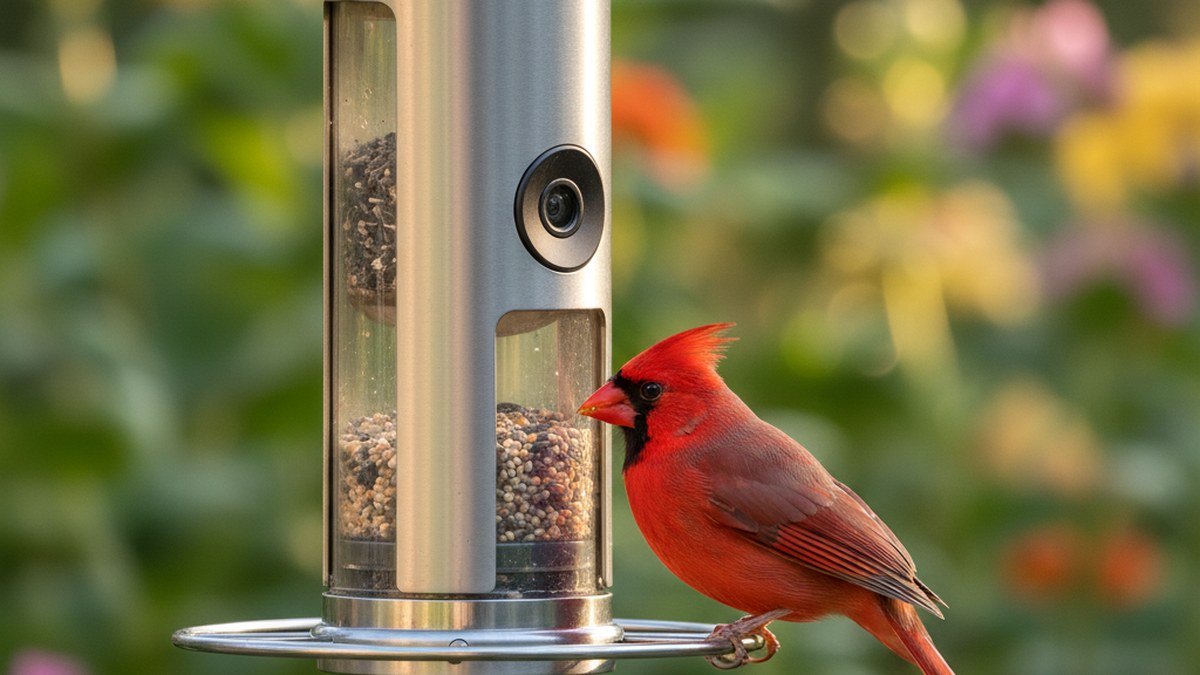
Quick Picks
Short on time? Here are our top recommendations:
- Bird Buddy PRO Solar (~$299) — Best overall, 2K AI camera with solar charging
- NETVUE Birdfy Solar 2K (~$250) — Best for bird identification, recognizes 6,000+ species
- Harymor Solar Bird Feeder (~$120) — Best budget, 2K video at a fraction of the price
- Bird Buddy Hummingbird Solar (~$229) — Best for hummingbirds, slow-motion 2K capture
Introduction
Smart bird feeders with built-in cameras were a niche gadget a couple of years ago. In 2026, they’re one of the fastest-growing categories in smart home, and for good reason. You mount one in your yard, birds land to eat, and your phone buzzes with a notification, a photo, and the exact species name — pulled from an AI model trained on thousands of birds. No binoculars, no field guides, no sitting quietly at a window waiting for something interesting to show up.
The appeal is obvious for anyone who likes nature but spends most of their day inside. It’s also why these feeders have become one of the most-gifted smart home products of the spring season — Mother’s Day, Father’s Day, and retirement gifts keep pushing them up the Amazon bestseller charts. If you’re shopping for the best smart bird feeder with camera in 2026, the good news is the category has matured. Cameras got sharper, AI got more accurate, and a budget model now does most of what a $300 flagship did two years ago.
This guide covers six smart bird feeders across every budget, from a $120 solar-powered picker to a $299 flagship, plus a specialized hummingbird feeder. Each pick is something you can actually buy on Amazon today with an active listing, verified ASINs, and real features — not a renamed Kickstarter campaign. By the end, you’ll know exactly which one fits your yard, your budget, and the birds you want to see.
The 6 Best Smart Bird Feeders with Camera
1. Bird Buddy PRO Solar — Best Overall
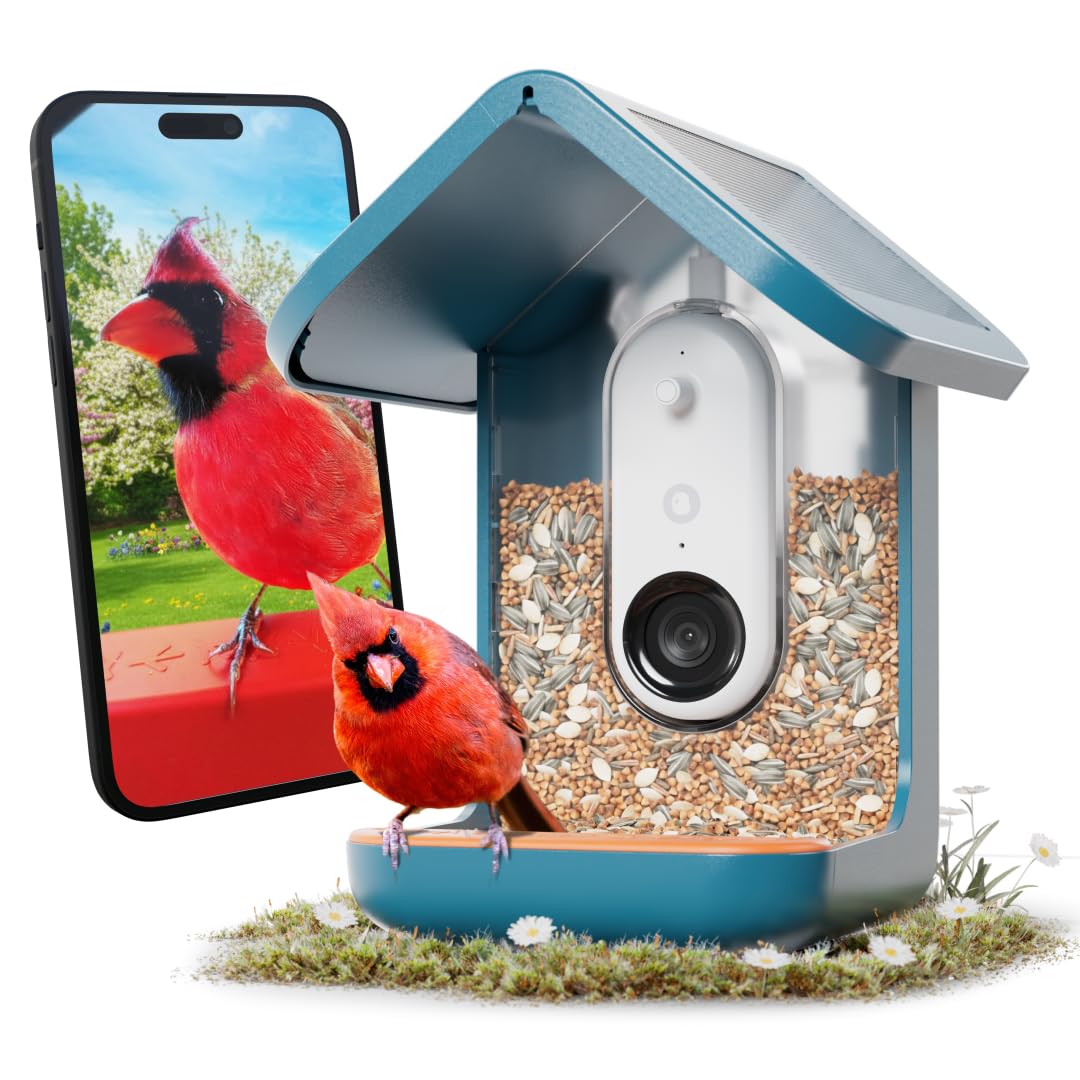
Price: ~$299 | Best for: Everyday backyard birdwatching with premium AI and video quality
The Bird Buddy PRO Solar is the smart bird feeder other smart bird feeders are measured against. It’s the one that put this category on the map, and the PRO version — released in late 2025 — upgraded nearly every part of the original. The camera is now 2K HD at 5 megapixels, the lens is closer to the perch for sharper close-ups, and the solar roof panel means you almost never have to bring it inside to charge.
What sets Bird Buddy apart from the cheaper clones is the AI identification quality. The app recognizes over 1,000 species with extremely high accuracy, thanks to a machine-learning model trained on millions of user-submitted photos over the past three years. When a bird visits, the app sends a “postcard” — a short video clip and a still image with the species name, some fun facts about the bird, and a map showing where it was last spotted. Over time you build a collection that doubles as a citizen-science record of what visits your yard.
The PRO version adds slow-motion 120fps video, which is genuinely cool the first time you see a chickadee beat its wings in slow-mo at your feeder. There’s also an HDR mode that saves the shot when a bird lands in harsh midday sun, and 122-degree wide-angle coverage so you capture more of the perch and surroundings in frame.
Capacity is modest — about 1.5 cups of seed — so active feeders will need refilling every few days during spring migration. The solar panel on the roof keeps the battery charged indefinitely in most yards with at least 4–6 hours of daily sun. In shaded yards, plan to bring it in every few weeks for a USB-C top-up.
At $299, it’s not cheap. But the app experience, AI accuracy, and build quality justify the premium for anyone who plans to actually use the feeder year-round.
Key Features:
- 2K HD camera with 5MP photos and slow-motion 120fps video
- Solar roof panel for continuous charging
- AI identifies 1,000+ species with high accuracy
- 122-degree wide-angle lens with HDR
- Free core features (ID, live stream, postcards, sharing)
- Weather-resistant polycarbonate build
Pros:
- Best AI identification accuracy in the category
- Solar charging means set-and-forget operation
- Sharpest camera of any mainstream smart feeder
- Mature app with four years of active development
- Free tier covers all essential features
Cons:
- $299 is the highest price of any single feeder on this list
- Small seed capacity (~1.5 cups) requires frequent refills
- Subscription needed for advanced features like unlimited cloud storage
- No night vision (daytime species only)
Verdict: The most polished smart bird feeder you can buy. If this is a daily-use device and you want the best identification quality and image sharpness, the Bird Buddy PRO Solar is the right call.
2. NETVUE Birdfy Solar 2K — Best for Bird Identification
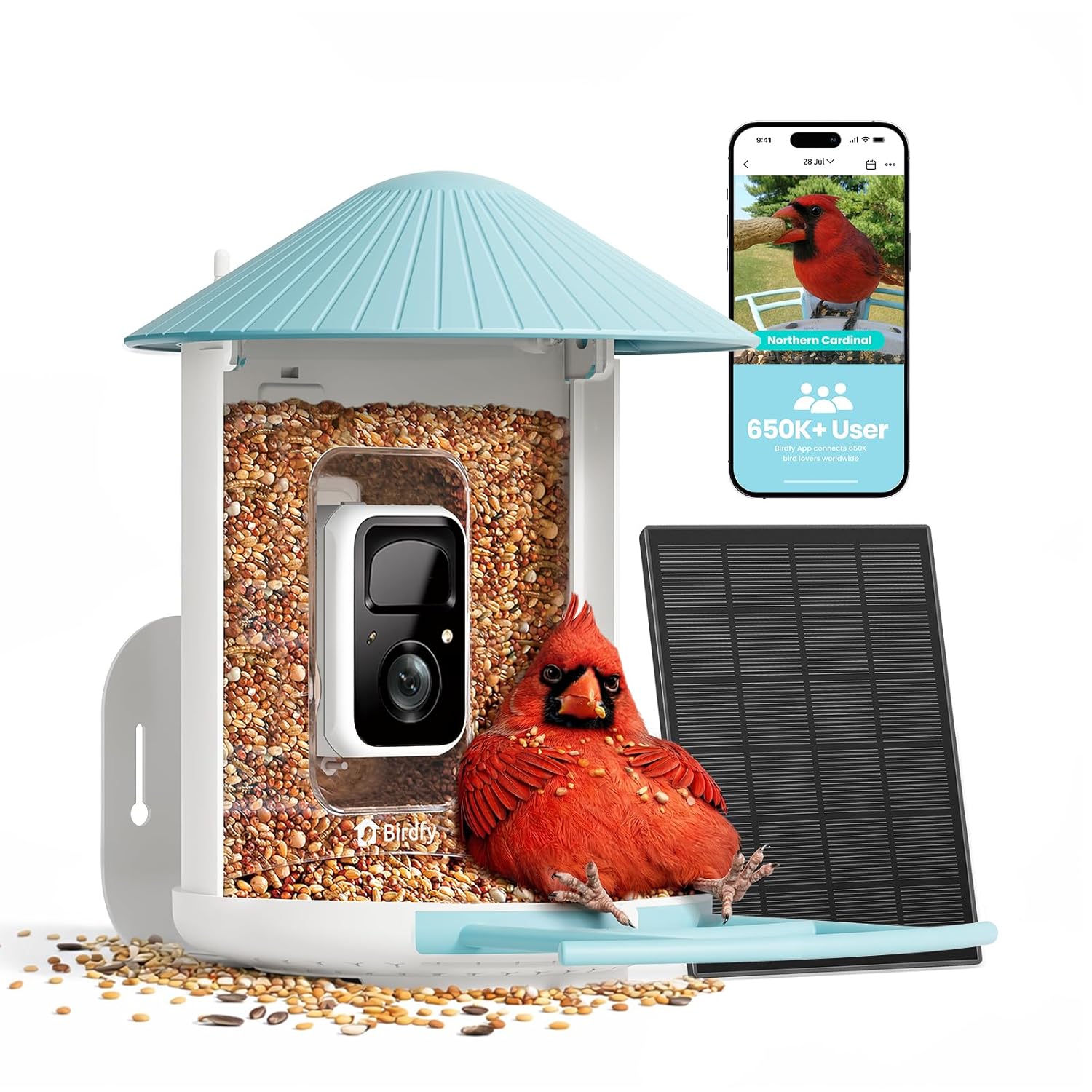
Price: ~$250 | Best for: Maximum species recognition and color night vision
The NETVUE Birdfy is Bird Buddy’s main rival, and in several ways it’s actually the better feeder. The 2K HD AI camera is comparable on paper, but where Birdfy pulls ahead is the AI database — it claims to recognize over 6,000 species globally, versus Bird Buddy’s ~1,000. If you live outside North America, have unusual migratory visitors, or just want broader coverage, this is the feeder that’ll name them.
The integrated solar panel sits on the roof and charges a removable battery inside. In most sunny yards, you’ll never need to bring it down to charge. If your yard is shaded, the battery is swappable so you can keep a second one charging indoors as a backup — a smart design touch the Bird Buddy doesn’t offer.
Color night vision is the other standout feature. Most smart feeders only capture daytime activity because birds don’t visit at night — but raccoons, opossums, and squirrels do. Birdfy’s night vision lets you see exactly who’s been raiding the seed tray at 2 AM, which solves one of the most common frustrations of backyard feeding.
The seed tray holds about 1.5 cups, similar to Bird Buddy. The plastic build is solid but not as refined-feeling as the Bird Buddy. Where Birdfy makes up for it is accessories — NETVUE sells a large selection of add-ons including suet holders, nectar converters, squirrel baffles, and mounting brackets. The ecosystem is significantly broader than Bird Buddy’s.
Auto-capture sends short video clips to the app whenever motion is detected. The free tier includes AI identification for a trial period; long-term AI requires a modest subscription (~$35/year). Cloud storage is also subscription-based, but local SD card recording is supported without any subscription, so you can skip the paid tier entirely if you prefer.
Key Features:
- 2K HD AI camera with color night vision
- AI identifies 6,000+ species globally
- Removable, swappable battery
- Integrated solar panel with dedicated charge controller
- SD card slot for subscription-free recording
- Wide accessory ecosystem (nectar, suet, baffles)
Pros:
- Largest species database of any mainstream feeder
- Color night vision catches nighttime visitors
- Swappable battery is unique in this category
- SD card option means you don’t need a subscription
- Strong accessory lineup
Cons:
- App is less polished than Bird Buddy’s
- AI features require subscription after trial period
- Build quality feels plastic-y compared to Bird Buddy
- Setup process has a slightly steeper learning curve
Verdict: The better pick if you want the broadest species identification or color night vision. Serious birders and anyone outside the US will get more value from the Birdfy’s global database than Bird Buddy’s North America-focused model.
3. NETVUE Birdfy Smart Bird Feeder — Best Value Bestseller
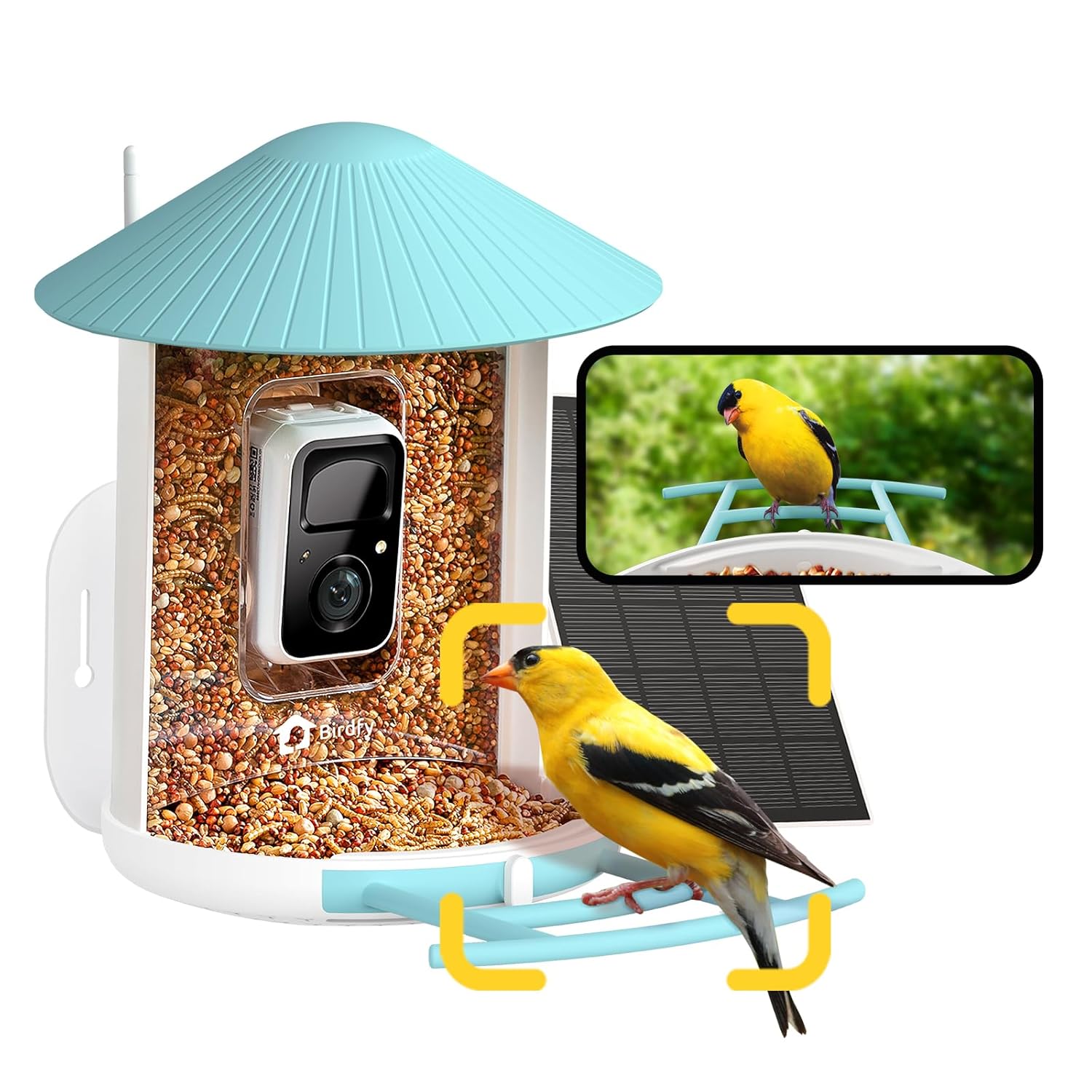
Price: ~$180 | Best for: Getting into smart birdwatching without the premium price
This is the standard Birdfy — the non-solar version that made the category take off on Amazon. It’s the same app and AI platform as the Solar 2K model above, just with a smaller camera sensor and no solar panel. For a lot of buyers, that’s actually the right call: you save $70+, and the tradeoff is that you’ll need to unclip the battery and charge it via USB-C every few weeks.
The camera is 2 megapixels with IR night vision (not color, just black-and-white). The 1080p video is clear enough to identify species confidently, and the AI pulls from the same 6,000-species database as the premium model. In real-world use, you probably won’t notice the sensor difference unless you’re doing slow-motion captures or comparing side-by-side.
The IP65 weatherproof rating keeps it protected from rain and sprinklers. It comes in blue, green, and other colors, all with matching perch and roof accents. The seed capacity is around 1.5 cups, same as the Solar version — NETVUE uses the same feeder body for both models, just different camera modules.
Battery life is about 3–4 weeks per charge in normal use. More active feeders with lots of visitors will hit closer to 2 weeks. The included USB-C cable plugs into any standard charger, and the battery charges in about 4 hours from empty. If you’re willing to handle that small bit of maintenance, this is the smart bird feeder to start with.
It’s consistently one of the top-selling smart bird feeders on Amazon, with thousands of reviews. The active online community means getting mounting help, troubleshooting tips, and seasonal advice is easy — search “Birdfy” on Reddit or YouTube and you’ll find hundreds of real-user videos.
Key Features:
- 2MP AI camera with infrared night vision
- Same 6,000+ species AI database as premium model
- IP65 weatherproof
- 2.4GHz WiFi connectivity
- Multiple color options (blue, green, more)
- Free core features with subscription for advanced AI
Pros:
- Best value entry point to smart birdwatching
- Same AI and app as the more expensive models
- Large, active user community for tips and help
- IP65 handles rain, sprinklers, and humidity
- Multiple color options to match your yard
Cons:
- Requires USB-C charging every 2–4 weeks
- IR night vision only (black and white, not color)
- 2MP camera is noticeably softer than 2K Solar model
- Plastic construction feels less premium than Bird Buddy
Verdict: The smart bird feeder to buy if you want to try the category without spending $250+. You get the same AI platform and most of the core features for under $200. If you love it and want sharper images or solar charging, you can always upgrade later.
4. Harymor Solar Bird Feeder — Best Budget
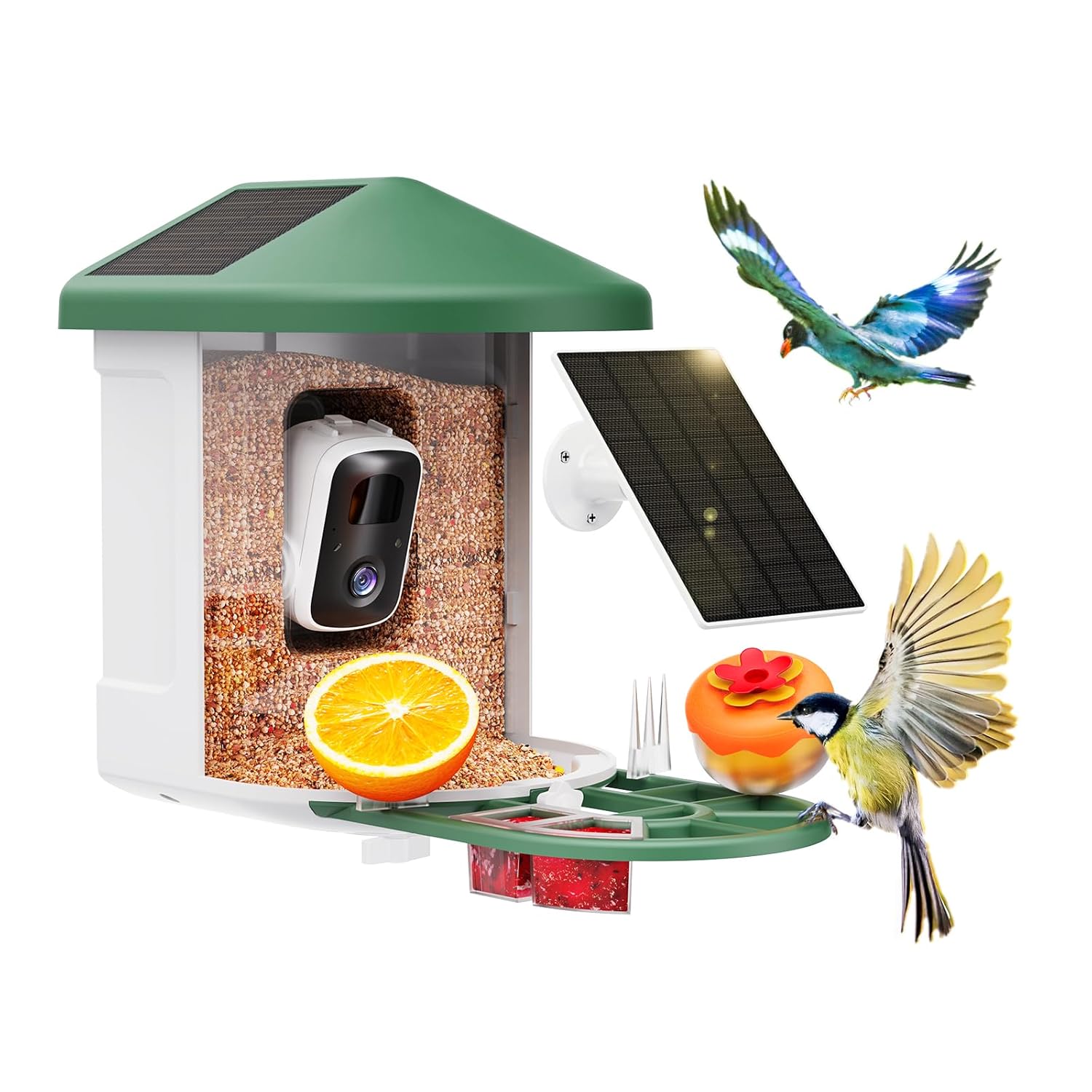
Price: ~$120 | Best for: Solar-powered smart bird feeding on a tight budget
If you want most of what a Bird Buddy does at less than half the price, Harymor is the pick. It’s not as polished, the app is clearly a second-tier product, and the AI isn’t as accurate — but you still get 2K HD video, AI bird identification, a built-in solar panel, and a larger 2-liter seed capacity than any of the premium options above.
The camera is a 120-degree wide-angle 2K sensor with 3x digital zoom, which is genuinely useful for capturing close-up detail on smaller visitors like chickadees and warblers. Real-time arrival alerts push to your phone the moment a bird lands. The AI claims to recognize over 10,000 species, though in practice expect more misidentifications than the Birdfy or Bird Buddy — common birds are usually correct, but unusual visitors can get mislabeled.
The solar panel and 5200mAh battery mean continuous operation in most yards. Harymor recommends at least 12 hours of accumulated sunlight per week to stay charged, which is easy in most US climates during spring and summer. The larger 2-liter (about 10 cups) seed capacity is a real advantage — you’ll refill this about 5x less often than a Bird Buddy or Birdfy.
Cloud storage is free for the first 2 years (a trial), and a 128GB SD card slot lets you skip subscriptions entirely. Video is saved as short clips triggered by motion detection.
The main cons are app polish and long-term support. Harymor is a newer brand, and the Vicohome app (used by multiple Chinese smart home manufacturers) is functional but not as refined as Bird Buddy’s or Birdfy’s. Reviews on Amazon are mostly positive, but the occasional firmware bug or connection hiccup is more common than with the premium brands.
For $120, these tradeoffs are completely fair. This is the smart bird feeder for someone who wants the experience without the investment.
Key Features:
- 2K HD camera with 120-degree wide angle and 3x zoom
- Built-in 3W solar panel with 5200mAh battery
- 2-liter seed capacity (5x larger than premium feeders)
- 10,000+ species AI recognition
- Free 2-year cloud trial plus SD card slot
- Instant arrival alerts
Pros:
- Less than half the price of premium alternatives
- Largest seed capacity on this list
- Solar-powered for set-and-forget operation
- Free SD card recording (no subscription required)
- 2K resolution at a budget price point
Cons:
- AI identification is less accurate than Bird Buddy or Birdfy
- Vicohome app is less polished than competitor apps
- Newer brand with less long-term track record
- Some reports of WiFi connection issues in low-signal areas
- No dedicated accessories ecosystem
Verdict: The best way to try smart birdwatching for $120. If you want the experience, you’ll get it. If you fall in love with it, upgrade to a Birdfy or Bird Buddy in a year. If you don’t, you’re not out a fortune.
5. Soliom BF08 Squirrel-Proof Feeder — Best for Squirrel Problems
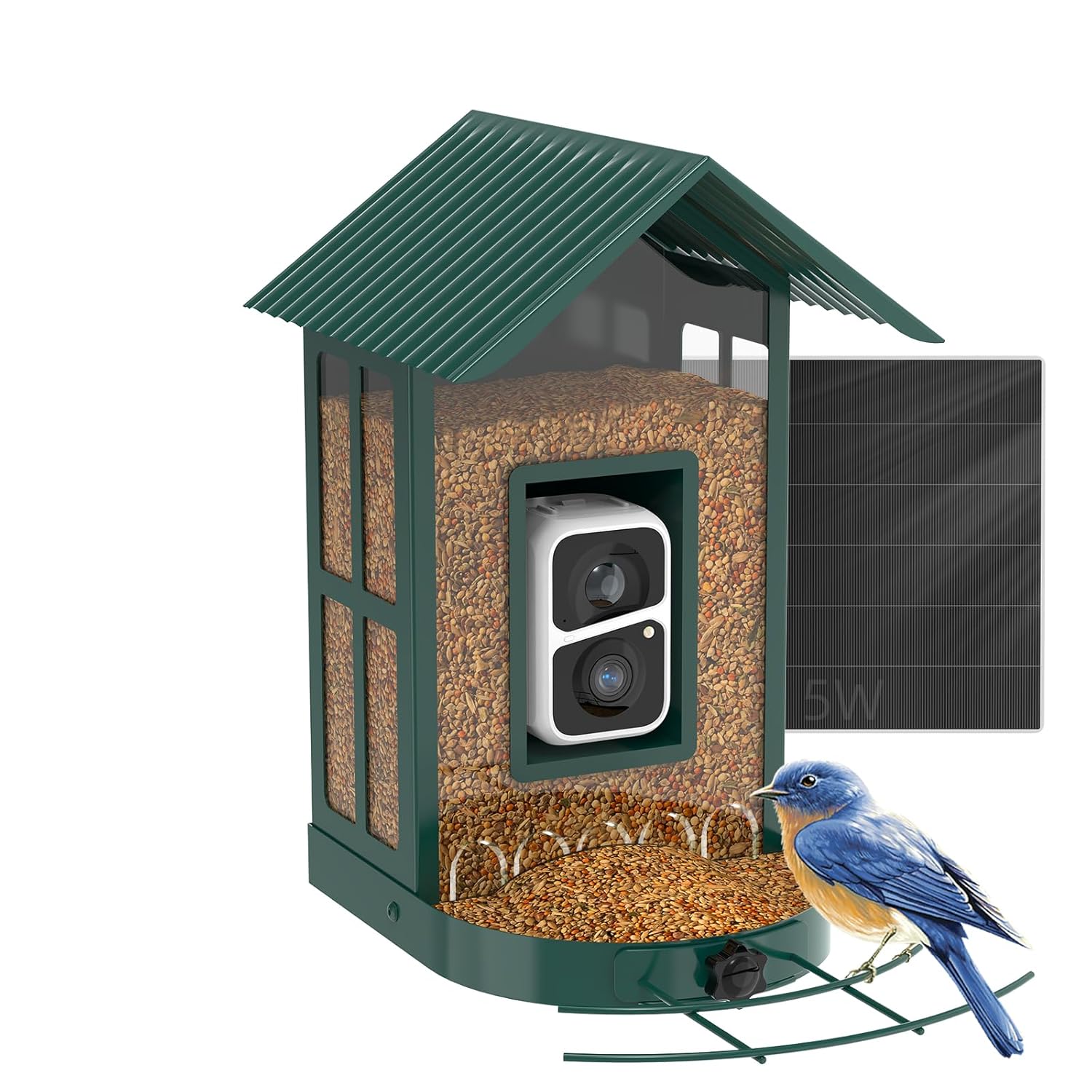
Price: ~$170 | Best for: Yards with aggressive squirrels or raccoons
Every bird feeder review site talks about squirrel problems because they’re real. A smart plastic feeder mounted in a squirrel-heavy yard can be chewed through, dropped, or emptied in a single afternoon. The Soliom BF08 is the smart bird feeder built to survive that.
The body is metal and heavy-duty acrylic with a total weight over 6 pounds when full. Squirrels can’t chew through the metal seed chamber, and the 2.7-liter capacity (about 13 cups) is the largest on this list. At that size, you’re refilling every couple weeks even in high-traffic yards, and the metal construction shrugs off raccoons, squirrels, and the occasional bear nibble.
On the tech side, the BF08 has a 2K HD camera with full-color night vision, real-time AI bird identification for over 10,000 species, and motion-triggered instant alerts. A 5W solar panel (larger than most competitors) keeps the battery topped up in even partially shaded yards. Live viewing through the app works smoothly, and the camera sends short clips to the cloud or to a local SD card.
The tradeoff for all that durability is weight and mounting complexity. This is not a hang-it-on-a-small-branch feeder — you’ll need a solid tree limb, a dedicated pole, or a proper wall mount rated for the load. Installation takes longer than the lighter plastic options, but once it’s up, it doesn’t come down for seasons at a time.
Squirrel-proofing isn’t 100% automatic — the main benefit is durability, not squirrel exclusion. If squirrels are climbing onto the perch, they’ll still eat seed. You’ll want to pair this with a standard squirrel baffle or pole system to keep them off entirely. What the Soliom gives you is the confidence that when they do figure out how to reach it, they can’t destroy it.
Key Features:
- Metal and acrylic squirrel-resistant construction
- 2.7-liter seed capacity (largest on this list)
- 2K HD camera with color night vision
- 5W solar panel (larger than competitors)
- AI recognizes 10,000+ species
- Free cloud storage with SD card backup option
Pros:
- Strongest build quality on this list
- Largest seed capacity — refill every 2+ weeks
- Powerful solar panel works in partial shade
- Color night vision captures nighttime raiders
- Handles rough weather, wildlife, and squirrels
Cons:
- Heavy (6+ lbs full) — needs sturdy mounting
- Not truly squirrel-proof on its own (they’ll still land on the perch)
- More expensive than the Birdfy standard
- Metal exterior can get hot in direct midday sun
- App interface feels dated
Verdict: The smart bird feeder for anyone with a squirrel problem or a history of destroyed feeders. The metal build and large capacity are genuinely valuable in the right yard. In a lightly-squirreled suburb, a cheaper Birdfy will serve you just as well.
6. Bird Buddy Hummingbird Solar — Best for Hummingbirds
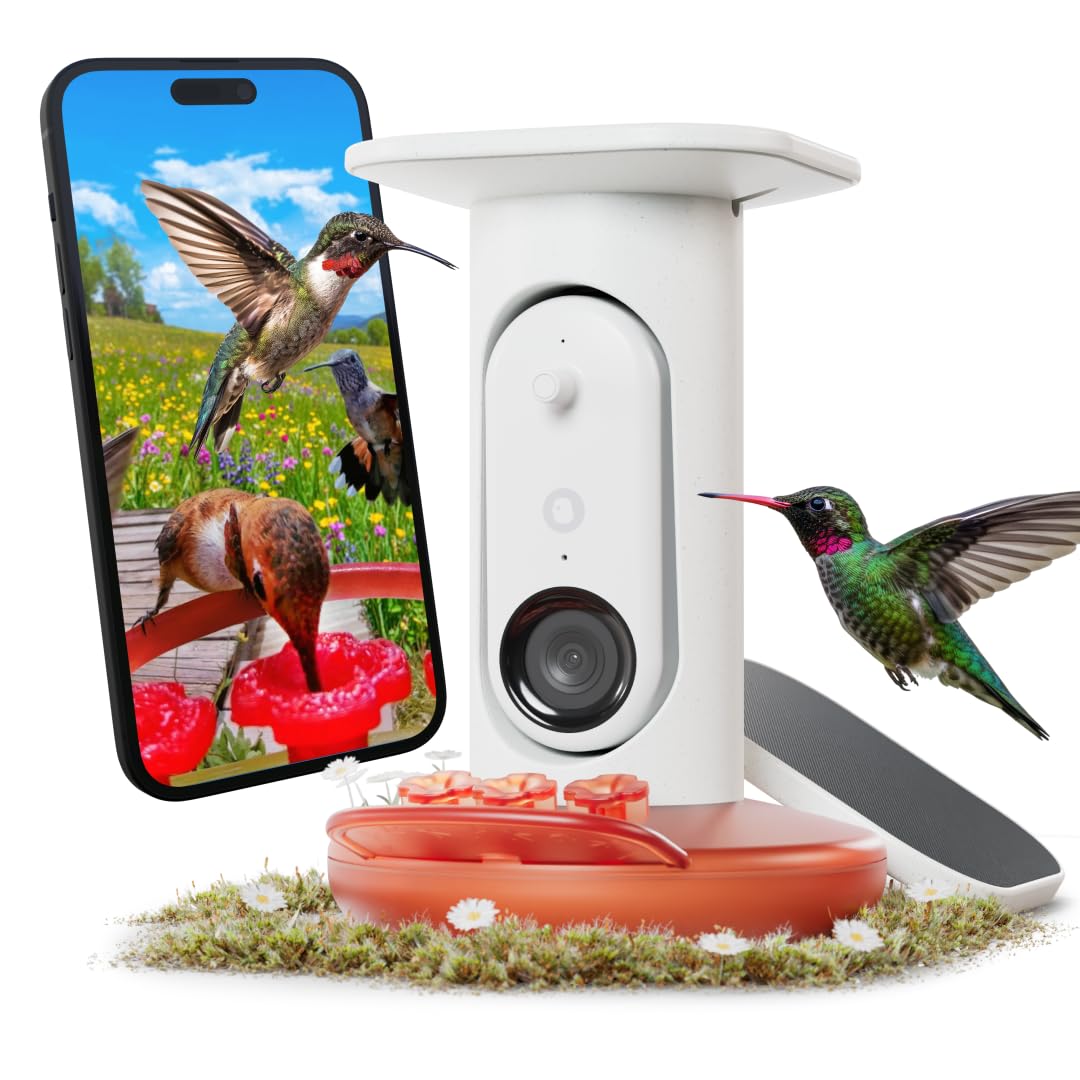
Price: ~$229 | Best for: Capturing hummingbirds in slow motion
Hummingbirds are the holy grail of backyard birdwatching — tiny, fast, iridescent, and almost impossible to photograph with a phone. This is the smart feeder built specifically to capture them. Bird Buddy’s hummingbird version uses the same 2K HD camera and AI platform as the seed feeder, but the feeder body is redesigned as a nectar reservoir with four feeding ports and bright red accents that attract hummingbirds naturally.
The killer feature is slow-motion 120fps capture. A hummingbird wing beats 50+ times per second — in real-time video it’s a blur, but in slow-motion you see every wing cycle in crisp detail. The app saves these slow-mo clips automatically whenever a hummingbird visits, and they’re consistently some of the most-shared smart feeder videos on social media for good reason.
The solar roof keeps the battery charged in most yards. Nectar capacity is about 10 ounces — on par with a standard non-smart hummingbird feeder — and the feeder comes apart easily for cleaning, which matters a lot with hummingbird nectar (it spoils in a few days in warm weather, so frequent cleaning is a must).
AI identification is tuned specifically for hummingbird species: Ruby-throated, Anna’s, Rufous, Allen’s, Broad-tailed, Calliope, and more. The app keeps a species log just like the seed feeder, and you can share sightings with other Bird Buddy users. One drawback: because the camera is pointed at a small feeding area, it can occasionally misidentify bees, wasps, and large moths as hummingbirds. Harmless, but a common FAQ in the app community.
For anyone with a yard that already attracts hummingbirds — or anyone in the Southwest and Southern California where they’re abundant — this is the single best way to watch and record them. For everyone else, start with the regular seed feeder, and add this as a second device if you want the full bird experience.
Key Features:
- Specifically designed for hummingbirds with 4 feeding ports
- 2K HD camera with 120fps slow-motion
- Solar roof for continuous charging
- AI identifies major North American hummingbird species
- Easy-disassembly nectar reservoir for cleaning
- Red accents to attract hummingbirds naturally
Pros:
- Slow-motion hummingbird footage is genuinely magical
- Same great app and AI as the Bird Buddy seed feeder
- Solar charging means no maintenance
- Easy to clean — critical for nectar feeders
- Supports all major North American hummingbird species
Cons:
- $229 is expensive for a specialty use case
- Only useful in regions with hummingbird populations
- Occasional false positives (bees, wasps) trigger alerts
- Nectar capacity is modest — refill every 3–5 days in hot weather
- Requires cleaning every 3–4 days in summer
Verdict: The only smart hummingbird feeder that really delivers on its promise. If hummingbirds visit your yard and you want to see them like you never have before, there’s no close second in this category.
Smart Bird Feeders with Camera Comparison Table
| Feeder | Price | Camera | AI Species | Power | Capacity | Night Vision |
|---|---|---|---|---|---|---|
| Bird Buddy PRO Solar | ~$299 | 2K / 5MP | 1,000+ | Solar | 1.5 cups | None |
| NETVUE Birdfy Solar 2K | ~$250 | 2K HD | 6,000+ | Solar | 1.5 cups | Color |
| NETVUE Birdfy Standard | ~$180 | 2MP / 1080p | 6,000+ | USB-C battery | 1.5 cups | Infrared |
| Harymor Solar | ~$120 | 2K HD | 10,000+ | Solar | 2 liters | None |
| Soliom BF08 | ~$170 | 2K HD | 10,000+ | 5W Solar | 2.7 liters | Color |
| Bird Buddy Hummingbird | ~$229 | 2K / 120fps | Hummingbird-specific | Solar | 10 oz nectar | None |
How to Choose a Smart Bird Feeder with Camera
Solar vs. Battery: Which Makes Sense?
This is the single biggest decision after picking your budget.
Solar feeders (Bird Buddy PRO Solar, Birdfy Solar 2K, Harymor, Soliom BF08, Bird Buddy Hummingbird) charge themselves as long as they get a few hours of sunlight per day. In most US yards, that means you set it up once and never think about the battery again. The downside is the feeder needs to be mounted somewhere with at least partial sun exposure — a north-facing shaded porch won’t work.
Battery feeders (NETVUE Birdfy Standard) use a removable rechargeable battery you top up every 2–4 weeks via USB-C. They work anywhere, including deep shade, but add the mild hassle of regular charging. The upside is you save $50–$100 vs. the solar version.
Rule of thumb: If your planned mounting spot gets at least 4 hours of sun per day, go solar. If it’s deep shade or an enclosed porch, battery is the right call.
AI Identification: How Accurate Does It Need to Be?
All the major smart feeders can identify common birds — chickadees, cardinals, sparrows, blue jays, finches. Where they differ is the edge cases: unusual visitors, juvenile birds, bird pairs that look similar (house finch vs. purple finch), and regional species.
Bird Buddy has the most polished AI model but a smaller database (~1,000 species, North America-focused). It rarely gets common birds wrong.
Birdfy (NETVUE) has a much broader database (6,000+ species, global) but occasionally flags uncommon birds as the wrong species. For serious birders and non-US users, this is the better choice.
Harymor and Soliom claim 10,000+ species but in practice the AI model is less refined. Common birds are correct, rare ones can be hit or miss.
If bird ID accuracy is the main draw for you, Bird Buddy and Birdfy are the two to choose between. If ID is a nice-to-have and you mainly want to watch birds on camera, any of these will do.
Subscription or No Subscription?
All the smart bird feeders in this guide work without a subscription for the core features: live view, motion alerts, and basic bird identification. But each brand has a paid tier that unlocks more:
- Bird Buddy Premium (~$3/month): Unlimited cloud storage, advanced AI, unlimited collections
- Birdfy AI Plus (~$30–$40/year): Expanded species recognition, extended cloud storage
- Harymor/Soliom (SD card option): Skip subscriptions entirely by using a local SD card
If you want the full experience long-term, budget an extra $30–$50/year for the subscription on top of the feeder. If you want to avoid subscriptions, the Harymor and Soliom both support SD card recording without paying anything.
Mounting: Pole, Tree, or Wall?
All six feeders ship with some form of mounting hardware, but the best mounting depends on your yard.
Pole mount is the safest from squirrels and raccoons — a 5- to 6-foot metal pole with a squirrel baffle around the base is the gold standard. This works for every feeder on this list.
Tree mount uses the included bracket to strap the feeder to a trunk or large branch. Easier setup but much easier for squirrels to reach. Best paired with a squirrel-baffle tube or above-feeder dome.
Wall/post mount attaches the feeder to a deck railing, fence post, or house wall. The Bird Buddy and Birdfy both sell dedicated wall mounts. Good for viewing from a specific window but requires drilling.
If you’re shopping for outdoor smart home gear to pair with a bird feeder, our guide to the best smart outdoor cameras covers broader yard surveillance options. For outdoor power (if you want a wired feeder option), check our smart outdoor plugs buying guide.
Is This a Good Mother’s Day or Father’s Day Gift?
Smart bird feeders are in the top 5 most-gifted smart home products of the spring season, and for good reason — they check every box for a thoughtful gift. Easy to set up, fun to use, creates ongoing joy instead of sitting in a drawer, and triggers that “wait, this is so cool!” reaction when the first bird notification arrives.
For Mother’s Day (May 10, 2026), the Bird Buddy PRO Solar is the go-to pick — polished app, premium feel, and the unboxing experience is genuinely delightful. If you want a more affordable gift, the NETVUE Birdfy standard at ~$180 is perfect. For a broader spring gift-guide covering other smart home ideas, see our roundup of the best smart home gifts for Mom 2026.
FAQ
Do smart bird feeders really work?
Yes, genuinely. Once mounted in a spot birds already visit (or near an existing bird-attracting yard setup), you’ll start getting notifications within a few days. The AI identification is surprisingly accurate on common birds, and the live view is just as fun as it sounds. The key is patience at the start — birds take time to discover a new feeder, especially in winter. Fill it with quality seed (black oil sunflower works for most backyard species), mount it somewhere with nearby tree cover for escape routes, and give it a couple of weeks before worrying.
How long does a smart bird feeder battery last?
It depends on the model and how busy your yard is. Solar-powered models (Bird Buddy PRO Solar, Birdfy Solar, Harymor, Soliom) essentially last indefinitely as long as they get a few hours of sun per day. Battery-only models like the standard NETVUE Birdfy last about 3–4 weeks between charges in moderate use. Heavy bird traffic, cold weather, and constant live-viewing reduce battery life; shaded or rainy weather reduces solar recharging. If you’re in a shaded yard, go with a battery model and keep a second battery ready to swap in.
Do I need a subscription to use a smart bird feeder?
No, but you’ll get more out of it with one. Every feeder in this guide works without a subscription for the basics — live view, alerts, species ID for common birds. Paid tiers (Bird Buddy Premium, Birdfy AI Plus) unlock unlimited cloud storage, better AI, and premium features. Harymor and Soliom support SD card recording, letting you skip subscriptions entirely. For casual users, free tiers are fine. For serious birders who want to save every video and collect species over years, the subscription is worth the ~$30–$40/year.
Can smart bird feeders handle rain and snow?
All six feeders in this guide are rated for outdoor use with weatherproof construction (typically IP65 or better). They handle rain, snow, and freezing temperatures without issue. In sustained freezing weather, battery capacity drops temporarily but returns to normal once temperatures warm up. In extreme heat (above 100°F for long periods), check battery health more often — heat degrades lithium batteries faster than cold. Just keep the seed dry by using a rain-shielding roof (built into every feeder here) and you’re good year-round.
Will squirrels break my smart bird feeder?
It’s possible, especially with all-plastic models like the Bird Buddy and Birdfy. Squirrels chew plastic and can damage the feeder body, solar panel, or camera lens if they get frustrated trying to get seed. The best defense is a squirrel baffle — a cone or dome mounted above or below the feeder that blocks them from climbing. A pole-mounted feeder with a baffle around the base is nearly squirrel-proof. If you’ve already got a serious squirrel problem, the Soliom BF08’s metal construction is the most damage-resistant option on this list. Pair any smart feeder with a baffle before you put it up, and you’ll save yourself repairs later.
Do smart bird feeders work in cold or winter weather?
Yes. Most are rated for operation down to 14°F (-10°C), and several can operate colder. Lithium battery performance drops in sub-freezing weather, so expect shorter battery life in winter — but solar-powered feeders still charge during daylight hours even in the cold. Ice and snow buildup on the solar panel can reduce charging, so occasionally brushing it off after a storm is worth doing. In most of the continental US, smart bird feeders work year-round. In extreme-cold regions (North Dakota, Montana, Alaska), bring the feeder inside if temperatures will stay below zero for extended periods.