
Quick Picks
Memorial Day weekend is days away and the mosquitoes are already winning. If you’re planning a backyard cookout, a string-light dinner on the patio, or just want to sit outside after sunset without getting eaten alive, here are the six smart mosquito traps and repellers worth your money in 2026:
- Dynatrap DT2030SR Fly Traps Outdoor – Mosquito & Flying Insect Killer for 1 Acre (~$170) — Best overall, silent UV + CO2 trap that covers a full acre with no zap, no spray, no propane
- Thermacell Mosquito Repellent E-Series Rechargeable Repeller (~$45) — Best patio repeller, 20-foot scent-free zone that’s perfect for cookouts and outdoor dining
- Thermacell Mosquito Repellent Rechargeable Adventure EX-Series EX90 (~$60) — Best portable, rugged rubber-armored repeller with a 9-hour battery and carabiner for camping or the deck
- DynaTrap DT152 Indoor Insect Trap and Killer (~$30) — Best indoor trap, catches gnats, flies, and mosquitoes inside the house with a plug-in UV+glue design that’s safe around kids and pets
- Mosquito Magnet MM4200B Patriot Plus Mosquito and Flying Insect Trap and Killer (~$400) — Best premium, propane-powered CO2 trap that actually attacks the breeding population over an acre
- Flowtron Electric Bug Zapper 1/2 Acre Outdoor Insect Control with Dual Lure Method (~$80) — Best classic bug zapper, octenol-lured UV zapper for backyards where you want the satisfying crackle
If you’re firing up the grill for Memorial Day weekend, the next four months are going to be a war with mosquitoes — and the difference between an enjoyable summer on the patio and a frustrating one usually comes down to what you’ve set up before the bugs arrive. Smart mosquito control in 2026 isn’t about hauling out a fogger or burning citronella candles you can smell from across the yard. It’s about app-controlled traps, rechargeable scent-free repellers, and propane-driven CO2 systems that quietly do the work in the background while you actually enjoy your backyard.
The category has split into three distinct types of devices. Traps (DynaTrap, Mosquito Magnet) use UV light, heat, and CO2 to attract mosquitoes and pull them into a holding chamber where they die — these reduce the local mosquito population over weeks. Repellers (Thermacell) create a 20-foot bubble of repellent vapor around you so the bugs that are already there don’t land — these work instantly but only protect the immediate area. Zappers (Flowtron) use UV light plus a high-voltage grid to attract and electrocute flying insects — these handle a wide variety of pests but are louder and less mosquito-specific.
Most homeowners are best served by combining two of these. A trap running 24/7 in a back corner of the yard to thin the population, plus a repeller on the patio table for the actual hours you’re outside, is the setup the pros use. We pulled the six products in this guide from current Amazon stock with verified ASINs and looked at how each one actually performs day-to-day, who it’s right for, and where each one earns its money. If you want the bugs gone by Saturday, here’s where to start.
Our Top Picks Reviewed
Dynatrap DT2030SR Fly Traps Outdoor - Mosquito & Flying Insect Killer for 1 Acre – Kills Mosquitoes, Flies, Gnats, Wasps - Bug Zapper Alternative - Black — Best Overall
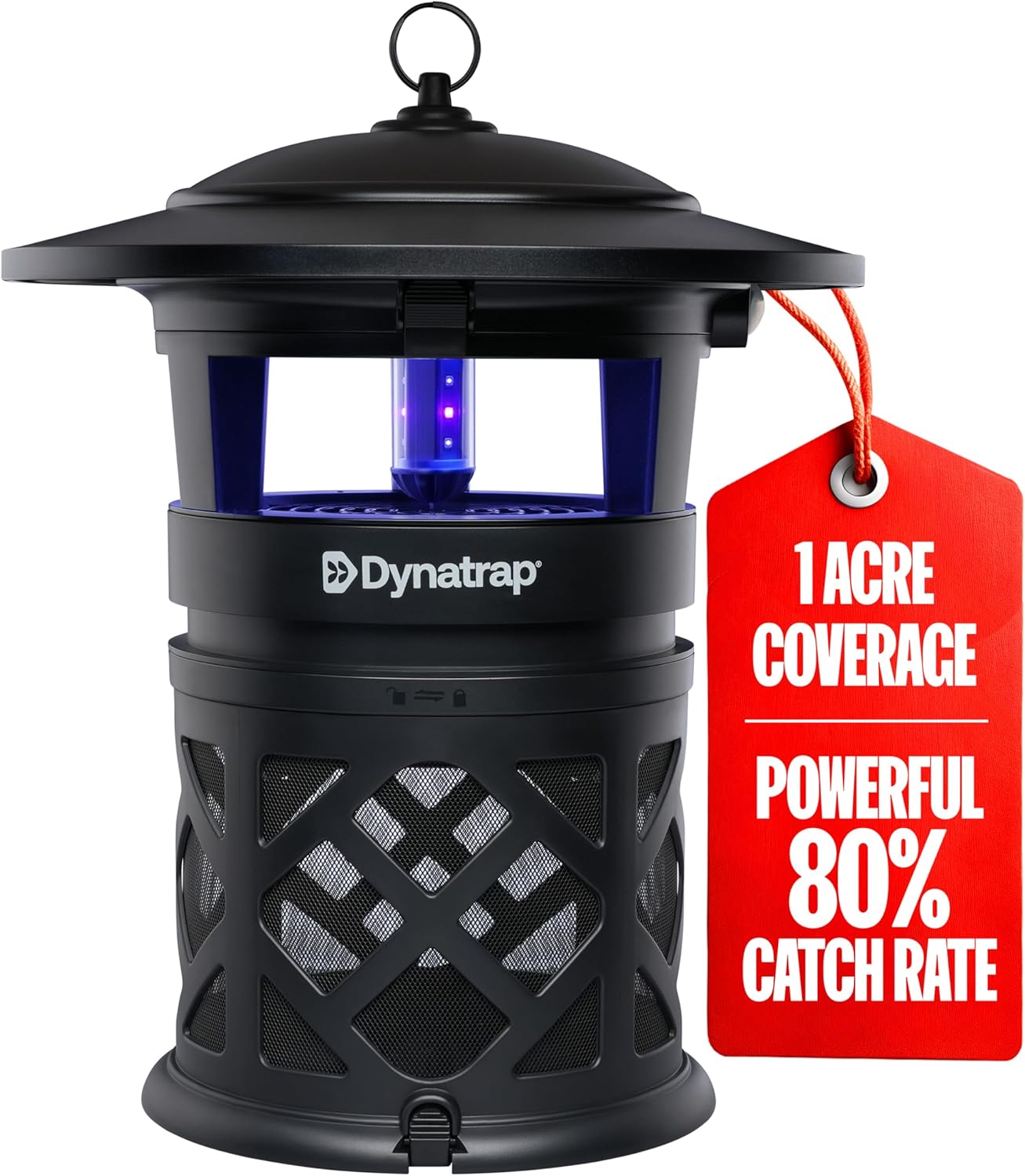
The DynaTrap DT2030SR is the trap most homeowners should start with. It covers a full acre, sits quietly on the patio or staked into the lawn like a lantern, and uses a three-stage attract-and-trap process that’s specifically tuned for mosquitoes. There’s no zap (it’s not a bug zapper), no propane (you don’t have to refill anything), and no spray (it’s kid and pet safe). You plug it in, switch it on, and within about two weeks you’ll notice a meaningful drop in the mosquito population around your house.
The DT2030SR’s three-stage system is what makes it different from a bug zapper. First, a 6-watt UV bulb glows warm white to mimic the wavelengths that attract mosquitoes. Second, a TiO2-coated grid surrounding the bulb generates a small amount of CO2 by reacting with UV light — mosquitoes home in on CO2 (it’s how they find mammals to bite). Third, a quiet whisper-fan creates a vacuum that sucks the attracted insects down into a retaining cage where they dehydrate. The whole process is nearly silent. You won’t hear it from across the yard.
The catch with any UV+CO2 trap is placement and patience. Put it 20 to 40 feet from where you actually hang out (you want to draw mosquitoes away from you, not toward you), run it 24/7 during mosquito season, and give it two weeks to start showing results. The retaining cage twists off for emptying once a week or so. For best results, drop in a DynaTrap Atrakta lure sachet (sold separately, about $10 for two months) — it boosts the catch rate noticeably.
The DT2030SR is the newer “SR” generation, which adds a slightly improved fan and a more efficient bulb compared to older DT2000XLP-style units. Replacement bulbs run about $15 to $25 once a year, and that’s the only recurring cost (plus optional lure).
Key Features:
- 1-acre coverage area, ideal for typical suburban backyards
- UV light + CO2 (via TiO2 coating) + whisper-quiet fan
- No zap, no propane, no spray — kid and pet safe
- All-weather outdoor housing, plug-in (25-foot cord)
- Hangs from included hook or sits on a flat surface
- Compatible with DynaTrap Atrakta lure for boosted catch rate
Pros:
- Silent operation, no zap noise to ruin a dinner party
- Genuinely catches mosquitoes (not just moths and flies, like cheap zappers)
- Easy weekly maintenance — twist, empty, reattach
- Lower running cost than propane CO2 traps
- Looks like a patio lantern, not an industrial bug killer
Cons:
- Takes 2 weeks to noticeably reduce the population
- Needs a 24/7 outdoor outlet (or a long extension cord)
- Annual bulb replacement (~$20)
- Coverage drops off in very large or open yards beyond an acre
Thermacell Mosquito Repellent E-Series Rechargeable Repeller; Patio Shield 20’ Mosquito Protection Zone; Includes 36-Hr Repellent Refill; No Flame or Scent; Bug Spray Alternative — Best Patio Repeller
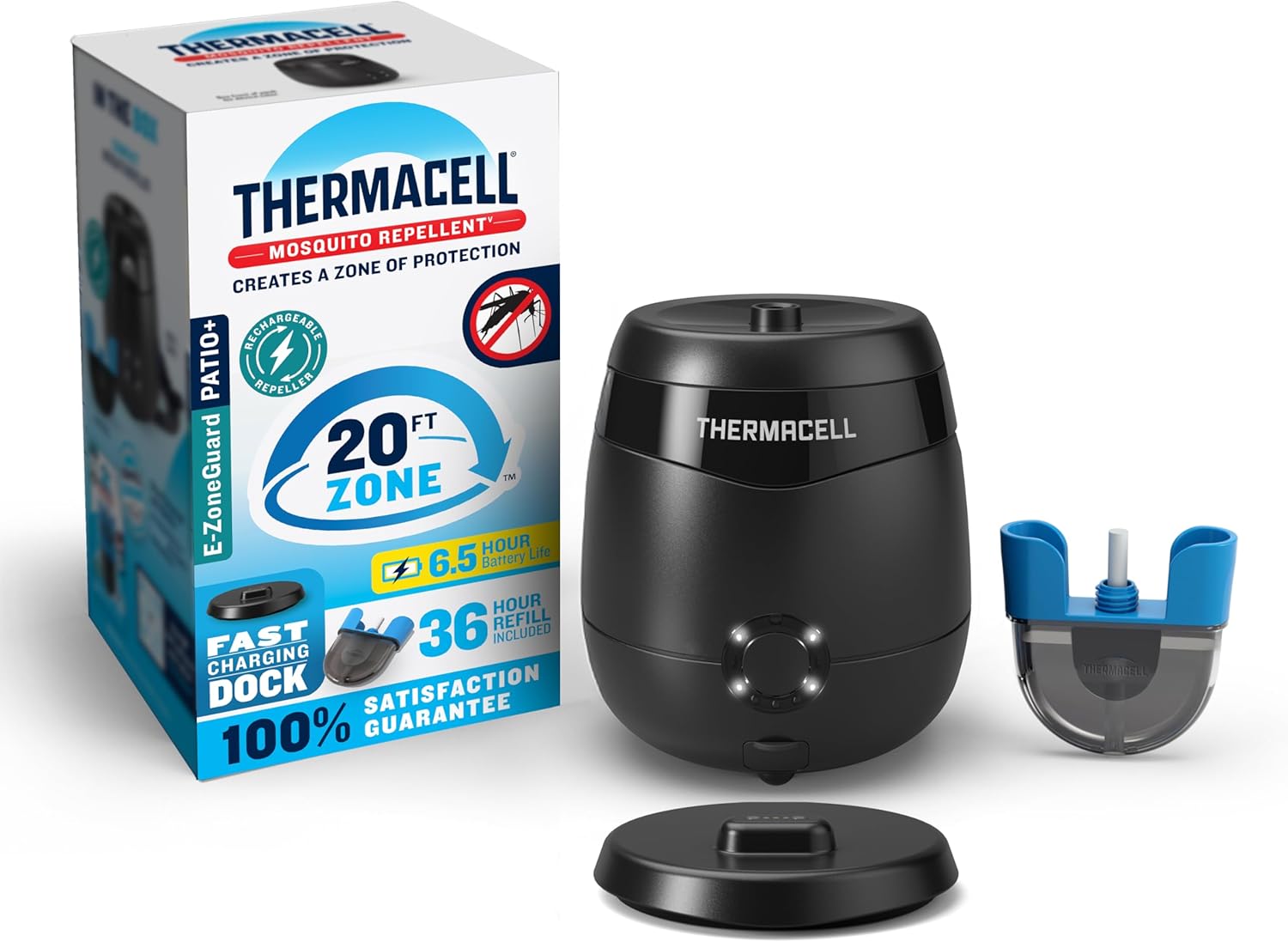
If you only buy one mosquito product for the patio this Memorial Day weekend, make it this one. The Thermacell E-Series is the modernized, rechargeable version of the propane-cartridge Thermacells that have been a backyard staple for two decades. It heats a small mat of repellent (a synthetic version of a compound found in chrysanthemums) to release an invisible, scent-free vapor that creates a 20-foot mosquito-free zone around the device. Within about 15 minutes of switching it on, the mosquitoes simply leave.
The reason this is the patio repeller most people should buy isn’t innovation — it’s that it works, doesn’t smell, doesn’t smoke, isn’t sticky, doesn’t have to go on your skin, and turns on with a single button. Plant it on the patio table, near the grill, by the firepit, or anywhere you actually want to sit. The 20-foot bubble is plenty for a 6-person dinner table and good for a small back deck.
The E-Series version (versus the older fuel-cartridge models) charges over USB-C and runs for about 5.5 hours per charge. The 36-hour repellent refill mat included in the box typically lasts a few weekends of normal use, and replacement mats run about $10 to $15 for a 36- or 40-hour pack. It’s also fully odorless, which is the big upgrade over old citronella torches and DEET sprays — your food doesn’t taste like bug spray.
One important note: this is a repeller, not a trap. It doesn’t reduce the mosquito population, it just keeps them away from you for the few hours you’re actually outside. That’s exactly what you want for cookouts, but for full-yard coverage, pair it with the DynaTrap above.
Key Features:
- 20-foot mosquito protection zone
- USB-C rechargeable, ~5.5 hours per charge
- Includes 36-hour repellent refill in the box
- Scent-free, smoke-free, no skin contact
- Single-button operation
- EPA-registered active ingredient
Pros:
- The single fastest way to get a mosquito-free patio (15-minute kick-in time)
- No propane, no flame, no smell, no greasy spray
- Lightweight and portable — move it from the table to the firepit to the deck
- Refill mats are cheap and last for entire weekends
- The version most reviewers consider the gold-standard backyard repeller
Cons:
- Only protects a 20-foot bubble — won’t clear your whole yard
- Refill mats are a recurring cost (~$0.30 per hour of use)
- Repellent vapor needs ~15 minutes to fully ramp up
- Effectiveness drops in heavy wind
Thermacell Mosquito Repellent Rechargeable Adventure EX-Series EX90; Patio Shield with 9-Hour Battery, Includes 12-Hour Refill, Rubber Armor & Carabiner; Scent Free — Best Portable
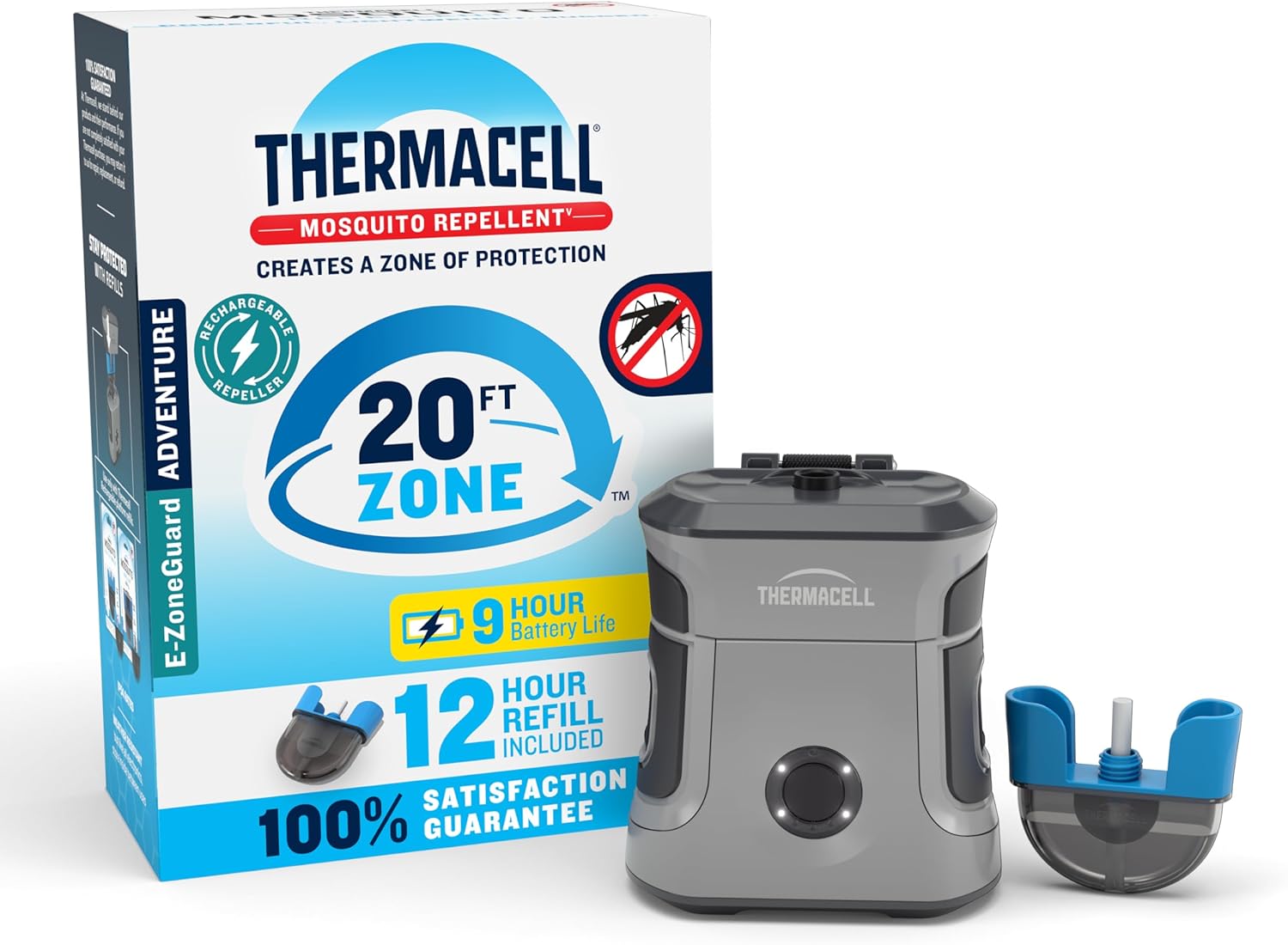
The EX-Series EX90 is the same Thermacell repellent technology in a ruggedized housing for people who actually move around. Camping, hiking, tailgating, fishing, or just hanging a repeller off the back of an Adirondack chair on the deck — this is the one to grab. It’s wrapped in rubber armor that survives drops, comes with a built-in carabiner to clip onto a backpack or tent loop, and runs nine hours on a single charge versus the E-Series’ 5.5.
The 20-foot protection zone is the same as the E-Series. What you’re paying extra for is durability and runtime. The longer battery means it’s the only Thermacell that can realistically run from sunset through a full evening cookout, plus an entire next morning at the dock, on one charge. The included 12-hour repellent refill gets it through the first long outing; after that, the same E-Series-compatible refill mats fit (so refill costs are identical).
For a stationary patio it’s overkill — the cheaper E-Series above does the same job for less. But if you have a deck and a campsite and a boat dock, owning two of these means you don’t have to remember which one is charged. Most reviewers who buy one end up buying a second within the same season.
Key Features:
- 20-foot mosquito protection zone (same as E-Series)
- 9-hour battery life per USB-C charge
- Rubber armor + clip-style carabiner
- Includes 12-hour repellent refill
- Scent-free, flame-free, no skin contact
- Compatible with same refill mats as the E-Series
Pros:
- Roughly double the runtime of the standard E-Series
- Built to take a drop or a backpack ride
- Carabiner clips onto chairs, tents, packs
- Same proven Thermacell repellent system
- Refill mats are interchangeable with the E-Series — no second supply chain
Cons:
- More expensive than the E-Series for the same coverage zone
- Bulkier on a patio table
- Refill mats are a recurring cost (~$0.40 per hour of use)
- Still wind-sensitive like all vapor repellers
DynaTrap DT152 Indoor Insect Trap and Killer – Catches and Kills Gnats, Flies, Moths & Other Flying Insects — Best Indoor
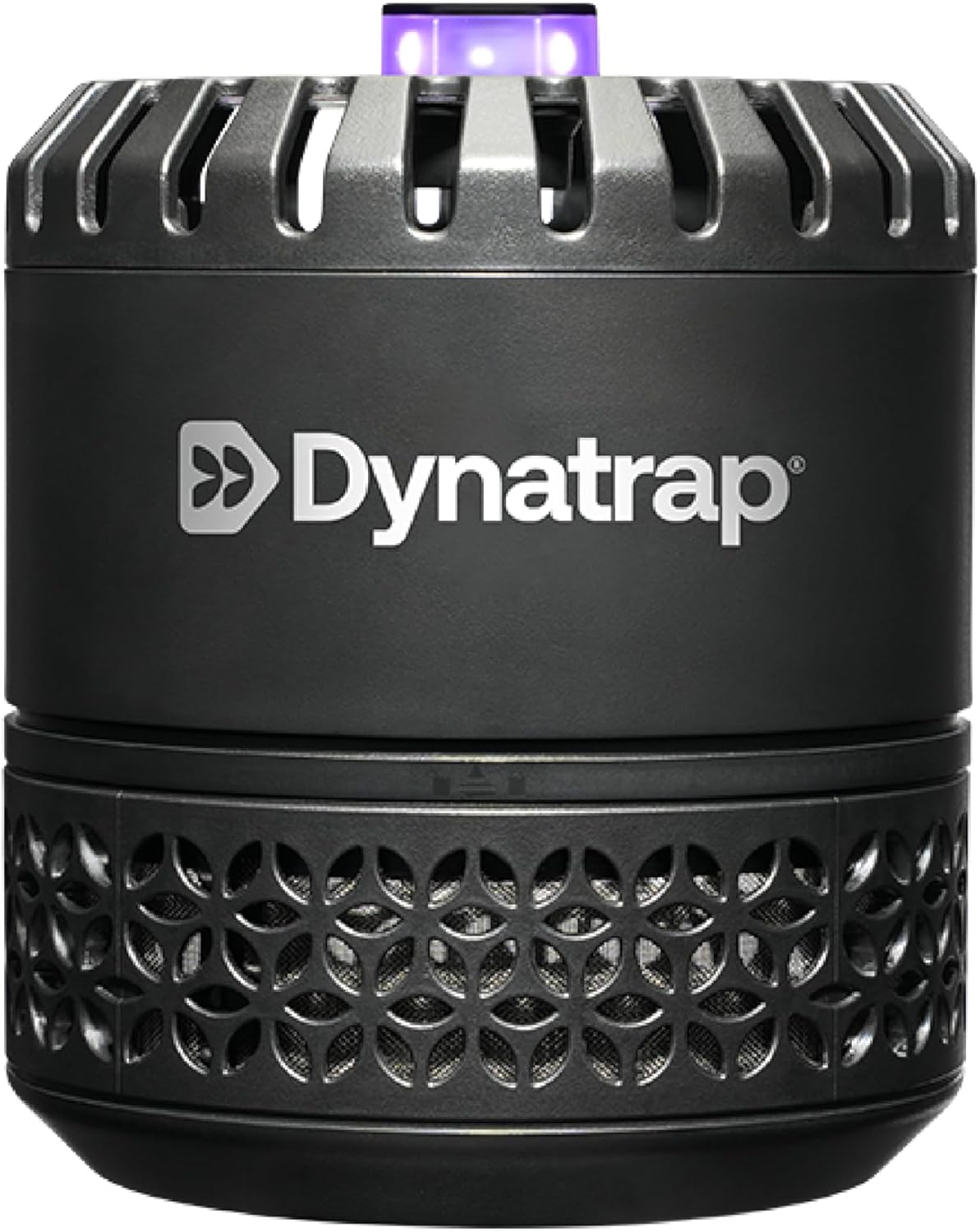
Mosquitoes that follow you in the back door, fruit flies hovering above the kitchen counter, and gnats around the houseplants are a different problem than yard mosquitoes, and the DT152 is built for it. It’s a small, plug-in indoor trap that uses a UV light to attract flying insects toward a sticky glue card hidden behind a louvered front. No zap, no fan noise, no chemicals, no scent — totally fine to run in a kitchen, bedroom, or near a baby’s nursery.
The DT152 plugs into any standard outlet and is small enough to sit on a countertop or plug straight into the wall. The UV light is on continuously (it’s low-wattage, about 4W) and pulls in flying insects that wander into the room. The glue card behind the grille catches them silently. You replace the glue card every 30 to 60 days for about $4 to $6 a card. That’s the entire maintenance schedule.
For mosquitoes specifically, this is a secondary device. Mosquitoes are less attracted to indoor UV traps than gnats or fruit flies are, but if a few are getting in from outside, this will catch them. The bigger value is for the other flying insects that arrive during summer — fruit flies from the compost, gnats from a houseplant, the occasional fly. Most reviewers who run one in the kitchen describe a noticeable difference within the first night.
Some users buy two: one for the kitchen, one for the laundry room or near a basement door where bugs sneak in. They’re cheap enough to do this without thinking about it.
Key Features:
- Indoor UV+glue trap, plug-in design
- Silent operation, no fan
- Glue cards behind a louvered front (kid and pet safe)
- Low power draw (~4W)
- Compact enough for a countertop or wall outlet
- No chemicals, no scent
Pros:
- Genuinely silent — safe in a bedroom or nursery
- Cheap to run (just glue card replacement every 30-60 days)
- Catches a wide range of indoor flying pests (gnats, fruit flies, mosquitoes, small moths)
- No zap noise to startle pets or kids
- Easy to hide behind a coffee maker or appliance
Cons:
- Glue cards are a recurring cost
- Less effective against mosquitoes than against gnats and fruit flies
- Catches are visible on the glue card (some users find this gross — keep it out of sight)
- Coverage is one room, not a whole house
Mosquito Magnet MM4200B Patriot Plus Mosquito and Flying Insect Trap and Killer - Outdoor Fly Trap Protects Up to 1 Acre, Green — Best Premium
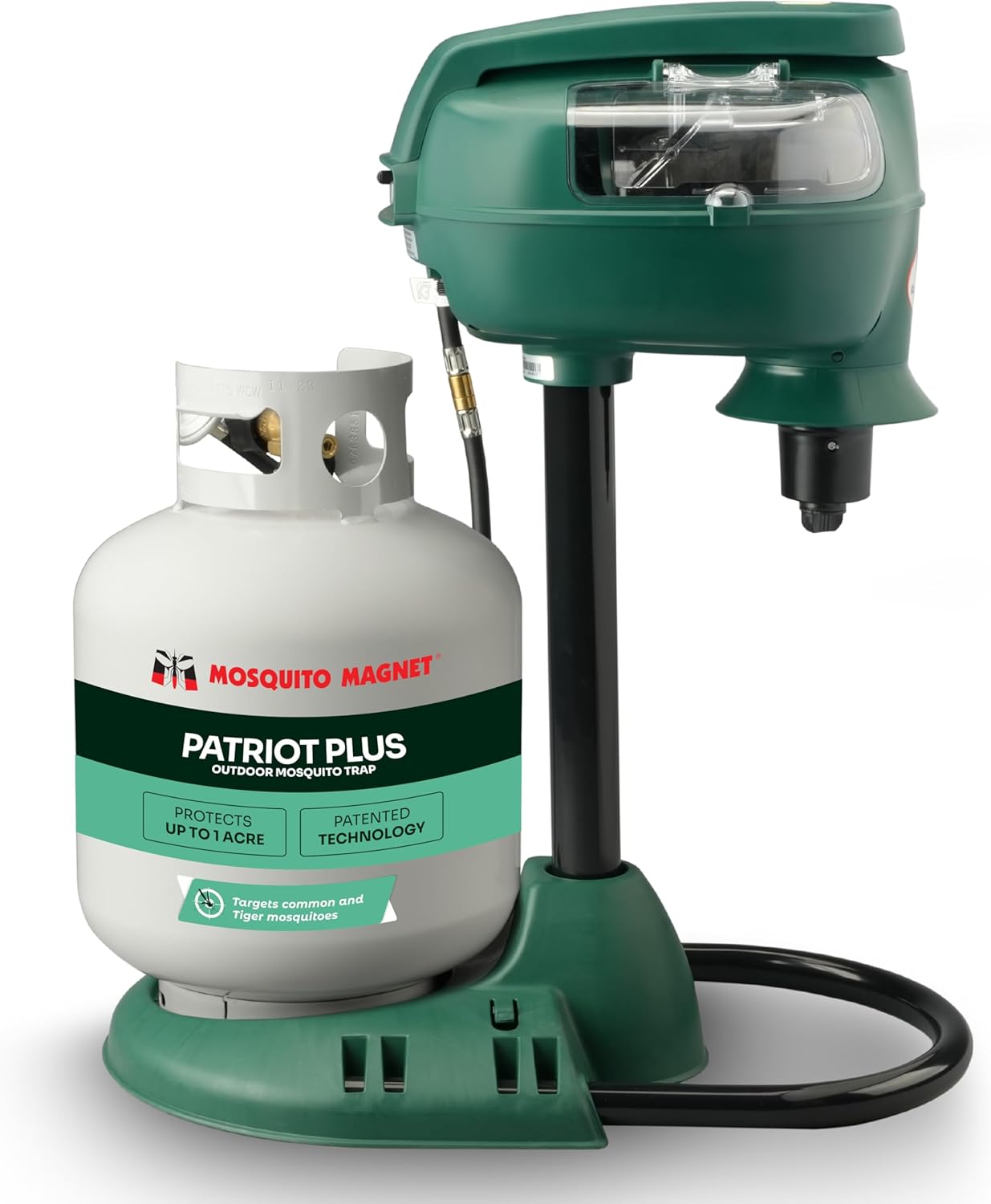
If the DynaTrap is the patio-trap most people should buy, the Mosquito Magnet Patriot Plus is the trap to buy when mosquitoes are a real, serious problem — homes near woods, water, marshes, or anywhere a normal UV trap isn’t keeping up. The Patriot Plus uses a 20-pound propane tank (sold separately, the kind that fits a standard gas grill) to generate genuine CO2, heat, and moisture, mimicking a large mammal so closely that mosquitoes treat it as a target instead of you.
The setup is significantly more involved than a plug-in trap. You’ll connect a propane tank to the unit, plug it into a 110V outlet for the fan and ignition, drop in an attractant cartridge (Octenol or Lurex, sold separately), and place it 30 to 40 feet upwind of your patio. The unit then quietly runs for about 21 days per propane tank, attracting female mosquitoes into a net catch bag where they desiccate and die. Because Mosquito Magnet specifically interrupts the breeding cycle by catching female mosquitoes before they lay eggs, the population reduction over a full summer is dramatic.
Running costs are the trade-off. A propane tank refill runs about $25 to $40 every three weeks of operation. Octenol cartridges are about $15 to $20 and last about 21 days. So you’re looking at $40 to $60/month in consumables during peak mosquito season. For a typical suburban yard, the DynaTrap is plenty. For waterfront property, a yard backing up to woods, or anywhere mosquito-borne disease (West Nile, EEE) is a concern, the Mosquito Magnet is the right tool.
Key Features:
- 1-acre coverage with propane-generated CO2, heat, and moisture
- Net catch bag captures female mosquitoes (interrupts breeding cycle)
- Uses standard 20 lb propane tanks (~3 weeks per tank)
- Compatible with Octenol and Lurex attractant cartridges
- Wheeled chassis for moving across the yard
- Built for sustained 24/7 outdoor operation
Pros:
- The most effective single-unit residential mosquito trap available
- Genuinely reduces the breeding population, not just the active population
- Wheels and a handle make placement easy
- Backed by decades of field studies (it was originally designed for malaria research)
- Coverage rivals professional fogging services without the spraying
Cons:
- Significantly more expensive upfront ($350-$450)
- Propane + attractant cartridges are a real monthly cost
- Requires placement near a 110V outlet (for fan/ignition only)
- Larger footprint than a UV trap
- Overkill for small or low-mosquito yards
Flowtron Electric Bug Zapper 1/2 Acre Outdoor Insect Control with Dual Lure Method, 15W UV Light & Octenol Attractant for Fly & Mosquito, 5600V Kill Grid, Made in the USA — Best Bug Zapper
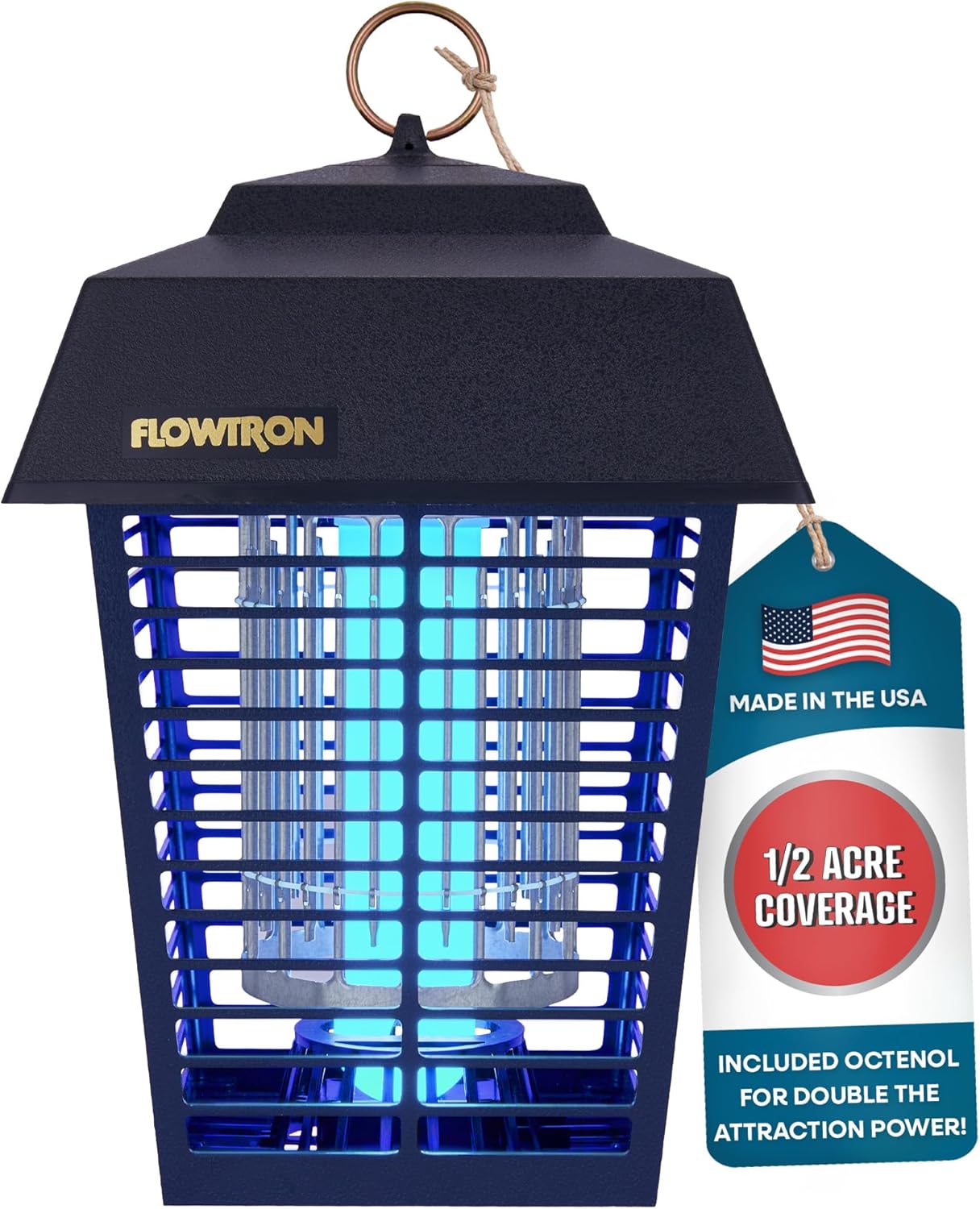
The Flowtron 1/2 Acre is the classic outdoor bug zapper, and if you’ve ever heard the satisfying “crack” of an insect frying on a backyard zapper, this is probably the one that made the sound. It’s an old-school 15-watt UV bulb surrounded by a high-voltage grid, with a slot for an octenol attractant cartridge to make it specifically lure mosquitoes in addition to the usual moths and flies. Hang it from a tree branch or a shepherd’s hook, plug it into an outdoor outlet, and it runs until the bulb burns out (about a year of nightly use).
We include the Flowtron not because it’s the most efficient mosquito trap (it isn’t — UV+CO2 traps catch more mosquitoes per watt), but because a lot of people genuinely want a zapper. The crackle is satisfying. It handles a wider variety of flying insects than a CO2 trap (moths, gnats, biting midges, no-see-ums, June bugs). And in a back corner of a yard where you don’t sit, the noise isn’t a problem.
The Made-in-the-USA Flowtron is the unit to buy if you’re going to buy a zapper, because the alternative is the flood of cheap import zappers that fail after one season and don’t carry octenol attractant slots. Flowtron’s been making these for 50+ years; the housing is solid, replacement bulbs are widely available for $15 to $25, and the octenol cartridges run about $4 to $6 each and last 30 days.
Pair this with one of the Thermacell repellers above for the patio itself — let the zapper handle the back corner of the yard while the Thermacell handles the dining table.
Key Features:
- 1/2-acre coverage area
- 15W UV bulb + 5600V kill grid
- Octenol attractant slot for mosquito-specific lure
- Hang or pole-mount design
- Made in the USA, 2-year manufacturer warranty
- All-weather outdoor housing
Pros:
- Handles a wider variety of pests than a CO2 trap (moths, gnats, beetles, mosquitoes)
- Cheap to run — just a bulb every year or two
- Octenol slot actually makes it useful for mosquitoes, unlike basic zappers
- Built like a tank — the steel housing lasts a decade
- The “crackle” is a feature for some, a bug for others
Cons:
- Catches a lot of beneficial insects too (moths, beetles, fireflies) — not ideal near pollinator gardens
- The zap noise is audible from across the yard
- Bug debris falls to the ground below — hang over grass or gravel, not over a deck
- Less mosquito-specific than DynaTrap or Mosquito Magnet
- Octenol cartridges are a recurring monthly cost
Smart Mosquito Trap & Repeller Comparison Table
| Model | Best For | Type | Coverage | Power | Recurring Cost | Price |
|---|---|---|---|---|---|---|
| Dynatrap DT2030SR | Best overall | UV + CO2 trap | 1 acre | Plug-in | Bulb ( | ~$170 |
| Thermacell E-Series | Best patio repeller | Vapor repeller | 20 ft zone | USB-C rechargeable | Refill mats (~$0.30/hr) | ~$45 |
| Thermacell EX-Series EX90 | Best portable | Vapor repeller | 20 ft zone | USB-C rechargeable | Refill mats (~$0.40/hr) | ~$60 |
| DynaTrap DT152 Indoor | Best indoor | UV + glue trap | 1 room | Plug-in | Glue cards (~$5 every 30-60 days) | ~$30 |
| Mosquito Magnet Patriot Plus | Best premium | Propane CO2 trap | 1 acre | Propane + 110V | Propane + Octenol (~$40-60/mo) | ~$400 |
| Flowtron 1/2 Acre | Best zapper | UV + high-voltage grid | 1/2 acre | Plug-in | Bulb ( | ~$80 |
How to Choose a Smart Mosquito Trap or Repeller
Picking the right device is mostly about matching the type of product to where and when you’ll use it. A trap and a repeller solve different problems, and most homeowners need both. Here’s how to think it through.
Trap vs Repeller vs Zapper
These three categories aren’t interchangeable. A trap (DynaTrap, Mosquito Magnet) attracts mosquitoes from across a wide area and removes them from the population over weeks. It runs 24/7 quietly in the background and reduces the baseline mosquito count in your yard over the course of a season. A repeller (Thermacell) doesn’t kill or remove anything — it creates a temporary scent-free vapor cloud that mosquitoes refuse to fly into, protecting a 20-foot zone for as long as the device is on. It works in 15 minutes but doesn’t reduce the population. A zapper (Flowtron) electrocutes flying insects that fly into its grid; it’s broad-spectrum (handles moths, gnats, beetles, mosquitoes) but loud and less mosquito-specific.
The right answer for most yards: one trap running 24/7 in the back corner, plus one repeller on the patio for actual outdoor hours. That’s the combo we recommend for Memorial Day-through-Labor Day backyard living.
UV vs CO2 vs Propane: How the Attractant Works
Mosquitoes find mammals using three signals: CO2, body heat, and certain skin volatiles. The more of these a trap mimics, the more effective it is.
- UV-only traps (basic bug zappers) lure mosquitoes weakly compared to the real signals. They catch moths and gnats better than mosquitoes.
- UV + TiO2 CO2 traps (DynaTrap) generate a small amount of CO2 by reacting UV light with a titanium dioxide coating on the grid. This brings mosquito catch rates up significantly.
- Propane CO2 traps (Mosquito Magnet) burn propane to generate real CO2 plus heat plus moisture — the closest possible mimic to a breathing mammal. These have the highest catch rates of any residential trap but the highest running cost.
- Lured traps add an octenol or proprietary attractant cartridge (DynaTrap Atrakta, Flowtron octenol) that mimics the skin volatile 1-octen-3-ol. These boost catch rates 30 to 100 percent.
Coverage Area — Match the Trap to the Yard
Coverage ratings on mosquito traps are generous and assume open, low-wind conditions. In practice, a “1-acre” trap typically covers about half that in a yard with fencing, trees, or buildings that block airflow.
For most suburban backyards (¼ to ½ acre), the DynaTrap DT2030SR is more than enough. For a full residential acre or property backing up to woods or water, the Mosquito Magnet Patriot Plus is worth the extra money. For a small urban patio or balcony, skip the trap entirely and just run the Thermacell E-Series — the 20-foot zone covers the whole space and you don’t need a yard-wide trap.
Indoor vs Outdoor — Don’t Mix Them Up
Outdoor mosquito traps and repellers should never be brought inside. UV bulbs are bright, fan-driven traps blow dust, repeller vapor isn’t designed for enclosed spaces, and propane traps are obviously outdoor-only. Indoor mosquito control is a different problem with different products — for that, the DynaTrap DT152 indoor unit is the right tool. It’s silent, scent-free, and safe to run in a kitchen, bedroom, or near a nursery.
Attractant and Refill Costs (The Hidden Operating Expense)
The sticker price is only part of the cost. Real running costs over a full season:
- DynaTrap DT2030SR: ~$20/year for a replacement bulb; optional Atrakta lure adds about $5/month
- Thermacell E-Series / EX-Series: Refill mats run about $10-15 for 36-40 hours. At 3 hours/night, 4 nights/week, you’ll use about 1-2 packs/month — call it $15-30/month at peak season
- DynaTrap DT152 Indoor: Glue cards run about $4-6 each, lasting 30-60 days — call it $5/month
- Mosquito Magnet Patriot Plus: Propane refill (
$25-40 every 3 weeks) + Octenol cartridge ($15-20 every 3 weeks) = roughly $40-60/month at peak season - Flowtron 1/2 Acre: Replacement bulb (
$20/year) + Octenol cartridges ($5/month) = about $10/month average
Budget for the consumables before you buy the trap. A $30 indoor unit that needs $5/month in glue cards is fine; a $400 Mosquito Magnet that needs $60/month in propane and attractant is a real ongoing line item.
Kid and Pet Safety
All six picks here are designed to be safe around kids and pets when used as directed, but the specifics differ:
- DynaTrap traps are sealed and have no high voltage, no propane, and no chemicals — fully safe even at toddler eye level.
- Thermacell repellers use an EPA-registered active ingredient (metofluthrin or allethrin depending on the line). The vapor is safe around people and pets in normal patio use; don’t aim the unit directly at a fish tank, beehive, or directly into the face of a sleeping cat. Repellents are mildly toxic to bees and aquatic life if heavily concentrated.
- Mosquito Magnet uses propane (kept in a tank like a gas grill) — same hazards as any grill, no special concern at a safe distance.
- Bug zappers (Flowtron) carry 5600 volts on the grid. The grid is recessed behind a guard so curious fingers can’t reach it, but mount the unit out of casual kid/dog reach anyway, and never on a porch ceiling above a play area where debris will rain down.
For households with toddlers or curious pets, the safest combo is DynaTrap traps (sealed, no zap) plus Thermacell repellers (no skin contact, scent-free) and skip the zapper.
How Smart Mosquito Traps Compare to Bug Zappers
This is the biggest source of confusion in the category, so it’s worth being direct: the smart UV+CO2 traps in this guide are different from old-school bug zappers, and for mosquitoes specifically, they’re more effective.
A classic bug zapper (like the Flowtron) uses UV light alone to attract insects, then electrocutes them on a high-voltage grid. The problem for mosquito control specifically is that mosquitoes aren’t strongly drawn to UV light — they’re drawn to CO2, heat, and body odor. Multiple university studies (Notre Dame, University of Delaware) have measured the catch of various zappers and found that mosquitoes typically account for under 5 percent of what a UV-only zapper kills. The rest is moths, beetles, fireflies, and other beneficial insects.
UV+CO2 traps like the DynaTrap fix this by generating CO2 (the mosquito’s primary cue) alongside the UV light. Catch rates for mosquitoes specifically can run 5 to 10 times higher than a UV-only zapper of similar wattage, and they leave beneficial pollinators alone.
So why include the Flowtron at all? Two reasons. First, some homeowners genuinely have a broad flying-insect problem (gnats, moths, biting midges) and want a broad-spectrum tool. Second, the Flowtron’s octenol attractant slot brings its mosquito catch closer to a CO2 trap. It’s the right call for a wooded back corner of a yard where you want to thin everything that flies; it’s not the right call for a back deck where pollinators and fireflies matter.
The smart-control story is also different. None of the current top-selling residential mosquito products have Wi-Fi or app control yet — Thermacell’s LIV system (their connected line) exists but isn’t broadly available and isn’t on Amazon. The “smart” in current generation products is about the trap technology itself (UV+CO2, rechargeable USB-C, sealed mat refills) rather than smartphone connectivity. If app-controlled mosquito systems matter to you, the Thermacell LIV professional install is coming, but for 2026 the smartest practical move is a quiet plug-in trap plus a USB-C rechargeable repeller.
For more outdoor smart-home upgrades that pair well with these picks — like extending the patio into the evening — see our best smart outdoor lights guide, and for powering everything safely from a single point our best smart outdoor plugs roundup covers the weatherproof options.
Frequently Asked Questions
Do mosquito traps actually work?
Yes, when paired correctly with your yard. UV+CO2 traps like the DynaTrap and propane-fueled traps like the Mosquito Magnet have been tested in real-world conditions and consistently catch hundreds to thousands of mosquitoes per week during peak season. The catch isn’t immediate — it takes about two weeks for population reduction to be noticeable because mosquitoes have a 7 to 10-day life cycle. Run the trap 24/7 from late spring through early fall and you’ll see a clear drop.
The fastest noticeable relief, though, comes from a repeller, not a trap. A Thermacell will clear the patio in 15 minutes. The trap is the long game; the repeller is the cookout.
Where should I place a mosquito trap?
Twenty to forty feet from where you actually sit, upwind of the patio if there’s prevailing wind, and in shade or partial shade (heat and bright sun reduce attractant performance). The goal is to draw mosquitoes away from you, not toward you, so never put a trap on the dining table. Hang or stake it at chest to waist height (mosquitoes fly low) and keep it at least three feet off the ground.
Will a mosquito trap catch beneficial insects too?
UV+CO2 traps like the DynaTrap are tuned to attract mosquitoes specifically and catch very few bees, butterflies, or fireflies. Propane CO2 traps like the Mosquito Magnet are even more selective — they target the female mosquitoes searching for a blood meal. UV-only bug zappers catch a much broader range of insects including many beneficial pollinators, which is one reason we recommend the Flowtron only for back corners of large yards where pollinator gardens aren’t an issue.
How long does the Thermacell E-Series refill mat actually last?
Thermacell rates the included refill mat at 36 hours of continuous use, but in practice you don’t run a repeller for 36 hours straight. For a typical “3 hours per evening, four evenings a week” usage pattern, one 36-hour refill gets you about three weeks. A 40-hour refill pack (~$15) typically gets a regular patio user through a full month of cookouts. Replacement mats are available at any hardware store and at Amazon.
Are mosquito repellers safe around kids and pets?
The Thermacell repellers use metofluthrin or allethrin, both EPA-registered pyrethroid-class active ingredients. At the concentrations they release in normal patio use, they’re considered safe around people and pets. The two exceptions are aquarium fish (don’t use a Thermacell near an open koi pond or outdoor aquarium) and beneficial pollinators if the unit is run inside a small enclosed greenhouse. For kids playing on a deck or dogs lying nearby, the documented exposure levels are well below any concern threshold.
The traps (DynaTrap and Mosquito Magnet) are inherently safer because they have no chemical emissions — they just attract and catch mosquitoes physically.
Can I leave a mosquito trap out in the rain?
Yes for outdoor-rated traps. The DynaTrap DT2030SR, Mosquito Magnet Patriot Plus, and Flowtron Bug Zapper are all rated for full outdoor exposure including rain. The Thermacell repellers are water-resistant but not waterproof — don’t leave them out in a thunderstorm. Bring USB-C rechargeable repellers inside when it’s not in use; both the battery and the refill mat last longer in dry storage.
What’s the difference between the DynaTrap DT2030 and the older DT2000XLP?
Both are 1-acre UV+CO2 traps with the same basic three-stage attract-fan-trap design. The newer DT2030SR (and DT2030-GRSR in green) uses an updated bulb assembly and a slightly more efficient fan, plus an improved retaining cage that’s easier to twist on and off. Functionally the catch rates are similar. If you already own a DT2000XLP that still works, there’s no urgency to upgrade. If you’re buying new, the DT2030SR is the current model and the one we’d recommend.
Do I need both a trap and a repeller?
For most suburban yards, yes — they solve different problems. The trap runs 24/7 in the background and thins the local mosquito population over weeks. The repeller protects the specific 20-foot area where you actually sit, for the actual hours you’re outside. Running both is how you get a yard that’s livable in July and August. If you can only buy one for this Memorial Day, buy the Thermacell E-Series for immediate patio relief, then add the DynaTrap in June once you’ve established a baseline.
Bottom Line
For most homeowners heading into Memorial Day weekend, the right move is a two-product setup: the Dynatrap DT2030SR running 24/7 in a back corner of the yard to thin the mosquito population over the next month, plus the Thermacell Mosquito Repellent E-Series Rechargeable Repeller on the patio table for immediate scent-free protection during cookouts and outdoor dinners. That combo solves both the long-term yard problem and the short-term “we have guests in two hours” problem.
If you spend time at campsites, on boats, at tailgates, or anywhere a patio repeller isn’t going to live, grab the Thermacell Mosquito Repellent Rechargeable Adventure EX-Series EX90 instead of (or in addition to) the standard E-Series. The longer battery and the rubber armor are worth the upcharge if you actually move it around.
If mosquitoes are a serious problem — wooded yard, waterfront property, EEE or West Nile concerns in your area — the Mosquito Magnet MM4200B Patriot Plus is the heavy artillery. It costs more upfront, the propane and attractant cartridges add up, but the population reduction over a full season is in a different class from any plug-in trap.
For indoor flying-insect problems (kitchen gnats, fruit flies, the occasional mosquito that slips in the back door), the DynaTrap DT152 Indoor Insect Trap and Killer is a quiet, scent-free plug-in that earns its keep within the first week.
And if you want the classic backyard bug zapper experience — moths, gnats, beetles, the satisfying crackle from across the yard — the Flowtron Electric Bug Zapper 1/2 Acre Outdoor Insect Control with Dual Lure Method is the Made-in-the-USA classic. Just hang it far from where you sit, far from a pollinator garden, and let it handle the back corner of the yard.
Whichever combination you go with, set it up before the weekend. Mosquito populations build quickly in late May, and the traps need about two weeks to make a real dent. Set one up Friday, fire up the repeller Saturday, and you’ll actually enjoy the holiday on the patio.
Once the bugs are handled, the natural next steps for the backyard are a smart bird feeder with camera for the morning coffee view, smart outdoor lights to extend the patio into the evening, and a smart grill so you’re not babysitting the brisket for six hours straight on Sunday.