Quick Picks
Short on time? Here are our top picks — tap any one to jump to its full review:
- SureFlap-Sure Petcare Microchip Pet Door (White) (~$210) — Best overall, microchip access for cats & small dogs
- PetSafe Electronic Dog and Cat Door (~$99) — Best budget, collar-key RFID for cats & small dogs
- Cat Mate Elite Microchip Cat Flap (355) (~$100) — Best microchip cat flap with curfew timer
- SureFlap DualScan Microchip Cat Door (~$210) — Best for indoor/outdoor control
- SureFlap Microchip Cat Door Connect with Hub Bundle (~$210) — Best app-connected (hub included)
- PetSafe Never Rust SmartDoor Connected (~$350) — Best premium app-controlled for dogs & cats
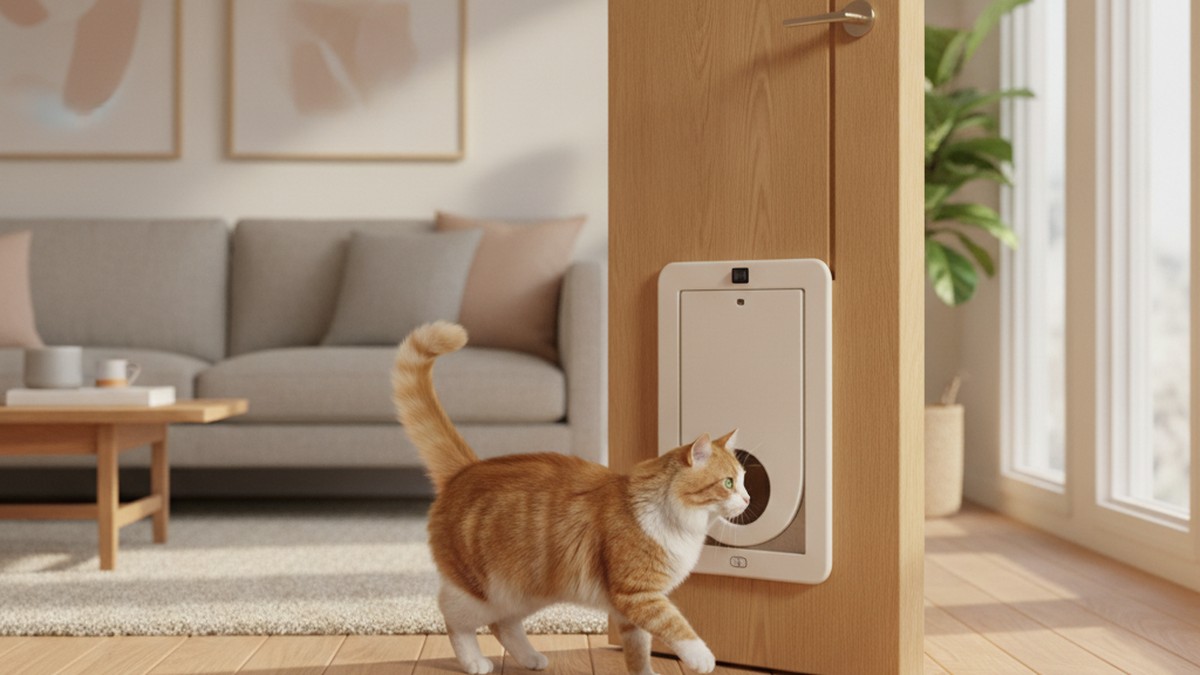
A regular pet flap is just a hole in your door. Any raccoon, neighborhood tomcat, or curious possum can walk right through it. A smart pet door fixes that. Instead of swinging open for anything, it only unlocks for your pet — reading either the microchip already implanted in their neck, an RFID tag clipped to their collar, or (on the newest models) unlocking on a schedule you set from an app on your phone.
For pet owners, that solves three problems at once: it keeps strays and wildlife out, it stops your indoor-only cat from being let out by a wandering neighbor’s pet, and — on the connected models — it tells you exactly when your pet came and went. The market breaks into three real categories: microchip doors that scan the chip your vet already implanted (no collar tag to lose), collar-key RFID doors that read a small fob on the collar, and app-connected doors that add scheduling, remote lock/unlock, and phone notifications on top of the selective entry.
We locked in six genuinely smart pet doors — every one uses microchip, RFID, or app control, and every one is currently listed on Amazon at the price we quote. They range from about $99 to $350. Below we break down which is right for a single indoor cat, a multi-cat household, or a 100-pound dog. If you’re building out a wider connected home, our best smart door and window sensors guide pairs well with a smart pet door for whole-home awareness.
Our Top Picks
SureFlap-Sure Petcare Microchip Pet Door (White) — Best Overall
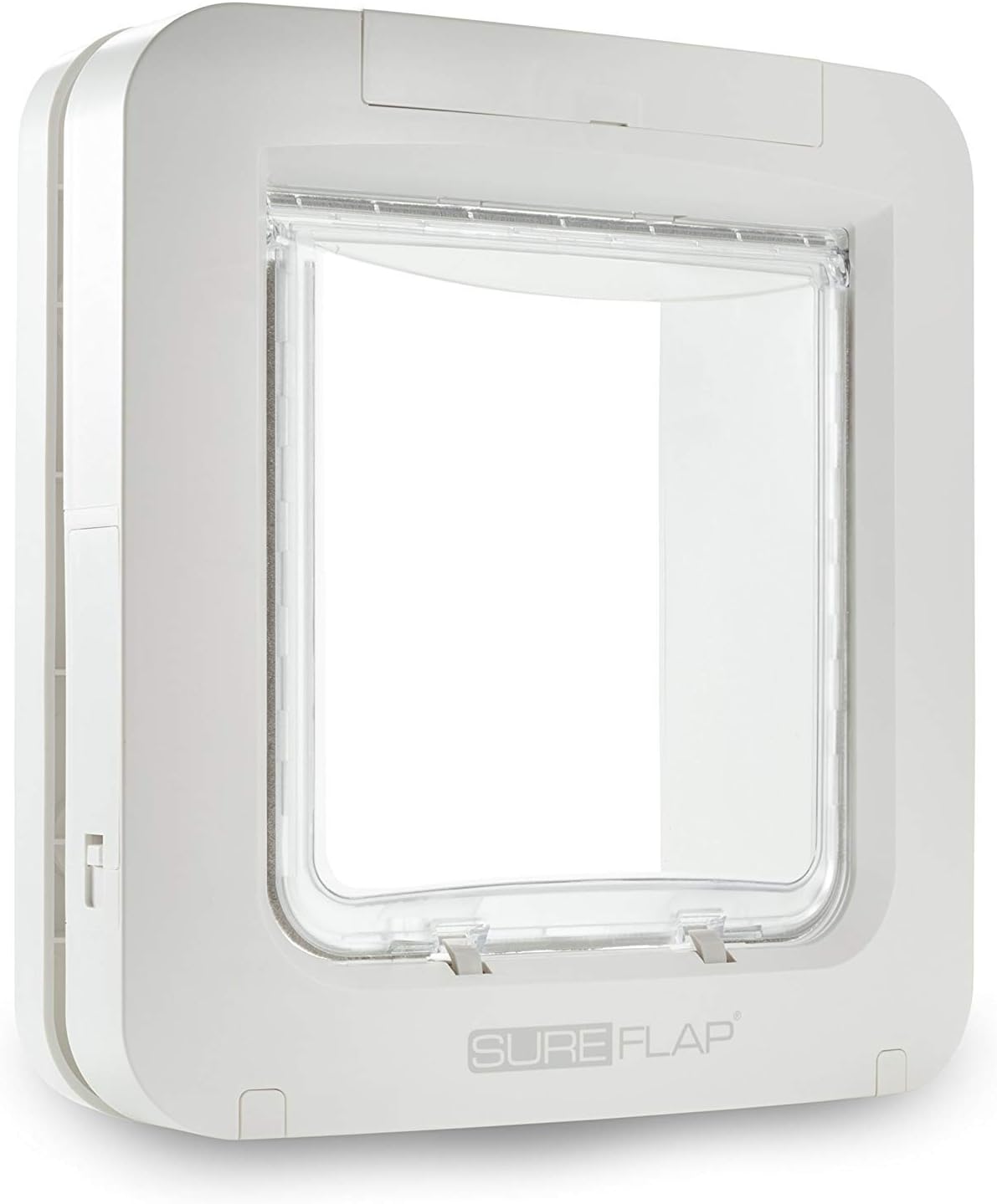
The SureFlap-Sure Petcare Microchip Pet Door earns our top spot because it nails the single most important thing a smart pet door should do: it only opens for your pet, and it does it using the microchip your vet already implanted. No collar tag to buy, lose, or replace. The scanner in the frame reads your pet’s existing 15-digit microchip (it’s compatible with all common chip standards worldwide) and unlocks the flap only when that pet’s head is right up against it.
This is the larger of SureFlap’s two microchip doors, with a 6 11/16” x 7” flap opening sized for large cats and small dogs. It stores up to 32 pets, so a multi-pet household can register the whole crew and lock every stray out. A built-in curfew timer lets you set the door to lock automatically at night — so your cat can come in for the evening but can’t wander back out until morning.
Installation is DIY-friendly: it mounts in wooden or uPVC doors, glass (with the right adapter), and walls using extension tunnels. It runs on 4 C batteries with roughly 12 months of life, and the flap has a magnetic seal and draught excluder to keep weather out. There’s no app on this model — it’s a self-contained selective-entry door — which is exactly why it’s so reliable. Nothing to reconnect to WiFi, no cloud outage, no monthly anything.
Why it stands out: Microchip access (no collar tag), 32-pet memory, and a built-in curfew timer make this the most set-and-forget smart door for cats and small dogs.
Pros:
- Reads your pet’s existing microchip — no collar tag needed
- Stores up to 32 pets
- Built-in curfew timer for automatic night locking
- Larger flap fits large cats and small dogs
- 3-year warranty, ~12-month battery life
- Installs in doors, glass, and walls
Cons:
- No app or notifications (self-contained only)
- Batteries not included (4x C)
- Flap opening may be tight for stocky small dogs — measure first
PetSafe Electronic Dog and Cat Door — Best Budget
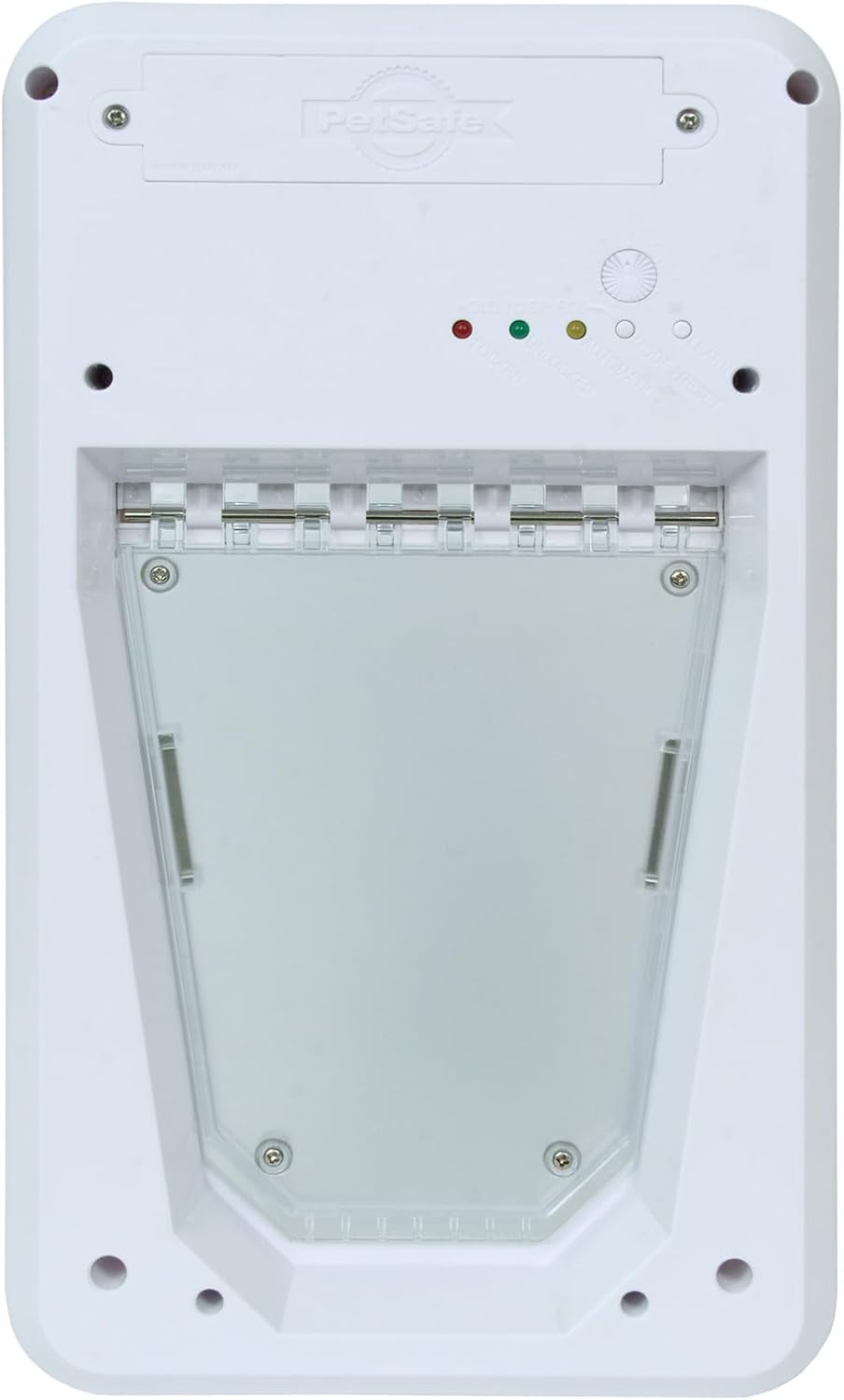
If you want selective entry without spending $200, the PetSafe Electronic Dog and Cat Door is the best value on this list at around $99. Instead of reading a microchip, it uses a small collar sensor key — a battery-powered fob that clips to your pet’s collar. When the pet (and its key) approaches, the door’s electronic latch releases and the flap unlocks. Walk away, and it locks again. Anything without a key stays out.
It’s sized for cats and small dogs 4–15 lb, with a flap opening of about 5 1/2” x 7 7/8”. A dial on the frame gives you four modes: in-only, out-only, both, and fully locked — handy when you want to let your cat out in the morning but keep them in overnight. LED indicators on the frame show the current mode at a glance. It installs in standard interior and exterior doors, and a separate wall kit is available if you’re going through a wall.
The collar-key approach has one trade-off versus microchip: your pet has to wear the fob, and the fob has its own small battery to replace occasionally. But it’s dead simple, there’s no chip-scanning fussiness, and at this price it’s the easiest way to upgrade a dumb flap to a selective one. It’s a natural companion to a smart pet feeder if you’re automating the whole “pet is home alone” routine.
Why it stands out: Real selective entry with a four-mode dial at under $100 — the cheapest way to keep strays out.
Pros:
- Around $99 — the budget pick
- Collar-key RFID keeps other animals out
- Four modes: in-only, out-only, both, locked
- LED status indicators on the frame
- Fits cats and small dogs 4–15 lb
Cons:
- Requires a collar key fob (with its own battery)
- Not microchip-based — key can be lost
- Smaller size range than the microchip doors
- No app or notifications
Cat Mate Elite Microchip Cat Flap with Digital Timer & LCD Display (355) — Best Microchip Cat Flap
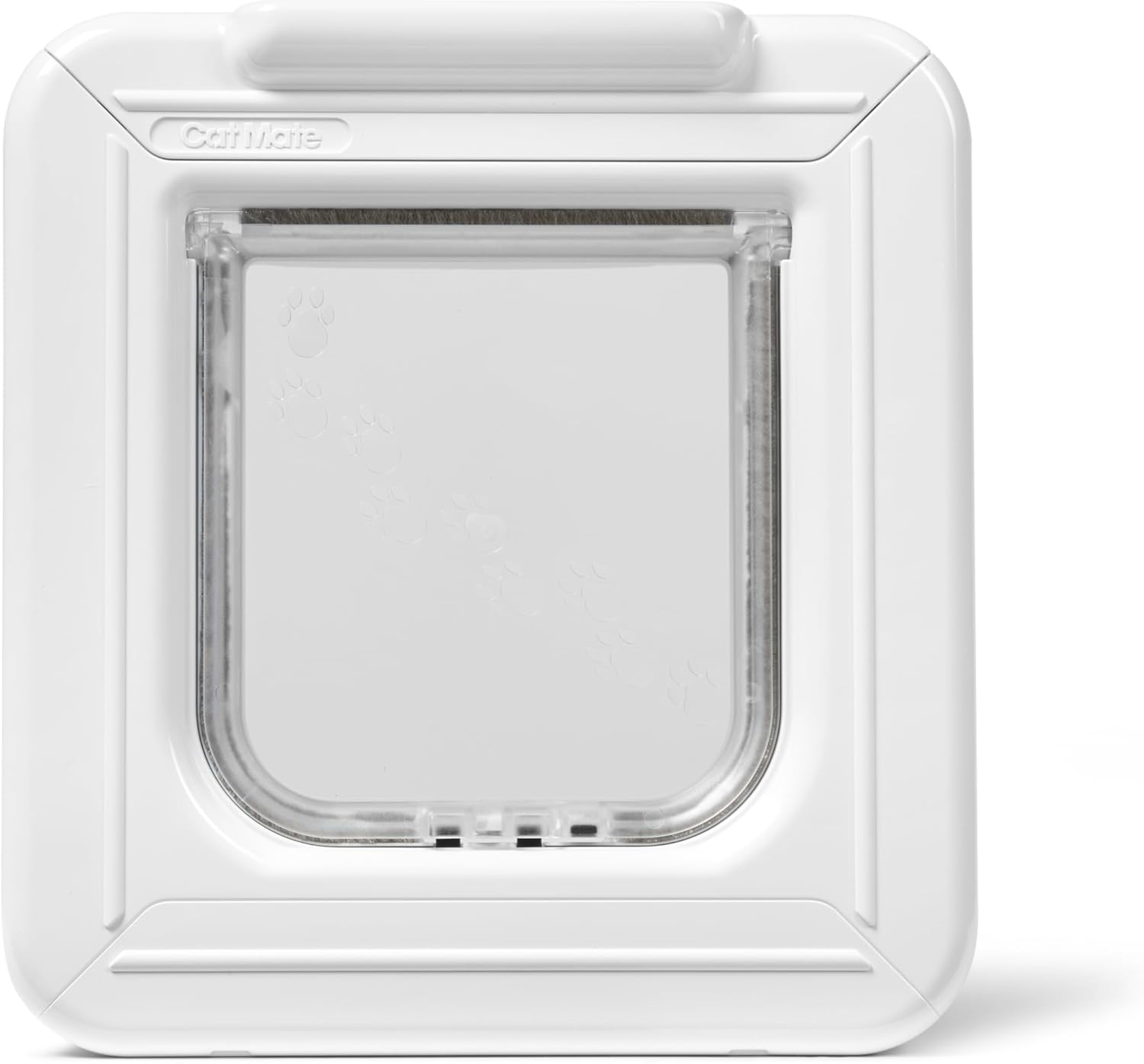
The Cat Mate Elite is the microchip alternative to SureFlap for cat owners, and it does one thing the others don’t at this price: it has an LCD display and digital curfew timer right on the flap. That screen shows entry/exit lock status, which of your cats is in or out, and the time since the door was last used for up to three selected cats. If you like knowing whether the cat is home without pulling out your phone, this is the one — and it’s around $100.
It reads your cat’s implanted microchip (compatible with 15-digit ISO chips) or the included Cat Mate ID disc, and allows access for up to nine cats. The built-in timer lets you program lock/unlock times so your cat is curfewed in overnight automatically. It’s built for small to average-sized cats with a weatherproof, draught-excluding magnetic seal, and it installs cleanly in uPVC doors, glass, wood, and walls (it self-lines up to 4”).
The trade-off versus the SureFlap doors is size: this is a cat flap, not a small-dog door, so it’s meant for cats specifically. But for a cat household that wants microchip security plus an at-a-glance status screen, it’s the standout. It runs on 4 AA batteries.
Why it stands out: Microchip access plus an on-flap LCD timer and status display — the most “informative” cat flap at around $100.
Pros:
- Microchip access — no collar tag required
- LCD display shows in/out status and last use
- Programmable curfew timer built in
- Stores up to nine cats
- Weatherproof magnetic seal, easy multi-surface install
Cons:
- Cat-sized only (not for dogs)
- No app or phone notifications
- 4 AA batteries required
- Smaller flap than the SureFlap pet door
SureFlap DualScan Microchip Cat Door — Best for Indoor/Outdoor Control
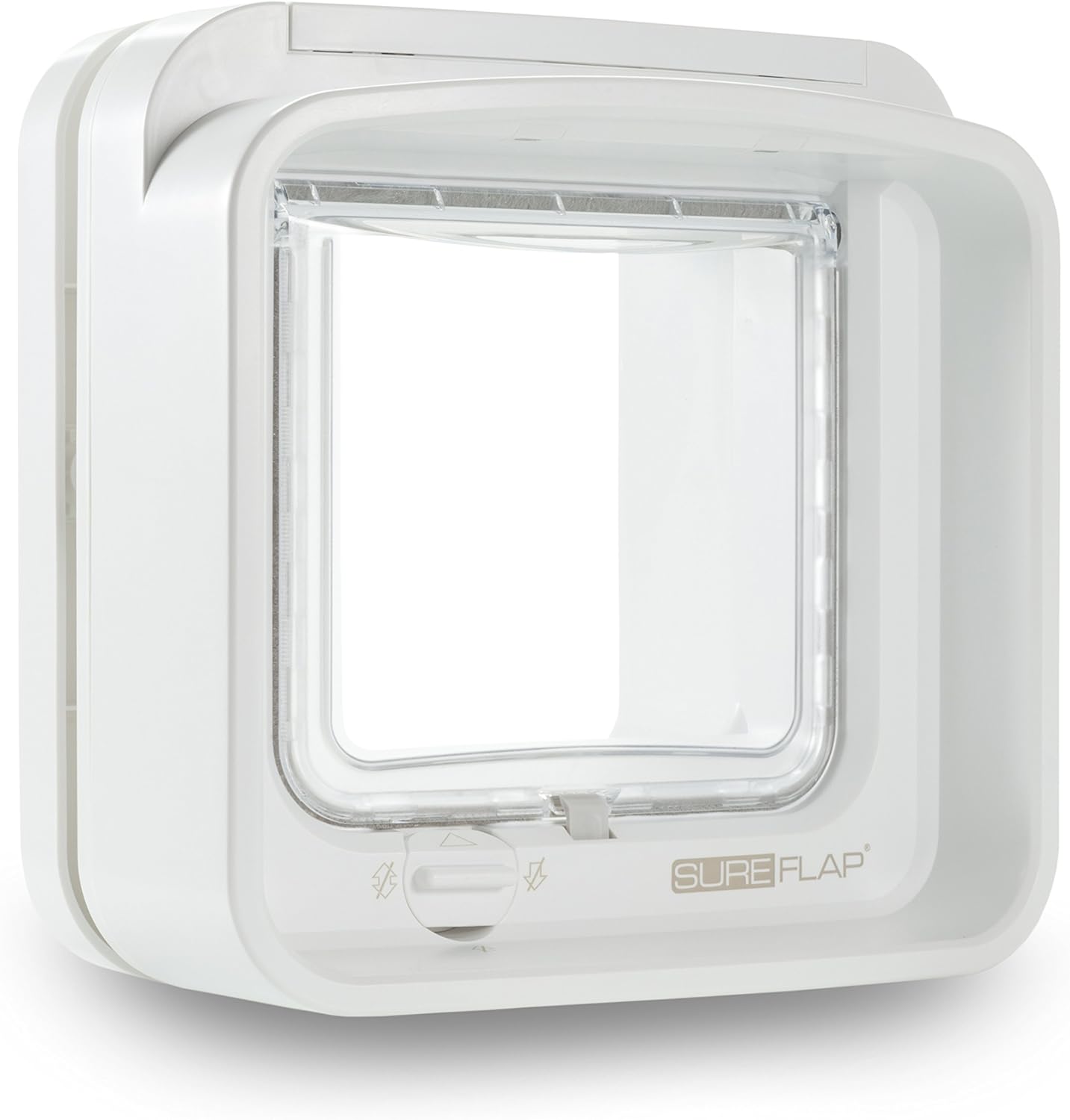
The regular SureFlap door reads the microchip on the way in to keep strays out. The SureFlap DualScan goes further: it scans your cat’s chip on the way out too. That means you can allow some cats outdoor access while keeping others strictly indoors — through the same door. If you’ve got one cat who roams and another who’s indoor-only (or on a recovery/medical restriction), DualScan is the only way to enforce that without separate doors.
You program each registered cat individually — this one can go out, that one can only come in — and the door enforces it per-microchip. It stores multiple pets, reads their existing implanted chips (no tag needed), and has a physical four-way selector dial on the flap for manual in/out/both/locked control on top of the per-cat rules. The flap opening (4 3/4” H x 5 5/8” W) is cat-sized, and it installs in doors, glass, and walls like the rest of the SureFlap line.
It’s roughly the same price as the standard SureFlap door, so the only reason to pick DualScan over Best Overall is if you specifically need selective exit — one indoor cat, one outdoor cat, one door. For a single-cat home, the standard door is simpler. For a mixed household, this is the answer.
Why it stands out: Scans on the way out as well as in, so you can keep one cat indoors while another roams — through a single door.
Pros:
- DualScan reads the chip on exit AND entry
- Per-cat indoor/outdoor permissions
- Microchip-based — no collar tags
- Four-way manual selector dial
- Great for mixed indoor/outdoor households
Cons:
- Cat-sized flap only
- No app (self-contained)
- Overkill for a single-cat home
- Batteries not included
SureFlap Microchip Cat Door Connect with Hub Bundle — Best App-Connected
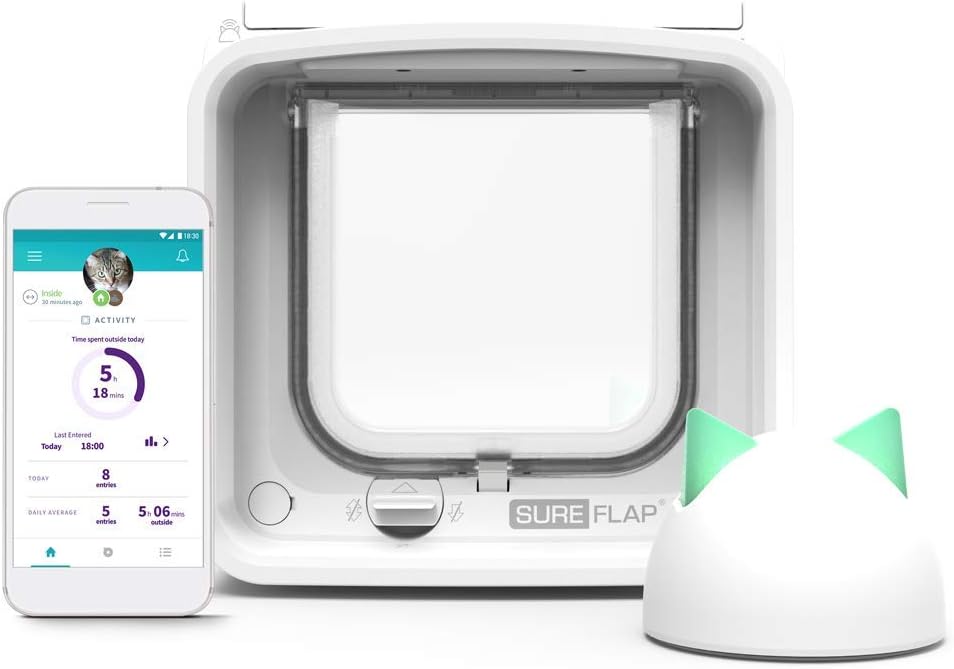
This is the SureFlap microchip door, plus WiFi. The Connect version pairs with the included Hub (that’s the “Bundle” — the hub is in the box, which matters because the hub is required for the app features and is often sold separately). Once the hub is plugged into your router, the Sure Petcare app gives you the piece the standalone doors can’t: real-time notifications every time your cat comes in or goes out, plus a log of activity and time spent outside, and the ability to lock or unlock the door remotely from your phone.
Under the app layer it’s still a proper microchip door — it reads your cat’s implanted chip, stores multiple pets, and keeps strays out exactly like the Best Overall pick. The flap opening is cat-sized (5 5/8” w x 4 3/4” h). If your cat has a habit of going missing for hours, the “your cat has left home / your cat is back” push notification is genuinely reassuring, and being able to lock the door from the couch (or from work) is a real convenience.
It needs 2.4GHz WiFi and the hub connected to your router by ethernet. That’s the trade-off of any connected door: it’s only “smart” while it’s online. But because the microchip scanning happens locally on the door itself, a WiFi hiccup won’t lock your cat out — you just lose the app features until it reconnects. If your WiFi is spotty near the door, a mesh WiFi upgrade helps every connected device in the house, not just this one.
Why it stands out: Microchip security plus phone notifications and remote lock/unlock, with the required hub included in the bundle.
Pros:
- Microchip access + app notifications for every entry/exit
- Remote lock/unlock from your phone
- Activity log and time-outside tracking
- Hub included (no separate purchase)
- Local scanning still works if WiFi drops
Cons:
- Requires the hub connected to your router (2.4GHz WiFi)
- Cat-sized flap only
- App features depend on internet connection
- Pricier than the non-connected SureFlap
PetSafe Never Rust SmartDoor Connected Pet Door (Large) — Best Premium
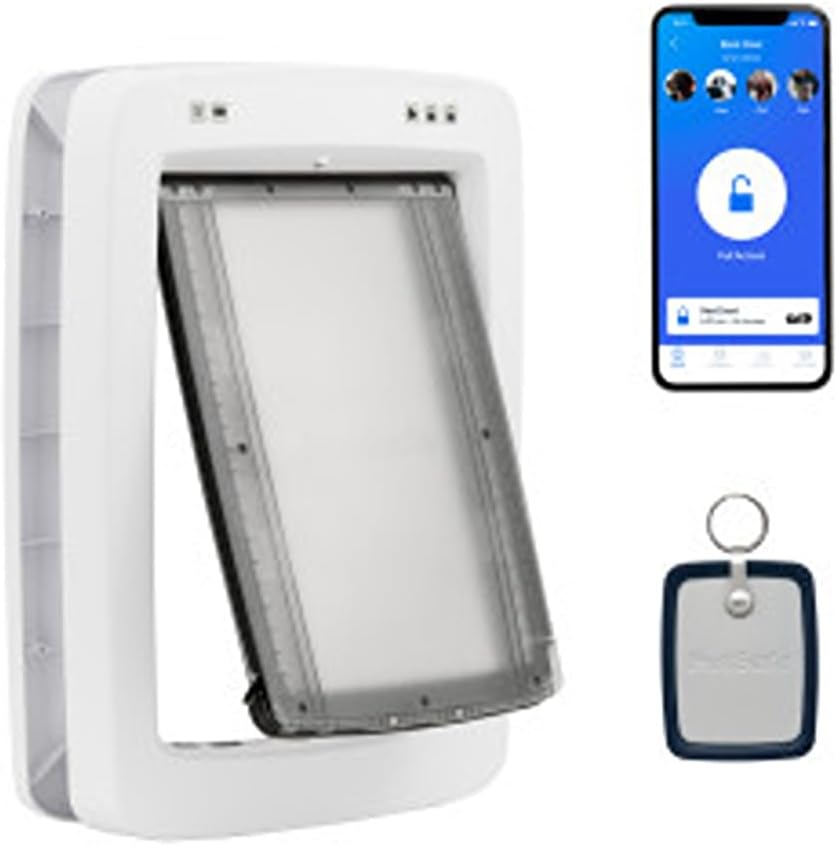
The PetSafe Never Rust SmartDoor Connected is the most fully “smart home” door on this list, and the only one here truly built for dogs as well as cats. This is the Large model, and it uses a collar key with the My PetSafe app layered on top. Through the app you get the full connected-home experience: set individual schedules per pet, get notifications on your phone or smartwatch when a pet comes and goes, and remotely engage the multi-point lock — so if a storm’s rolling in, you can lock the flap from your phone and keep everyone inside.
Because it’s a full pet door rather than a cat flap, the Large size accommodates bigger dogs (there’s also a Medium version). The collar key gives each pet selective, exclusive access, and the app lets you build a schedule — outdoor access during the day, locked at night — that runs automatically. The “Never Rust” frame is built for exterior doors and weather exposure, which matters for a door a dog will use in all conditions.
It needs 2.4GHz WiFi for the connected features and runs on 4 D-cell batteries (a wall adapter is sold separately). At around $350 it’s the priciest pick here, and you’re paying for the app control, the scheduling, and the larger dog-friendly size. For a cat-only home the SureFlap Connect does the connected job for less — but if you have a dog, or want per-pet schedules and remote lock from an app, this is the one. Pair it with a smart litter box and a smart feeder and the pets basically run themselves while you’re out.
Why it stands out: App scheduling, remote lock, phone notifications, and a dog-friendly large size — the most complete connected pet door.
Pros:
- Full app control — schedules, notifications, remote lock
- Works for dogs and cats (Large size)
- Multi-point lock you can engage from your phone
- Per-pet collar keys for selective access
- Weatherproof “Never Rust” frame
Cons:
- ~$350 — the most expensive here
- Collar key required (not microchip)
- Needs 2.4GHz WiFi; wall adapter sold separately
- 4 D-cell batteries required
Comparison Table
| Feature | SureFlap Microchip | PetSafe Electronic | Cat Mate Elite 355 | SureFlap DualScan | SureFlap Connect + Hub | PetSafe SmartDoor Connected |
|---|---|---|---|---|---|---|
| Price | ~$210 | ~$99 | ~$100 | ~$210 | ~$210 | ~$350 |
| Best For | Overall | Budget | Cat flap | In/out control | App-connected | Premium / dogs |
| Access Type | Microchip | Collar-key RFID | Microchip | Microchip (DualScan) | Microchip + app | Collar-key + app |
| App / Notifications | No | No | No | No | Yes (hub) | Yes (WiFi) |
| Remote Lock | No | No | No | No | Yes | Yes |
| Curfew / Schedule | Timer | 4-mode dial | LCD timer | Selector dial | App schedule | App schedule |
| Pet Size | Large cats / small dogs | Cats / small dogs 4–15 lb | Small–avg cats | Cats | Cats | Cats & dogs (Large) |
| Pets Stored | 32 | Multiple keys | 9 | Multiple | Multiple | Multiple |
| Hub / WiFi Needed | No | No | No | No | Hub (2.4GHz) | 2.4GHz WiFi |
| Battery | 4x C | Fob battery | 4x AA | Batteries | Batteries | 4x D |
How to Choose the Right Smart Pet Door
Picking the right smart pet door comes down to a few key questions:
Microchip, collar-key, or app? This is the biggest decision. Microchip doors (SureFlap, Cat Mate) read the chip your vet already implanted — nothing to clip on, nothing to lose. Best for cats, since almost every cat is chipped. Collar-key RFID doors (PetSafe Electronic) read a fob on the collar — cheaper and simpler, but your pet has to wear the key and its little battery. App-connected doors (SureFlap Connect, PetSafe SmartDoor Connected) add scheduling, notifications, and remote lock on top of selective entry — the “smart home” tier.
Do you need a hub? The SureFlap Connect’s app features only work with its hub plugged into your router — the good news is the bundle we picked includes it, so you’re not buying it separately. The PetSafe SmartDoor Connected talks to WiFi directly (2.4GHz), no separate hub. If you buy a bare “Connect Without Hub” version by mistake, you get a door with no app until you add the hub — so make sure you’re getting the bundle.
Cat or dog? Most smart doors are cat-sized. If you have a small dog, the standard SureFlap Microchip Pet Door (large flap) works. For a medium-to-large dog, the PetSafe SmartDoor Connected (Large) is the pick — it’s the only door here truly built for bigger dogs. Always measure your pet’s width and shoulder height against the listed flap opening before buying; a flap that’s too small is the #1 return reason.
Where are you installing it? All six install in standard wooden doors. For glass (like a patio door) you’ll usually need an adapter and a glazier to cut the hole — factor that cost in. For walls, you’ll need an extension tunnel kit to bridge the wall thickness. Exterior installs should use a weatherproof model (the “Never Rust” PetSafe and the SureFlap magnetic-seal doors handle weather well).
Do you need indoor/outdoor control? If one cat roams and another must stay in, the SureFlap DualScan is the only door here that scans on exit — letting you set per-cat outdoor permissions. A single-mode door can’t do that.
How much do notifications matter? If you just want to keep strays out, a self-contained microchip door is more reliable and cheaper — nothing to reconnect. If you want “your pet just came home” pings and remote lock, step up to a connected model and accept the WiFi dependency. The scanning still happens locally, so a dropped connection won’t lock your pet out.
FAQ
What’s the difference between a microchip pet door and an RFID collar-key door? Both are RFID — the difference is what they read. A microchip door scans the tiny chip already implanted under your pet’s skin (the one your vet put in), so there’s nothing to wear. A collar-key door reads a small fob clipped to the collar. Microchip is more convenient (nothing to lose) and best for cats; collar-key is usually cheaper and is the norm on dog-sized doors like the PetSafe models.
Will a smart pet door keep raccoons and stray cats out? Yes — that’s the whole point. The flap stays locked unless it detects your pet’s specific microchip or collar key. A raccoon, opossum, or neighbor’s cat walks up and the door simply won’t open. This is the main reason people upgrade from a plain flap, especially in areas with wildlife or a lot of outdoor cats.
Do these work if my WiFi or the internet goes down? The self-contained doors (SureFlap Microchip, DualScan, Cat Mate Elite, PetSafe Electronic) don’t use WiFi at all, so nothing changes. The connected doors (SureFlap Connect, PetSafe SmartDoor Connected) do the actual microchip/key scanning locally on the door, so your pet can still get in during an outage — you just temporarily lose the app notifications and remote lock until it reconnects. Your pet won’t get locked out by a WiFi hiccup.
Can I install a smart pet door myself? For a standard wooden or uPVC door, yes — most owners cut the hole with the included template and mount it in an afternoon. Glass doors are the exception: cutting tempered glass is a job for a glazier, so budget for that. Walls need an extension tunnel kit to span the wall thickness. Measure twice, cut once — the hole can’t be un-cut.
How long do the batteries last? It varies by model and traffic. The SureFlap Microchip door is rated around 12 months on 4 C batteries. The Cat Mate Elite (4 AA), PetSafe Electronic (collar-key fob plus door), and connected doors (4 D-cell for the PetSafe SmartDoor Connected) generally run several months to a year depending on how often the door is used. Connected models draw a bit more because of the WiFi radio; some offer an optional wall adapter to skip batteries entirely.
My cat is indoor-only — is a smart door still useful? It can be. A model with a curfew timer or app schedule (SureFlap Microchip, Cat Mate Elite, or either connected door) lets a mostly-indoor cat have supervised outdoor time on a schedule, then locks automatically. And the DualScan specifically lets you keep one cat indoors while another goes out — through the same door. If your cat is strictly indoor with no yard access, you may not need a pet door at all.