Quick Picks
Short on time? Here are our top recommendations:
- WaterGuru Sense S2 (~$300) — Best overall, drops in your skimmer and tests chlorine, pH, CYA, and alkalinity automatically
- AIPER HydroComm Smart Pool Monitor (~$200) — Best new release for 2026, 5-in-1 testing with app coaching from a major pool brand
- iopool Smart Water Monitor (~$200) — Best for chlorine and bromine pools, no subscription, precise dosage instructions
- kactoily Digital Pool Water Tester with App (~$150) — Best budget, 7 parameters including salinity and ORP, magnetic charging
- WaterGuru Sense Smart Pool Monitoring System (~$250) — Best original-generation choice if S2 is out of stock
- WaterGuru SENSE S2E-PS Smart Pool & Hot Tub Monitor (~$500) — Best premium for vacation homes and multi-pool monitoring
Pool season is a few weeks away, and if you’ve owned a pool for more than one summer you already know the routine. Pull a sample, count drops of reagent, squint at the color chart, guess. Or worse, dip a strip and try to convince yourself it’s between the two yellow squares. Then drive to the pool store, hand them the same water, get a slightly different reading, and walk out with $80 worth of chemicals you might not actually need.
Smart pool monitors fix this. They’re battery-powered or rechargeable devices that float in the skimmer or in the pool itself, run automatic chemistry tests on a schedule (anywhere from every 15 minutes to a few times per day), and push the readings to an app on your phone. The good ones don’t just give you numbers — they tell you what to add and how much, in plain English, based on your pool’s actual size and current state. That’s the leap that makes them worth the money: less guessing, fewer trips to the pool store, and noticeably fewer “oh no, the pool turned green overnight” weekends.
If you’ve already added a robot pool cleaner and a smart sprinkler controller to the yard, a water monitor is the obvious next step — it’s the brain that tells you what your already-clean pool actually needs. We pulled six of the most credible smart pool monitors currently available on Amazon, looked at how they actually work day-to-day, and broke down the tradeoffs. Here’s what’s worth your money heading into the 2026 swim season.
Our Top Picks Reviewed
WaterGuru Sense S2 Smart Pool Monitor — Best Overall
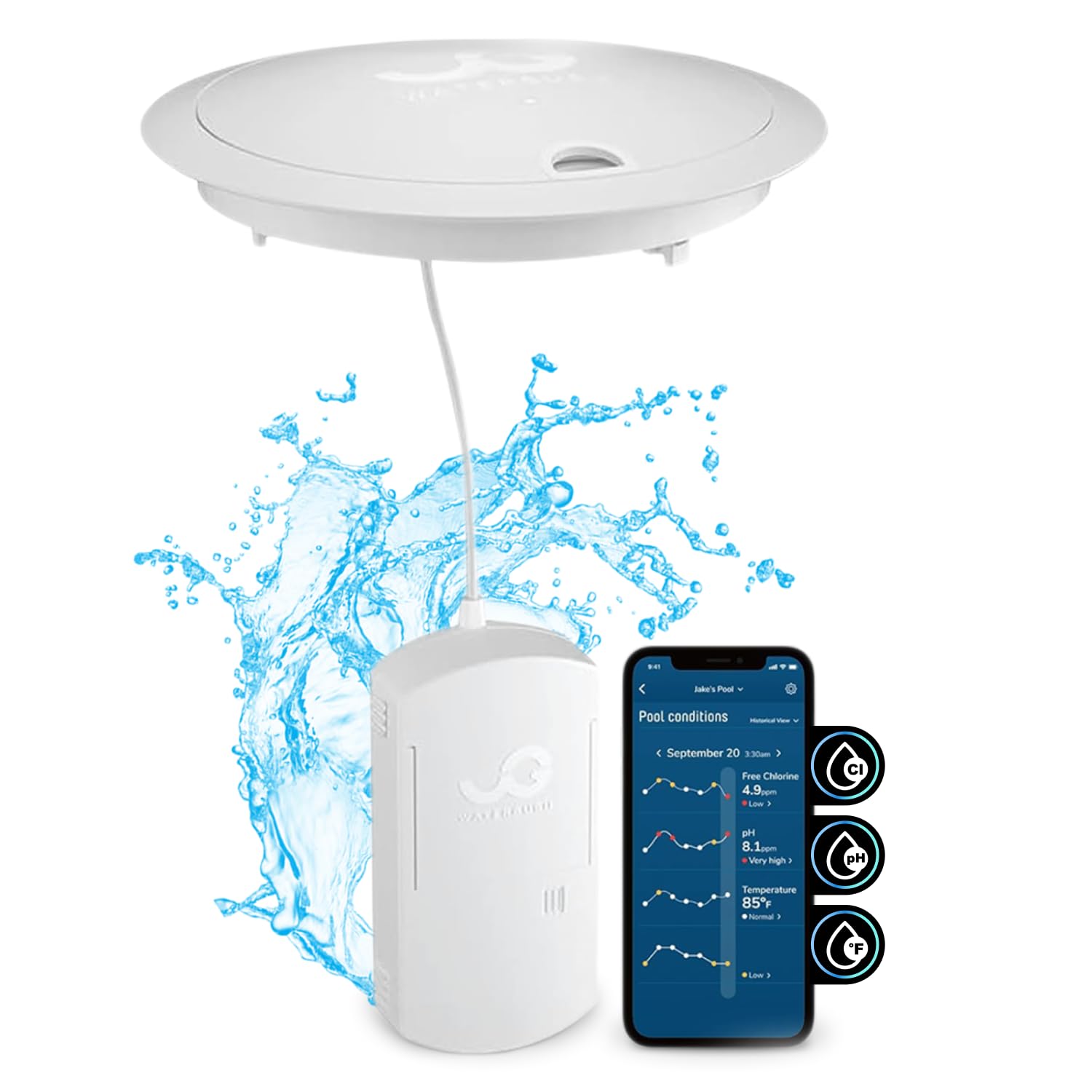
The WaterGuru Sense S2 is the smart pool monitor most pool owners should buy. WaterGuru pioneered the “drop it in the skimmer” form factor, and the S2 is the second-generation refinement of the design. It uses a replaceable cassette (the C5) loaded with reagent that runs an actual chemistry test daily, which is fundamentally more accurate than the optical or electrochemical sensors most floating monitors use.
Setup takes about ten minutes. You unbox the unit, pop in the C5 cassette and batteries, drop the device into your skimmer (it floats, you don’t need to mount anything), pair to your home Wi-Fi via the WaterGuru app, and you’re done. The next time your pool pump runs, the Sense S2 pulls in a water sample, runs the test, and pushes results to the app. It tracks chlorine, pH, cyanuric acid (CYA), and total alkalinity — the four numbers that actually matter for pool chemistry.
The app is where the WaterGuru really earns the price. Instead of dumping numbers on you, it tells you exactly what to add — for example, “add 12 oz of chlorine and 6 oz of muriatic acid” — based on your pool’s gallons and current readings. For anyone who’s stared at a Taylor test kit wondering what to do with a pH of 7.8, this is night-and-day better.
The cassette is the recurring cost to be aware of. A C5 cassette runs each daily test and lasts about 2 to 3 months depending on how often your pump runs. Plan on replacement cassettes a few times per swim season. Most owners say it still costs less than what they used to spend on pool-store testing.
Key Features:
- Drops into standard pool skimmer, no mounting required
- Daily chemistry test using replaceable C5 reagent cassette
- Tracks chlorine, pH, CYA, and alkalinity
- Wi-Fi enabled with iOS and Android app
- Plain-English dosing recommendations based on your pool size
- AA battery powered, 6 to 12 month battery life
Pros:
- Most accurate residential smart monitor on the market
- Skimmer placement means it works during normal pump cycles
- App tells you exactly what chemicals to add and how much
- Tracks the four parameters that actually matter
- No subscription required
Cons:
- Replacement cassettes are an ongoing cost
- Requires a working skimmer (not a fit for above-ground pools without one)
- Daily test cadence is plenty for most pools but slower than 15-minute monitors
AIPER HydroComm Smart Pool Monitor — Best New Release for 2026
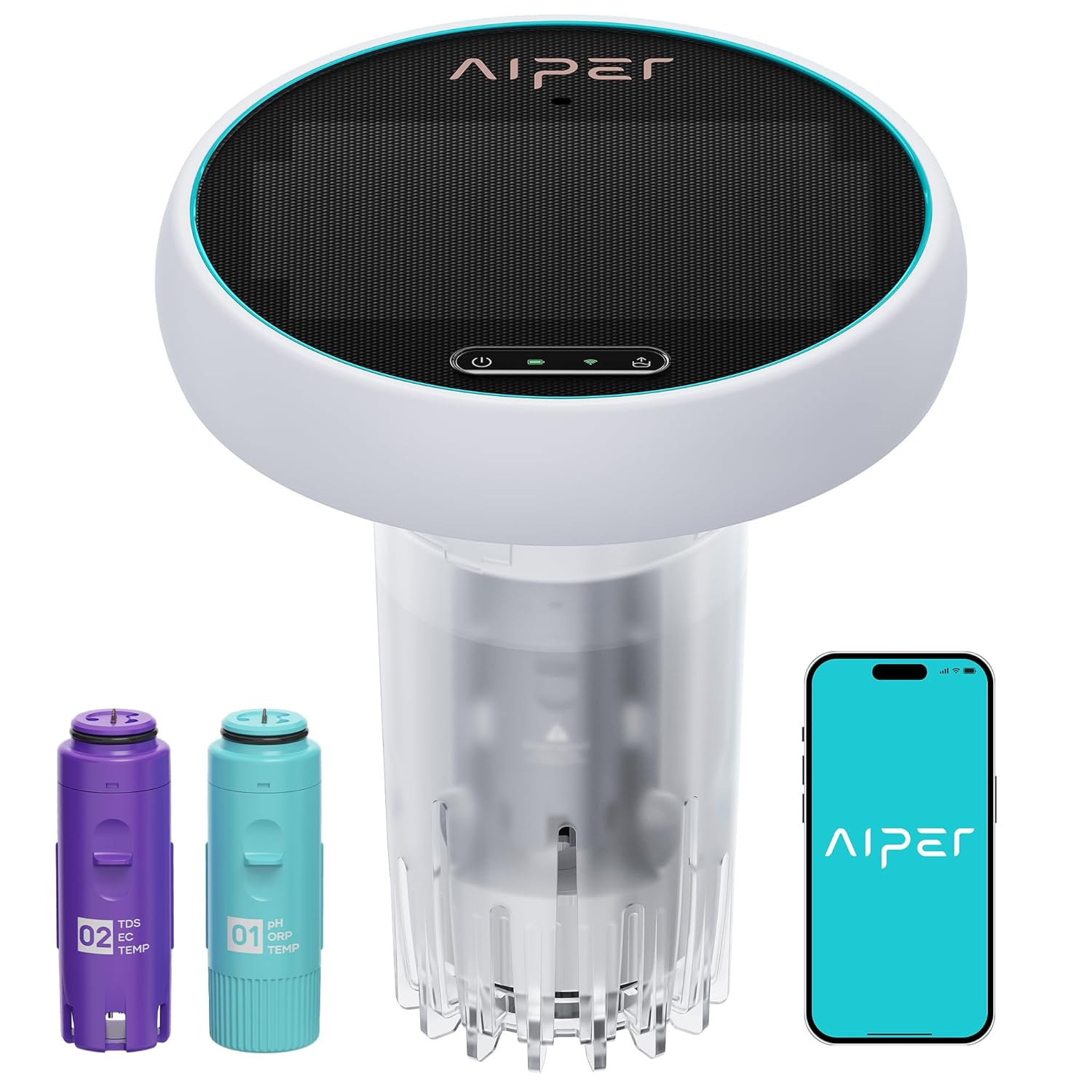
AIPER is best known for cordless robot pool cleaners (the Scuba S1 is in our robot pool cleaner roundup), and the HydroComm is their first push into water monitoring. It’s a floating sensor-based monitor — no cassette, no recurring reagent cost — that tracks five parameters: chlorine, pH, ORP, salinity, and temperature. Because AIPER already has a major app ecosystem for their cleaners, the HydroComm plugs into the same app on day one, which is a real convenience if you already own AIPER hardware.
The hardware is the typical floating-puck format that’s become standard in the category. You charge it via USB, drop it in the pool, and it transmits readings to your home Wi-Fi (no separate hub required). Tests run automatically on a schedule, and the app translates the numbers into “your pool needs X amount of Y” recommendations, the same way WaterGuru does. The white version is the version most people will want for aesthetics — a blue version (B0GPVYJDXR) exists for the same price if you prefer it.
The reason this is the “best new release” pick rather than the “best overall” pick is the long-term track record. WaterGuru has years of in-the-field data and a proven cassette-based chemistry test. AIPER’s HydroComm is brand new, sensor-based (which historically has been less accurate than reagent tests for free chlorine), and unproven over multiple swim seasons. If you trust AIPER’s track record on pool robots, the HydroComm is a strong, no-subscription, no-cassette alternative. If you want maximum accuracy, the WaterGuru is the safer bet.
Key Features:
- 5-in-1 sensor: free chlorine, pH, ORP, salinity, temperature
- App control via the AIPER app (same app as their robot cleaners)
- 24/7 automatic water testing
- USB rechargeable, no batteries to replace
- No reagent cassettes or subscription
- Personalized chemical-dose recommendations
Pros:
- No recurring cost (no cassettes, no subscription)
- Works with the existing AIPER app if you own their cleaners
- Five parameters including ORP and salinity (good for salt pools)
- Cleaner aesthetic than most floating monitors
- USB-C charging is convenient
Cons:
- New product, limited multi-season durability data
- Sensor-based free chlorine reading is generally less precise than reagent
- App ecosystem is solid but newer than WaterGuru’s
iopool Smart Water Monitor — Best for Chlorine and Bromine Pools
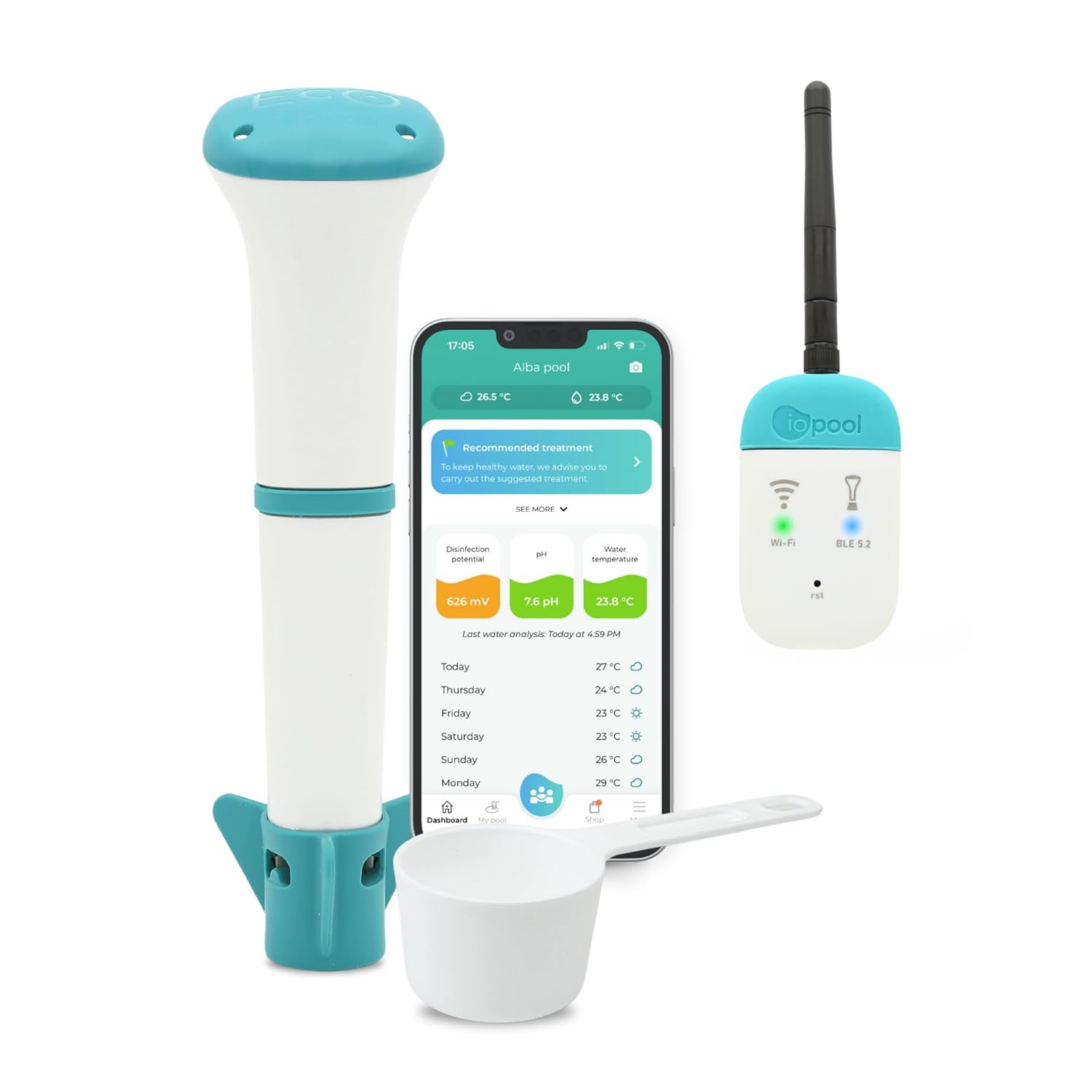
The iopool Smart Water Monitor is a Belgian-made floating monitor that has built a strong following among pool owners who want accurate chemistry without a recurring cassette cost. It’s specifically designed to handle both chlorine and bromine sanitizer systems, which makes it the best pick if you have a hot tub or spa that uses bromine, or if you switch between sanitizers across the season.
The monitor itself is a small, neutral-colored floating puck that sits in the pool full-time. It tests pH, ORP (a strong proxy for sanitizer effectiveness), and temperature on a continuous basis and pushes readings to the iopool app via Wi-Fi. You enter your pool’s volume and sanitizer type during setup, and the app then translates raw readings into dosage instructions — for example, “add 12 oz of chlorine to reach optimal” — calibrated for your specific pool and the chemicals you actually use.
What sets iopool apart is the dosage precision. Many sensor-based monitors give you a vague green-yellow-red status. The iopool app gives you specific quantities in ounces or milliliters, broken down by chemical type, and tells you when to retest. It’s also subscription-free, which matters because some competitors started gating advanced features behind monthly fees in the last year.
The honest tradeoff is that iopool measures sanitizer indirectly via ORP rather than directly via free chlorine, which means it’s measuring how effective your sanitizer is rather than its concentration. For most pool owners, ORP is actually a more useful metric — but if you specifically want a free-chlorine ppm number for compliance or pool-store comparison, you’ll get that more directly from the WaterGuru.
Key Features:
- Floating monitor, no skimmer mount required
- Works for chlorine and bromine pools, hot tubs, and swim spas
- Continuous monitoring of pH, ORP, and temperature
- iOS and Android app with precise dosage recommendations
- No subscription, no replaceable reagent cassettes
Pros:
- One of the only smart monitors specifically rated for bromine
- Continuous (not just daily) monitoring catches problems faster
- Truly subscription-free
- Strong dosage instructions in actual measurement units
- Works in pools, hot tubs, and swim spas
Cons:
- ORP rather than direct free-chlorine reading takes some getting used to
- Initial calibration period of a few days before readings stabilize
- Smaller US support footprint than WaterGuru
kactoily Digital Pool Water Tester with App — Best Budget
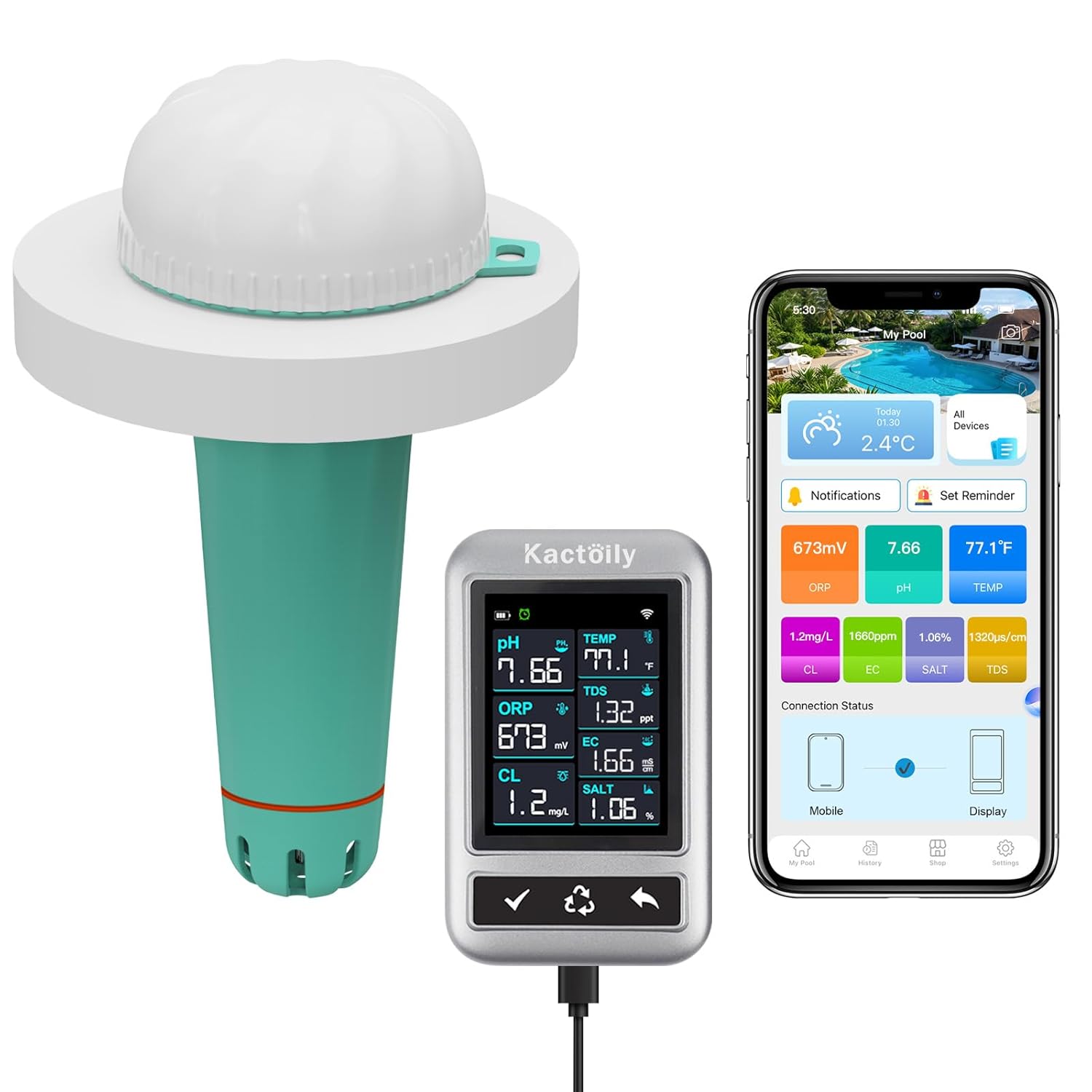
If you want a smart pool monitor under $200 and you can live with a smaller brand, the kactoily Digital Pool Water Tester is the best budget option currently on Amazon. It tracks seven parameters — chlorine, pH, salinity, ORP, EC (electrical conductivity), TDS (total dissolved solids), and temperature — which is actually more parameters than most monitors twice the price. It’s a floating puck with magnetic charging (no charging port to fail or leak) and pushes real-time alerts to the app when any value drifts out of range.
This is the best fit for an owner who wants to start tracking pool chemistry without committing to the WaterGuru cassette ecosystem. Setup is the standard pair-to-Wi-Fi-via-app flow. Once it’s running, you’ll get notifications when chlorine drops, pH drifts, or salinity goes out of range — useful for catching problems before they turn into algae blooms.
The honest caveat is that this is a less-established brand than WaterGuru, AIPER, or iopool. The hardware looks well-made and the parameter list is impressive, but you should expect less long-term firmware support and a smaller community of users to compare notes with. For a first smart monitor — especially if you’re not sure you want to commit to recurring cassette costs — it’s a low-risk way to test the category.
Key Features:
- 7-in-1 testing: chlorine, pH, salinity, ORP, EC, TDS, temperature
- Real-time alerts via app when any value goes out of range
- Magnetic charging (no exposed charging port)
- Works in pools, hot tubs, and spas
- Lower price than the major brands
Pros:
- Most parameters of any monitor in this roundup
- Magnetic charging reduces failure points
- Real-time alerts for fast response
- Strong starter price for the category
- Works for salt water systems out of the box
Cons:
- Smaller brand with less long-term track record
- App polish lags behind WaterGuru and iopool
- Sensor accuracy in real-world long-term use is less proven
WaterGuru Sense Smart Pool Monitoring System — Best Original-Generation Choice
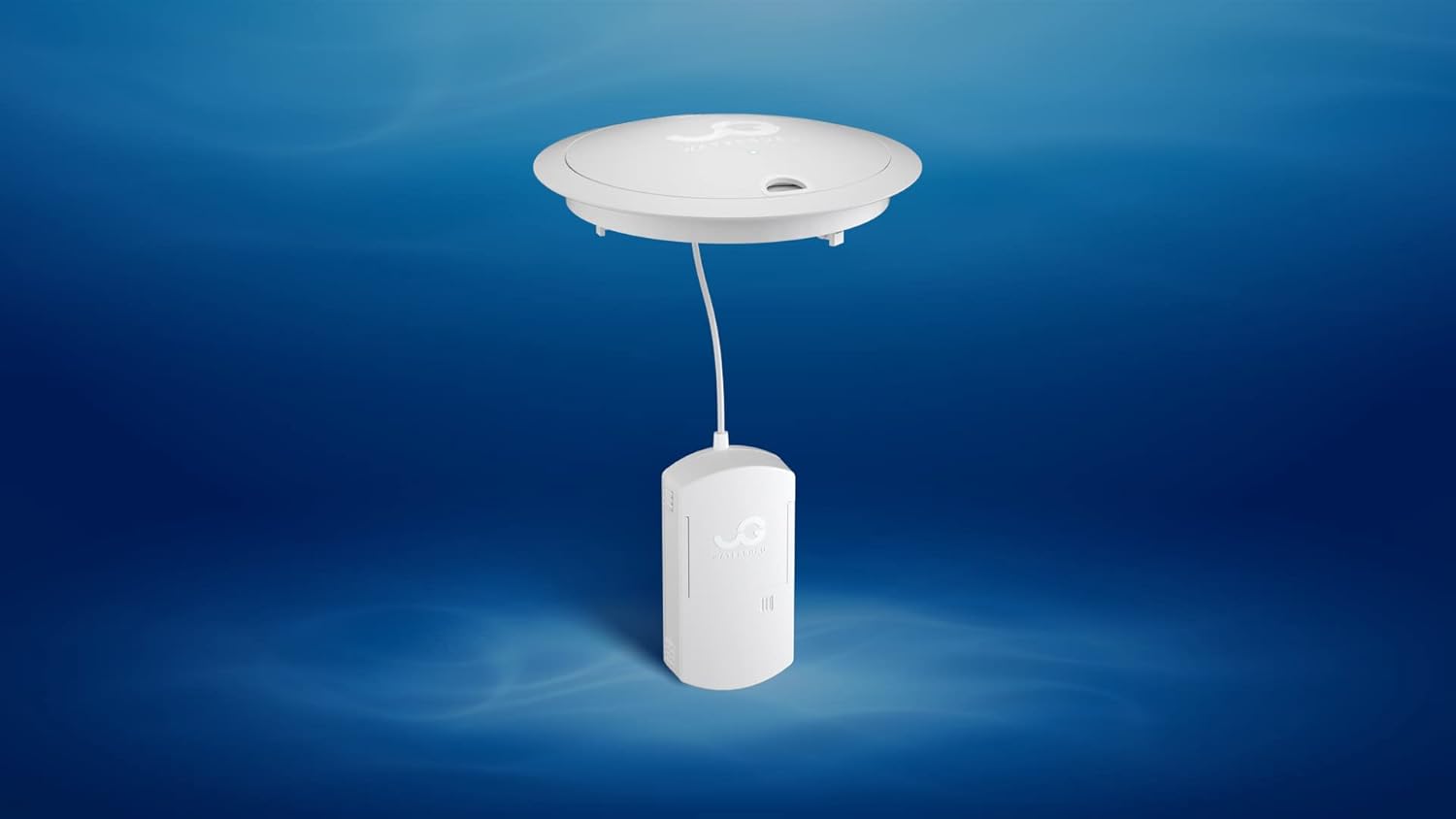
The original WaterGuru Sense (the model the S2 replaced) is still on Amazon and still a credible buy if the S2 is out of stock or you find it on a deal. It uses the same skimmer-drop form factor and the same plain-English dosing app. The main differences from the S2 are that it tests chlorine and pH only (not the four-parameter set the S2 covers), and it uses the older C1 cassette rather than the newer C5.
For pool owners who don’t care about CYA and total alkalinity tracking — typically because they manage those manually a few times a season and don’t need an automatic check — the original Sense covers the two parameters that drift the most week to week. It’s also a good pick for a vacation home or rental property where a simpler “is the chlorine still in range?” alert is the main use case.
If you’re choosing between the original Sense and the S2 at similar prices, get the S2. The four-parameter coverage is worth it. But if the original is meaningfully cheaper or in stock when the S2 isn’t, it’s still one of the best smart pool monitors you can buy.
Key Features:
- Same skimmer-drop form factor as the S2
- Tests free chlorine and pH automatically
- Dosing recommendations via the WaterGuru app
- C1 reagent cassette (not interchangeable with S2’s C5)
- Wi-Fi enabled, AA battery powered
Pros:
- Proven hardware with multiple full seasons of field data
- Same plain-English dosing app as the S2
- Often available when the S2 isn’t
- Lower entry price when discounted
Cons:
- Two parameters instead of four (no CYA or alkalinity)
- Older cassette ecosystem
- Most owners should still buy the S2 at full price
WaterGuru SENSE S2E-PS Smart Pool & Hot Tub Monitor — Best Premium for Vacation Homes
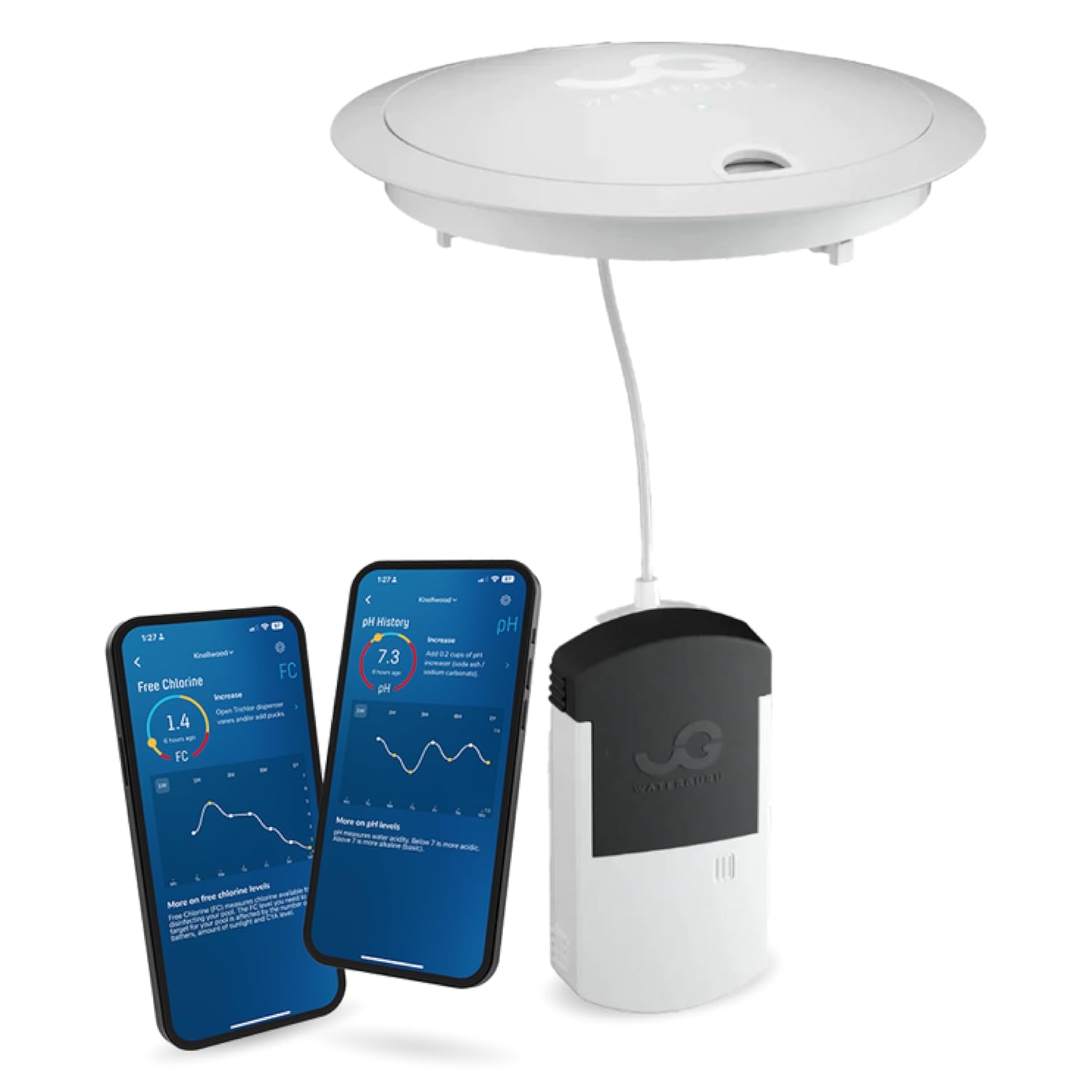
The WaterGuru SENSE S2E-PS is the step-up model designed for owners who manage more than one pool — vacation properties, rental homes, multiple residences — or who just want the most aggressive testing schedule available in a residential monitor. It runs the same skimmer-based chemistry test as the S2 but adds scheduled testing up to multiple times per day, AI dosing recommendations, and proper data logging that lets you pull historical trends across the season.
The “PS” version is the residential-vacation property variant of WaterGuru’s pro line. If you have a pool at a second home or a rental that you can’t physically check on every weekend, this is the monitor that lets you keep tabs from a phone hundreds of miles away. The data logging matters because it gives you a season-long view of how your pool reacts to weather, bather load, and chemical additions — useful for figuring out whether a slow chlorine drift is the heat, the rain, or a leak somewhere in your circulation.
This is overkill for a single backyard pool you swim in three times a week. The standard S2 covers that case completely. But for owners managing multiple pools or who want pro-grade monitoring for a vacation property, the S2E-PS is the clear pick.
Key Features:
- All S2 capabilities plus multi-pool monitoring
- Scheduled testing up to 8 times per day
- AI-driven dosing recommendations
- Full historical data logging and trend analysis
- Designed for residential and vacation property use
- Same skimmer-drop installation
Pros:
- Best monitor for second homes and vacation rentals
- Most aggressive testing cadence in the residential lineup
- Data logging is genuinely useful for pattern analysis
- Same proven WaterGuru hardware platform
- Multi-pool support in one app
Cons:
- Significant price premium over the standard S2
- Overkill for a single backyard pool
- Same cassette consumable cost as the S2
Comparison Table
| Model | Parameters | Test Cadence | Reagent Cost | Best For |
|---|---|---|---|---|
| WaterGuru Sense S2 | Cl, pH, CYA, alkalinity | Daily | C5 cassette every 2-3 mo | Most pool owners |
| AIPER HydroComm | Cl, pH, ORP, salinity, temp | 24/7 sensor | None | AIPER cleaner owners |
| iopool Smart Water Monitor | pH, ORP, temp | Continuous sensor | None | Chlorine + bromine pools |
| kactoily Digital Pool Tester | 7-in-1 incl. Cl, pH, salinity, ORP, EC, TDS, temp | Real-time sensor | None | Budget / starter |
| WaterGuru Sense (original) | Cl, pH | Daily | C1 cassette every 2-3 mo | Backup / vacation rental |
| WaterGuru SENSE S2E-PS | Cl, pH, CYA, alkalinity | Up to 8x daily | C5 cassette every 2-3 mo | Multi-pool / vacation home |
How to Choose a Smart Pool Monitor
Reagent vs Sensor: The Big Decision
The single most important choice in smart pool monitors is reagent-based versus sensor-based testing.
Reagent-based monitors (WaterGuru) use a small chemistry cassette that runs an actual chemistry test, the same way a Taylor test kit or a pool-store test does. The result is significantly more accurate, especially for free chlorine. The downside is the cassette is a consumable — plan on replacing it a few times per swim season.
Sensor-based monitors (AIPER, iopool, kactoily) use electrodes and optical sensors to measure water properties directly and infer chemistry. The hardware never needs reagent replacement, so total ownership cost is lower. The tradeoff is that sensor measurements drift over time, especially for free chlorine in chlorinated pools, and need periodic calibration.
For most pool owners, reagent-based wins on accuracy. For owners who don’t want to deal with cassette replacements or who run bromine systems where sensors handle the workload well, sensor-based is the better fit.
Pool Type: Chlorine, Salt, or Bromine
Not every monitor handles every sanitizer system equally well.
Chlorine pools: Any monitor in this roundup will work. WaterGuru Sense S2 is the most accurate for free chlorine.
Salt water pools: Any of the sensor-based monitors with salinity tracking (AIPER HydroComm, kactoily) is a strong fit because you can monitor salt level directly. The WaterGuru works on salt pools too — it just doesn’t track salinity as a parameter.
Bromine pools and spas: iopool is explicitly rated for bromine. Most other monitors are chlorine-first and may or may not give accurate readings on bromine systems. If your hot tub or spa uses bromine, iopool is the safe pick.
Skimmer or Floating
WaterGuru models live in your pool’s skimmer basket. They work great in any pool with a functional skimmer (most in-ground pools), but they’re not a fit for above-ground pools without a skimmer. Floating monitors (AIPER, iopool, kactoily) drop into the water and drift around, which works in any pool type including above-ground.
App Quality and Dosing Recommendations
The whole point of a smart monitor is that the app turns numbers into actions. Look for “add X oz of Y chemical” recommendations rather than just raw readings. WaterGuru and iopool both deliver this well. AIPER is solid. kactoily gives you the data but is less polished on the dosing side.
Subscription Status
This is changing fast in the category. As of early 2026, all six monitors in this roundup are subscription-free for core functionality. WaterGuru and iopool both have optional premium tiers for advanced features. AIPER and kactoily are fully free. If subscription-free is non-negotiable, iopool is the cleanest pick.
Battery vs Rechargeable
WaterGuru models use AA batteries that last 6 to 12 months. AIPER, iopool, and kactoily are USB or magnetic-charging rechargeable. Both work. Rechargeable means no battery purchases but more frequent attention (monthly to seasonal recharge depending on the model). AA batteries mean less frequent maintenance but you do have to remember to keep spares around.
Frequently Asked Questions
Are smart pool monitors actually accurate?
The reagent-based ones (WaterGuru) are very close to professional pool-store testing for the parameters they cover. Sensor-based monitors are accurate enough for day-to-day decisions but can drift over weeks and months, especially for free chlorine. For high-stakes decisions (opening the pool, closing the pool, troubleshooting a problem), confirm with a Taylor test kit or pool-store test. For routine “do I need to add chlorine today” decisions, the smart monitor is enough.
Do I still need to test the pool with strips or a Taylor kit?
Less often. Most owners with a smart monitor still keep a strip pack on hand for spot checks and reduce manual testing from weekly to roughly monthly. If you suspect a sensor calibration issue, do a manual test to compare. The Taylor K-2006 is still the gold standard for confirming your monitor is accurate.
How long do these monitors last?
Expect 2 to 4 swim seasons from a smart pool monitor. The most common failure points are battery (on rechargeables) and sensor drift (on sensor-based units). WaterGuru has the strongest replacement-program ecosystem if hardware fails outside the warranty.
Will these work with Alexa or Google Home?
Most do not have direct Alexa or Google Home integration as of 2026 — pool chemistry isn’t a strong fit for voice control. They all have iOS and Android apps with push notifications. WaterGuru does have an Alexa skill for asking the current pool status if you really want it.
Can I use one monitor for both my pool and my hot tub?
Most floating monitors can physically work in either, but you’d be moving the unit back and forth manually. The better approach is a separate monitor in each — most are cheap enough that buying two is reasonable. The WaterGuru S2E-PS is the only model in this roundup designed to manage multiple pools from a single app account.
Do smart monitors work in winter or off-season?
Skimmer-based monitors (WaterGuru) need the pump running to draw water through, so they’re mostly idle when the pool is closed. Floating monitors can keep working as long as the water isn’t frozen and the unit isn’t damaged by ice. In hard-freeze climates, pull all monitors out before closing for the season.
What about cyanuric acid (stabilizer) tracking?
CYA is critical for outdoor chlorine pools because it protects chlorine from sunlight breakdown. The WaterGuru Sense S2 and S2E-PS are the only monitors in this roundup that automatically track CYA. For sensor-based units, you’ll still need to test CYA manually a few times per season.
Does a smart monitor pay for itself?
For most pool owners, yes within one to two seasons. Pool stores typically charge $15 to $25 for a full water test, and the recommendations they give often include chemicals you could have skipped with better monitoring. Owners report saving $200 to $500 per season on chemicals and trips, which more than covers a $300 monitor and its replacement cassettes.
Bottom Line
If you want the most accurate, most-recommended smart pool monitor, get the WaterGuru Sense S2 Smart Pool Monitor. The reagent cassette gives you actual lab-quality chemistry testing, the app translates the numbers into clear dosing instructions, and four-parameter coverage handles every chemistry decision a typical residential pool throws at you.
If you want a no-cassette, no-subscription monitor and you’re comfortable with the AIPER ecosystem, the AIPER HydroComm Smart Pool Monitor is the strongest 2026 release. The five-parameter sensor and shared app with AIPER cleaners makes it a smart fit if you already own their hardware.
If you have a bromine hot tub or swim spa, or you want truly subscription-free continuous monitoring, the iopool Smart Water Monitor is the cleanest pick in the category.
For a second home or vacation rental where you need pro-grade remote monitoring, the WaterGuru SENSE S2E-PS Smart Pool & Hot Tub Monitor is worth the premium.
For more outdoor smart home upgrades this season, check out the best smart sprinkler controllers, the best robot pool cleaners, and the best smart outdoor lights.