Quick Picks
Short on time? Here are our top solar security camera recommendations:
- Ring Spotlight Cam Plus, Solar (~$200) — Best overall for Alexa and Ring households
- eufy Security 3K Dual Camera, SoloCam S340 (~$200) — Best dual-lens for full coverage with no monthly fee
- Tapo SolarCam C402 KIT (~$80) — Best budget solar camera
Introduction
The single most annoying thing about a battery-powered security camera is the day the battery dies. It always seems to happen during the one week you’re away, leaving a gap in your footage exactly when you’d want it most. Climbing a ladder every few months to pull a camera down, charge it overnight, and remount it gets old fast.
Solar security cameras fix that. A small panel sits next to (or built onto) the camera, trickle-charges the battery whenever the sun is out, and keeps the whole thing running indefinitely. No outlet, no wiring through your wall, no recurring trips up the ladder. You mount it once and forget it. For anyone covering a spot far from power — a back fence, a detached garage, a driveway, a barn — this is the install method that actually makes sense.
This is a distinct category from standard outdoor cameras. If you want the broader rundown of wired and battery options, see our guide to the best outdoor smart cameras of 2026. This guide is specifically about cameras designed to run on sunlight, so every pick below either ships with a solar panel or is built to charge from one.
We verified all six picks below are currently listed on Amazon, named exactly as the manufacturer lists them, and chosen to cover different budgets, brands, and use cases. Memorial Day weekend tends to kick off the outdoor-project season, so it’s a good time to get a camera mounted before the summer.
The 6 Best Smart Solar Security Cameras
1. Ring Spotlight Cam Plus, Solar
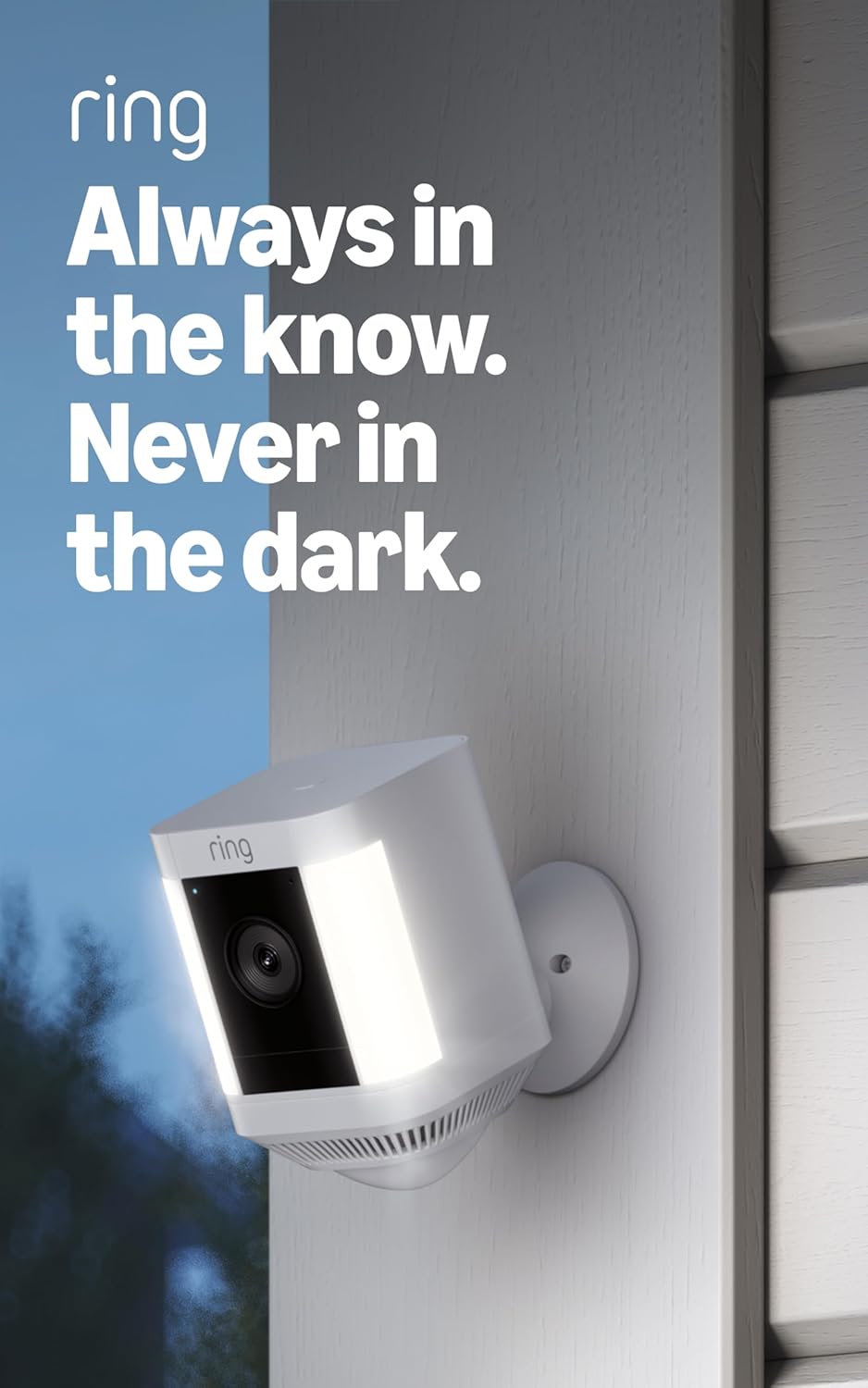
Price: ~$200 | Best for: Alexa and existing Ring households
The Ring Spotlight Cam Plus, Solar is the easiest pick for anyone already in the Ring or Alexa world. It bundles the camera with Ring’s solar panel, so the rechargeable battery stays topped off as long as the panel gets a few hours of direct sun a day. You get 1080p HD video, two built-in LED spotlights for color night vision, two-way talk, and a security siren you can trigger from your phone.
What makes it the smoothest experience is the ecosystem. If you have a Ring doorbell, Echo Show, or other Ring cameras, this camera slots right into the same app and the same notifications. You can pull up the live view on an Echo Show by voice, link motion alerts to other devices, and manage everything in one place. The spotlights are genuinely useful — they kick on with motion at night, which both lights up the scene for the camera and acts as a deterrent.
The trade-off is the subscription. Live view, motion alerts, and the siren work without paying, but to actually save and review recorded clips you’ll want a Ring Home plan (starts around $5/month per device). If you’ve used Ring before, you already know whether that fits your budget. For a head-to-head on how Ring stacks up against the other big names, our Ring vs Arlo vs Wyze comparison breaks down the differences in detail.
Key Features:
- 1080p HD video with two LED spotlights for color night vision
- Includes Ring solar panel — no wiring needed
- Two-way talk and a built-in security siren
- Works with Alexa and the Ring app ecosystem
Pros:
- Cleanest experience if you already own Ring or Alexa devices
- Spotlights double as a deterrent and improve night footage
- Solar panel included in the box
Cons:
- Cloud recording requires a Ring Home subscription
- 1080p resolution rather than 2K/4K like some rivals
- Locked into the Ring ecosystem
Verdict: If your home already runs on Ring or Alexa, this is the obvious choice. The included panel and spotlight combo make it a strong all-rounder, just budget for the subscription if you want saved recordings.
2. eufy Security 3K Dual Camera, SoloCam S340
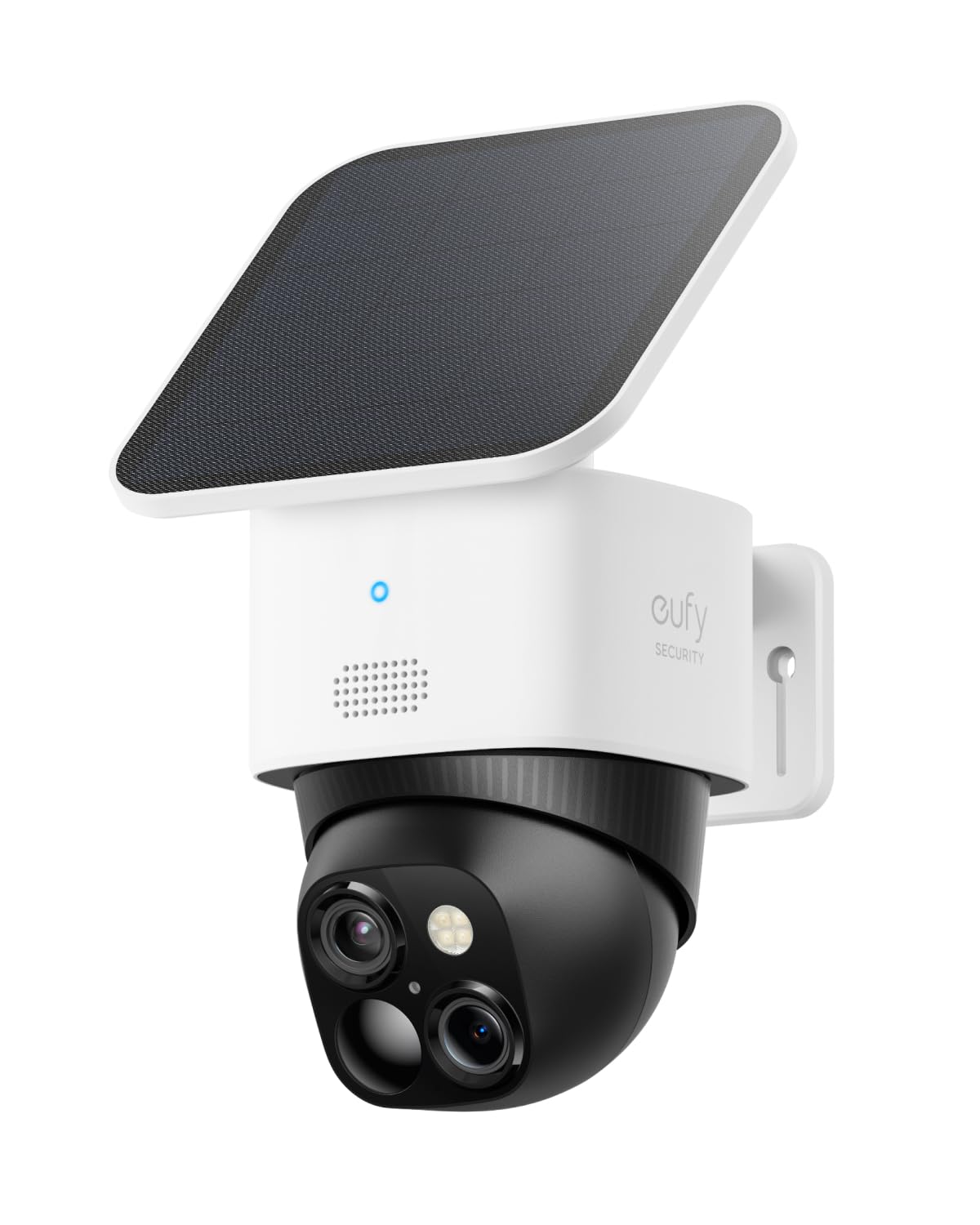
Price: ~$200 | Best for: Full coverage with zero monthly fees
The eufy Security 3K Dual Camera, SoloCam S340 is the pick for people who hate subscriptions. Everything records to 8GB of built-in storage, with no cloud plan required and no monthly fee — ever. That alone saves you $60 or more a year compared to the Ring and most rivals.
The headline feature is the dual-camera design. A wide-angle lens watches a broad area while a telephoto lens zooms in for detail, and the whole head pans and tilts a full 360 degrees with auto-tracking. The two lenses work together to follow a person across the frame, so you get both the wide context and a close-up of who’s actually there — no blind spots. The built-in solar panel keeps it charged with a couple of hours of direct sunlight per day, and color night vision plus AI person detection round out a genuinely premium feature set.
The catch is that the pan-tilt-zoom mechanism and dual cameras make it a bit larger and more conspicuous than a simple fixed camera. That’s fine for most yards (a visible camera deters people anyway), but if you want something discreet, look at a smaller fixed unit. The local-only storage also means you should mount it somewhere a thief can’t easily grab it, since there’s no cloud backup of footage by default.
Key Features:
- Dual lens (wide + telephoto) with 360° pan and tilt
- 3K resolution with AI auto-tracking and person detection
- Built-in 8GB local storage — no monthly fee
- Integrated solar panel for continuous charging
Pros:
- No subscription required, ever — local storage included
- Dual cameras eliminate blind spots and follow movement
- Excellent value for the feature set
Cons:
- Larger and more visible than fixed cameras
- Local-only storage means no cloud backup unless you add a HomeBase
- Pan-tilt mechanism is one more moving part
Verdict: The best overall value here if you want strong coverage and refuse to pay a monthly fee. The dual-camera tracking is the standout, and the no-subscription promise is exactly what most homeowners want.
3. REOLINK Altas PT Ultra Black - 4K Solar Security Cameras Wireless Outdoor
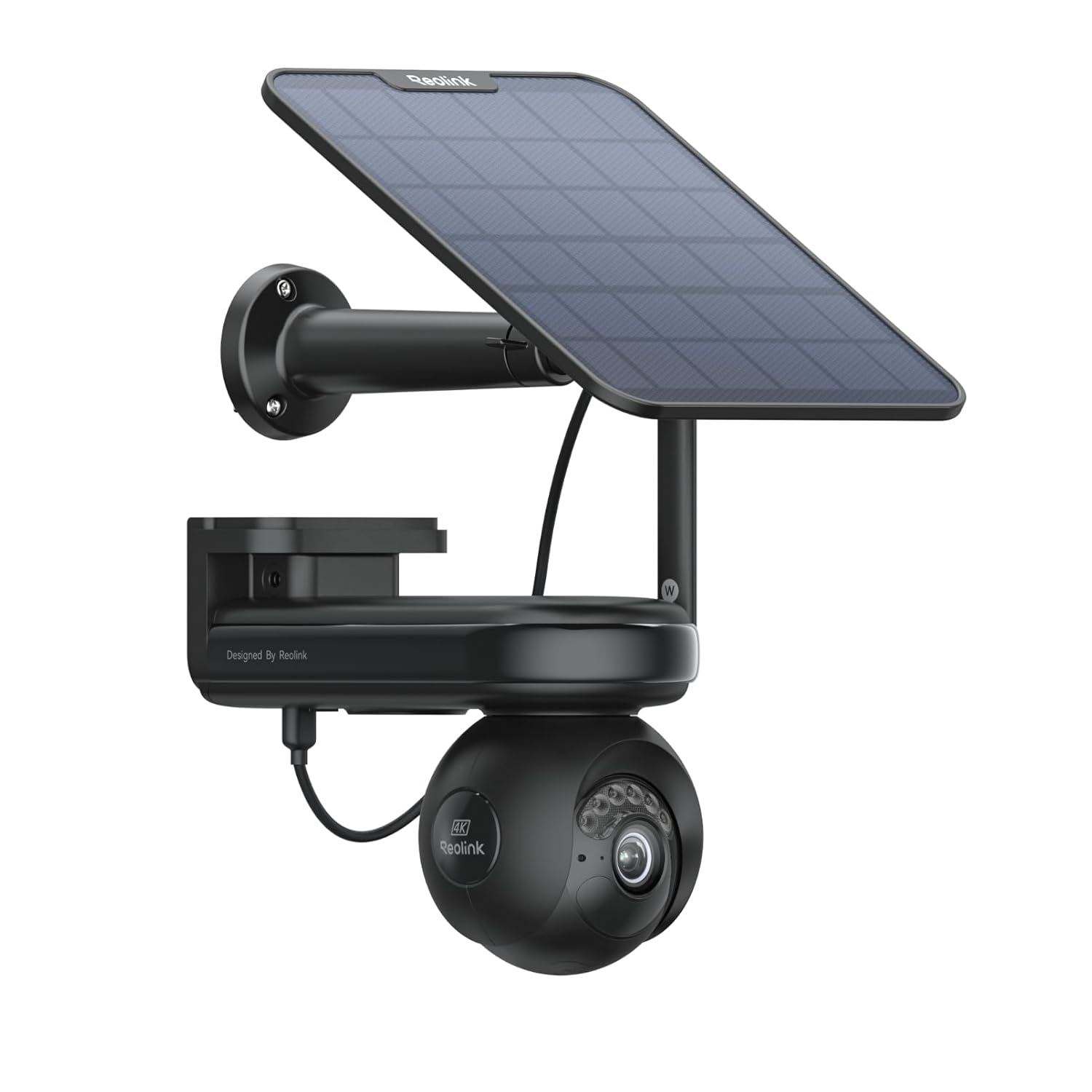
Price: ~$200 | Best for: The longest runtime and 4K detail
If battery anxiety is the whole reason you’re shopping for solar, the REOLINK Altas PT Ultra is built to put that worry to bed. Reolink rates it for up to 500 days of battery life on a single charge before solar even enters the picture — meaning that even through a stretch of gray winter weeks, you’re nowhere near running flat. Pair that with the bundled solar panel and it effectively never needs you to touch it.
It’s also one of the most capable cameras on this list. You get true 4K resolution, Reolink’s ColorX night vision that captures full-color footage in very low light without a spotlight, 360-degree pan and tilt with auto-tracking, and dual-band Wi-Fi 6 for a more reliable connection. A clever pre-recording feature buffers a few seconds before motion triggers, so you don’t miss the start of an event the way many battery cameras do.
Reolink leans local-first: footage saves to a microSD card or a Reolink Home Hub, with no mandatory subscription. The app is powerful but a little more technical than Ring’s, which is a fair trade for the control you get. This is the pick for someone who wants the most camera and the least maintenance, and doesn’t mind a slightly steeper learning curve.
Key Features:
- 4K resolution with ColorX color night vision
- Up to 500 days of battery life, plus included solar panel
- 360° pan/tilt with auto-tracking and pre-recording
- Dual-band Wi-Fi 6, local storage, no required subscription
Pros:
- Class-leading battery life means true set-and-forget
- 4K detail and excellent low-light color footage
- No subscription needed for full functionality
Cons:
- App is more technical than mainstream brands
- Larger pan-tilt body
- Best features reward a bit of setup effort
Verdict: The longest-running, highest-resolution pick on the list. If you want to mount a camera in a hard-to-reach spot and genuinely never think about it again, this is the one.
4. REOLINK Argus 4 Pro 4K Solar Camera Outdoor Wireless
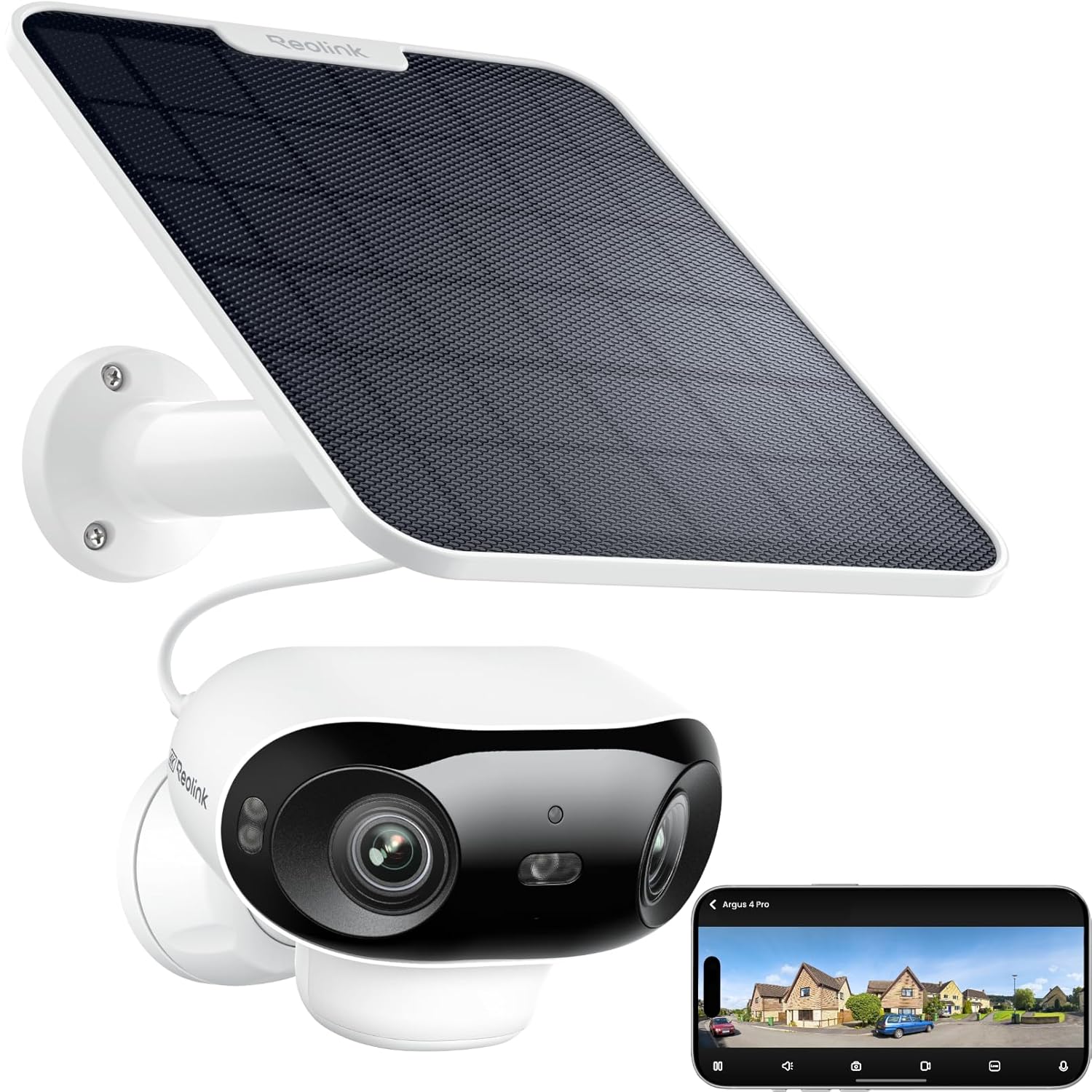
Price: ~$180 | Best for: Covering a wide area with one camera
The REOLINK Argus 4 Pro takes a different approach to coverage. Instead of panning and tilting, it uses two lenses stitched into a single seamless 180-degree ultra-wide view. That means one camera watching an entire side of your house, a full driveway, or a whole backyard in a single distortion-corrected frame — no moving parts, no blind spots, nothing to wear out.
Like its sibling above, it shoots 4K (8MP) and uses ColorX night vision for full-color footage after dark without needing a spotlight to give you away. Smart detection separates people, vehicles, and animals so you’re not getting an alert every time a cat walks by. Storage is local via microSD or the Reolink hub, with no subscription required. A compatible solar panel keeps it charged in any reasonably sunny spot.
The 180-degree stitched view is the reason to buy this over a pan-tilt model: you capture everything at once, all the time, rather than having the camera pointed away from the action when something happens. The downside is that an ultra-wide view spreads resolution across a larger scene, so faces at the far edges aren’t as crisp as a zoomed-in pan-tilt shot. For watching a broad area, that’s an easy trade.
Key Features:
- 180° dual-lens view with no moving parts
- 4K / 8MP resolution with ColorX color night vision
- Smart person/vehicle/animal detection
- Local storage, no subscription, solar charging
Pros:
- One camera covers an entire wide area with no blind spots
- Fixed design with nothing to wear out mechanically
- No monthly fees and strong night-vision quality
Cons:
- Wide view trades some edge sharpness for coverage
- Reolink app has a learning curve
- Solar panel availability varies by listing
Verdict: The best pick when you want maximum coverage from a single camera. The 180-degree view means you never miss action happening at the edge of the frame.
5. eufy Security SoloCam S220, Solar Security Camera
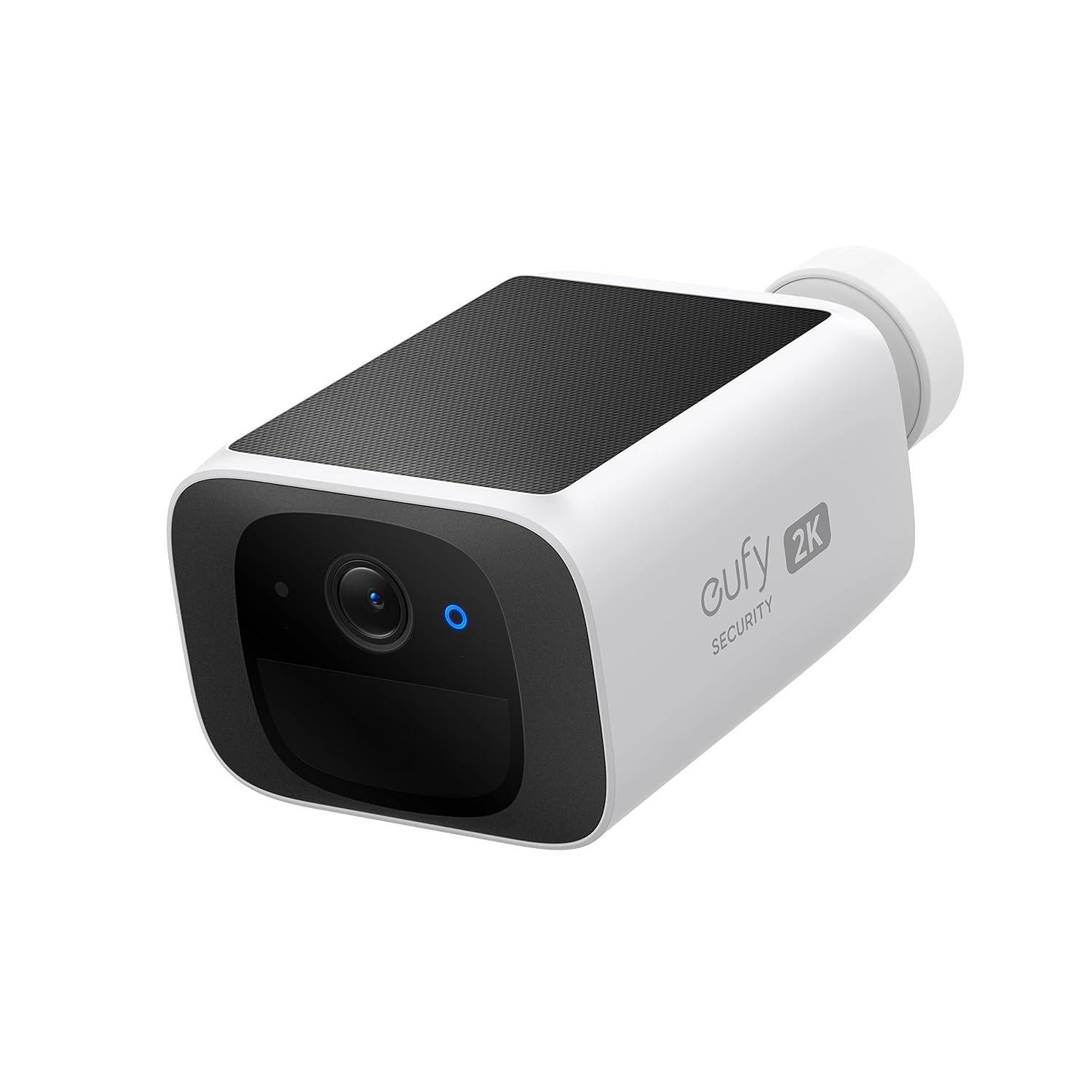
Price: ~$100 | Best for: A simple, no-fee fixed camera
Not everyone needs pan-tilt tracking or dual lenses. The eufy Security SoloCam S220 is the straightforward, point-it-and-forget-it option — a fixed 2K camera with a built-in solar panel that, in eufy’s words, delivers “continuous power” with just a couple of hours of sun per day. It’s the kind of camera you mount over a back door or a side gate and never think about again.
You get crisp 2K resolution, AI human detection to cut down on false alerts, a spotlight for color night vision, and 8GB of built-in local storage with no subscription required. It’s HomeBase 3 compatible if you later want to expand into a larger eufy system, but it works perfectly well as a standalone camera right out of the box. For roughly half the price of the flagship cameras here, it covers the essentials without cutting the corners that matter.
The limitations are the obvious ones for a budget fixed camera: a single fixed field of view (no tracking), and 2K rather than 4K. But for the vast majority of single-spot monitoring jobs, 2K is plenty to identify a person or read what’s going on, and the fixed design means there’s nothing to break. It’s a sensible, affordable way to add solar coverage to one specific spot.
Key Features:
- 2K resolution with AI human detection
- Built-in solar panel for continuous power
- Spotlight for color night vision
- 8GB local storage, no subscription, HomeBase 3 compatible
Pros:
- Affordable entry into solar cameras
- No monthly fee — local storage built in
- Simple, reliable fixed design
Cons:
- Fixed view only — no pan, tilt, or tracking
- 2K rather than 4K
- Single camera, narrower coverage than dual-lens models
Verdict: The smart budget pick. If you just need to watch one spot, charge itself, and never bill you monthly, the S220 nails the basics for around $100.
6. Tapo SolarCam 1080p Security Camera Wireless Outdoor (C402 KIT)
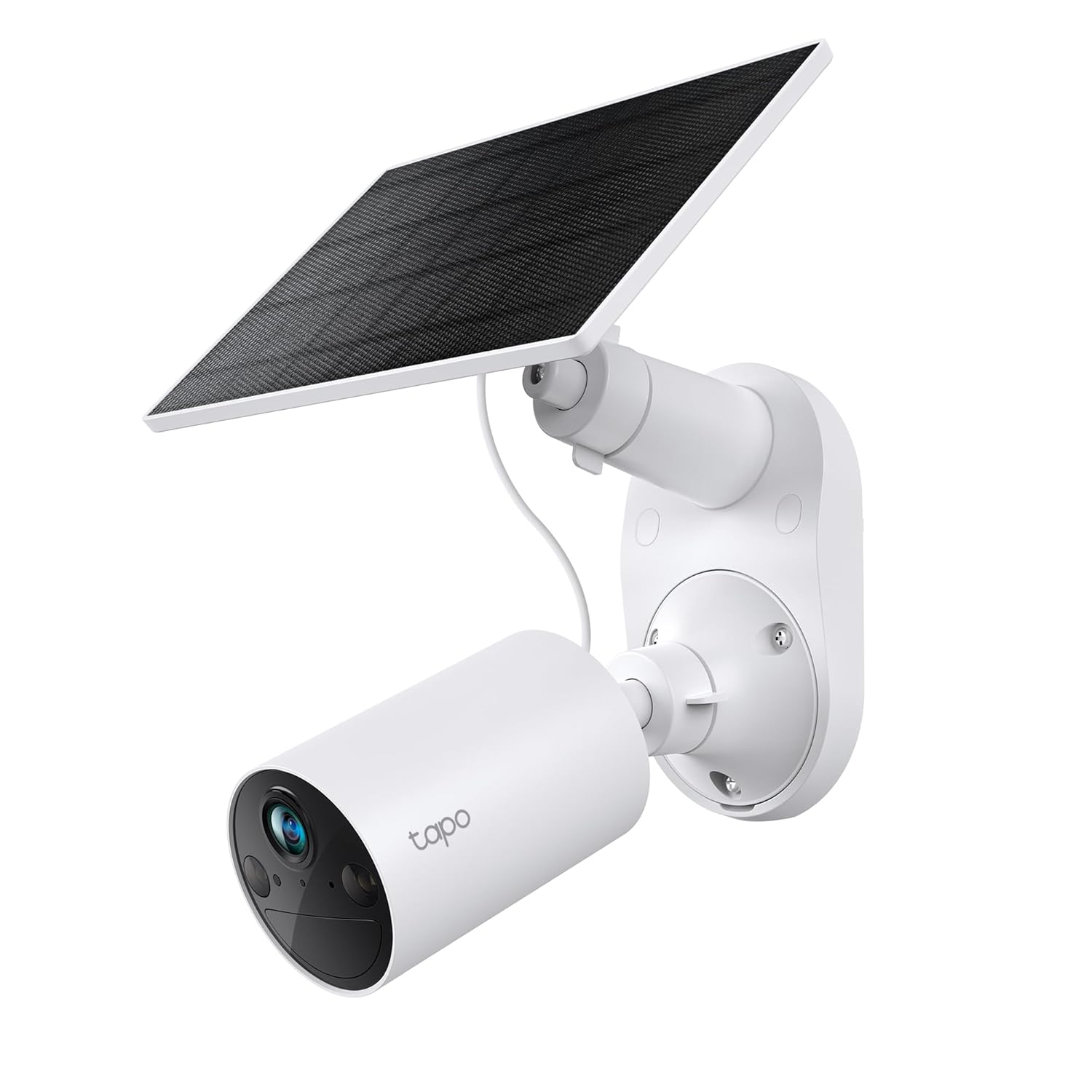
Price: ~$80 | Best for: The cheapest solar camera that still works well
The Tapo SolarCam C402 KIT (from TP-Link’s Tapo line) is the lowest-cost way onto this list, and it’s a genuinely solid camera for the money. The kit pairs the camera with a solar panel out of the box, so you get the full wire-free experience for around $80. It records in 1080p, handles person detection to filter alerts, and works with both Alexa and Google Assistant, so it fits into whichever voice ecosystem you already use.
Tapo’s biggest strength at this price is its flexible storage. You can record to a microSD card locally with no fees at all, or opt into Tapo Care cloud storage if you’d rather have off-site backup — the choice is yours, and the local option keeps it subscription-free. It’s IP65 weatherproof, easy to set up through the Tapo app, and a great choice for a renter, a first camera, or anyone who wants to test the solar concept without spending $200.
You are buying down at the entry level, so manage expectations: 1080p instead of 2K/4K, and a smaller battery and panel than the premium units, which means it really does want a sunny mounting spot to stay topped off. But for a budget shopper, it’s hard to argue with a fully solar, no-subscription camera for the price of a few takeout dinners.
Key Features:
- 1080p video with person detection
- Camera and solar panel included in the kit
- Local microSD storage (no fee) or optional Tapo Care cloud
- Works with Alexa and Google Assistant, IP65 weatherproof
Pros:
- By far the cheapest fully solar option here
- Subscription-free local storage out of the box
- Easy setup and broad voice-assistant support
Cons:
- 1080p resolution only
- Smaller battery/panel — needs a genuinely sunny location
- Fewer advanced features than the premium picks
Verdict: The best budget buy. If you want to dip a toe into solar cameras or cover a spot cheaply, the C402 kit delivers the core experience for the least money.
Comparison Table
| Camera | Resolution | Power | Storage | Monthly Fee | Best For |
|---|---|---|---|---|---|
| Ring Spotlight Cam Plus, Solar | 1080p | Solar panel + battery | Cloud (Ring Home) | Required for recordings | Ring/Alexa homes |
| eufy SoloCam S340 (3K Dual) | 3K | Integrated solar | 8GB local | None | Full coverage, no fees |
| Reolink Altas PT Ultra | 4K | Solar + 500-day battery | microSD/Hub | None | Longest runtime |
| Reolink Argus 4 Pro | 4K | Solar + battery | microSD/Hub | None | Wide-area coverage |
| eufy SoloCam S220 | 2K | Integrated solar | 8GB local | None | Simple fixed budget cam |
| Tapo SolarCam C402 KIT | 1080p | Solar panel + battery | microSD or cloud | Optional | Cheapest solar option |
Buying Guide: How to Choose a Solar Security Camera
Solar panel size and sun-hours
A solar camera is only as good as the charge it can pull in. Most of these panels are rated between roughly 2 and 6 watts, and the manufacturers quote a required amount of direct sunlight per day — usually somewhere between one and two hours. That sounds easy, but “direct sunlight” is the key phrase. A panel in full shade, behind a tree, or facing north will struggle no matter how it’s rated.
Before you mount anything, watch where the sun actually lands on your wall through the day. South-facing spots (in the northern hemisphere) get the most consistent sun. If your only good camera location is shaded, lean toward a model with a large battery (like the Reolink Altas PT Ultra’s 500-day rating) so it can coast through cloudy stretches, or plan to bring it down and top it off occasionally.
Battery capacity matters more than you’d think
Even with solar, the battery is your buffer for dark, rainy, or short winter days. A bigger battery means longer gaps between needing strong sun. This is where the premium Reolink models shine — a multi-month battery means a week of clouds is a non-issue. Budget cameras with smaller batteries are fine in sunny climates but can dip during winter, so factor your local weather into the decision.
Local vs. cloud storage
This is the biggest ongoing cost decision. Local storage (microSD card or a base station) means your footage saves on-site with no monthly fee — the eufy and Reolink picks here all work this way. Cloud storage uploads clips off-site, which protects footage if the camera is stolen, but usually costs a monthly subscription. Ring leans cloud-first; eufy and Reolink lean local-first; Tapo lets you pick either.
There’s a security trade-off too: local storage can be lost if someone steals the camera, while cloud storage keeps a copy safe but puts your footage on someone else’s servers. Many people split the difference by mounting local-storage cameras high and out of reach.
Subscription costs over time
The sticker price is only part of the math. A $5/month plan is $60 a year, or $180 over three years — more than the camera itself in some cases. If you’re buying multiple cameras, per-camera fees add up fast. The no-subscription eufy and Reolink models cost more upfront but nothing afterward, which usually wins over a few years. If you go with Ring, factor the plan into your real budget.
Wire-free installation
The whole appeal of solar is skipping the wiring, and installation is genuinely simple: mount the bracket with a couple of screws, attach the camera, position the panel toward the sun, and connect to Wi-Fi through the app. No electrician, no drilling through walls for cable. The one thing worth checking first is Wi-Fi signal strength at the mounting location — outdoor spots far from the router can be weak, and a camera with a poor connection will frustrate you. Test your signal at the spot before you commit, and add a mesh node or extender if needed.
If you’re building out a fuller setup rather than adding a single camera, our DIY smart home security system guide walks through planning coverage, choosing a hub, and tying everything together.
Frequently Asked Questions
Do solar security cameras work in winter or cloudy weather?
Yes, but the battery does more of the work. Solar panels still generate some charge on overcast days, just less of it. The key is battery capacity — a camera with a large battery (like the Reolink Altas PT Ultra’s 500-day rating) easily rides out a week of clouds or short winter days, while a small-battery budget camera may slowly drain and need a manual top-up during a long gray stretch. In sunny climates, winter is rarely an issue. In cloudier regions, choose a model with a bigger battery.
How much direct sunlight does a solar camera need?
Most manufacturers quote roughly one to two hours of direct sunlight per day to keep the battery topped off. The important word is “direct” — a panel in partial shade, behind foliage, or facing the wrong direction won’t hit its rated output. Aim the panel at a south-facing, unobstructed patch of sky (in the northern hemisphere) for the best results, and watch how the sun moves across your wall before mounting.
Do solar security cameras require a monthly subscription?
It depends on the brand. eufy and Reolink cameras record to built-in or microSD/local storage with no required subscription — you own the footage and pay nothing monthly. Ring requires a Ring Home plan to save and review recorded clips (live view and alerts are free). Tapo lets you choose: free local microSD recording or optional paid cloud storage. If avoiding fees matters, the eufy and Reolink picks here are subscription-free.
Are solar cameras completely wireless?
For power, yes — there’s no power cable to run, which is the whole point. They do still rely on Wi-Fi to send alerts and stream live video, so they’re not “wireless” in the sense of working with no network. They store footage locally and keep recording during a Wi-Fi outage on most models, but you won’t get remote alerts or live view until the connection is back. Check your Wi-Fi signal at the mounting spot before buying.
Can I add a solar panel to a battery camera I already own?
Often, yes — many battery cameras (including various Ring, Arlo, Blink, eufy, and Reolink models) support a compatible solar panel accessory sold separately. The catch is matching the right panel to your specific camera, since connectors and wattage differ between brands and even models. Buying a camera that already includes the panel, like the picks in this guide, removes the guesswork and guarantees compatibility.
The Bottom Line
Solar security cameras solve the one real headache of going wire-free: keeping the thing charged. Once you’ve mounted one in a sunny spot, it largely takes care of itself, which is exactly what you want from a device whose whole job is to be watching when you’re not around.
For most people, the eufy Security 3K Dual Camera, SoloCam S340 is the sweet spot — dual-lens coverage, sharp 3K video, and zero monthly fees thanks to built-in local storage. If you’re already living in the Ring and Alexa world, the Ring Spotlight Cam Plus, Solar drops into that ecosystem with the least friction. Want the absolute longest runtime and highest resolution? The Reolink Altas PT Ultra runs for months between charges and shoots in 4K. And if you just want to cover one spot cheaply, the Tapo SolarCam C402 KIT delivers a real solar camera for around $80.
Whichever you pick, watch where the sun lands before you mount it, check your Wi-Fi at the spot, and decide upfront whether you want to pay monthly for cloud storage or keep it all local. Get those three things right and you’ll have a camera that quietly keeps watch and never asks you to climb a ladder again.