Quick Picks
Short on time? Here are our top recommendations by use case:
- Anova Culinary Sous Vide Precision Cooker 3.0 (WiFi), 1100 Watts, Stainless Steel (~$200) — Best overall, dual-band WiFi and 1100W of heating muscle
- Breville BSV600PSS Joule Turbo Sous Vide Machine, Polished Stainless Steel (~$250) — Best app experience, Turbo mode cooks in half the time
- Anova Culinary Sous Vide Precision Cooker Pro, 1200 Watts, Black and Silver (~$270) — Best for big batches, restaurant-grade 1200W
- Anova Culinary Sous Vide Precision Cooker Nano 3.0, 800 watts (~$130) — Best compact WiFi, stows in a kitchen drawer
- INKBIRD WIFI Sous Vide Cooker ISV-100W, 1000 Watts (~$70) — Best budget WiFi, full app control for under $80
- Instant Pot Accu Slim Sous Vide 800W Precision Cooker (~$80) — Best no-app pick, simple touchscreen, no phone required
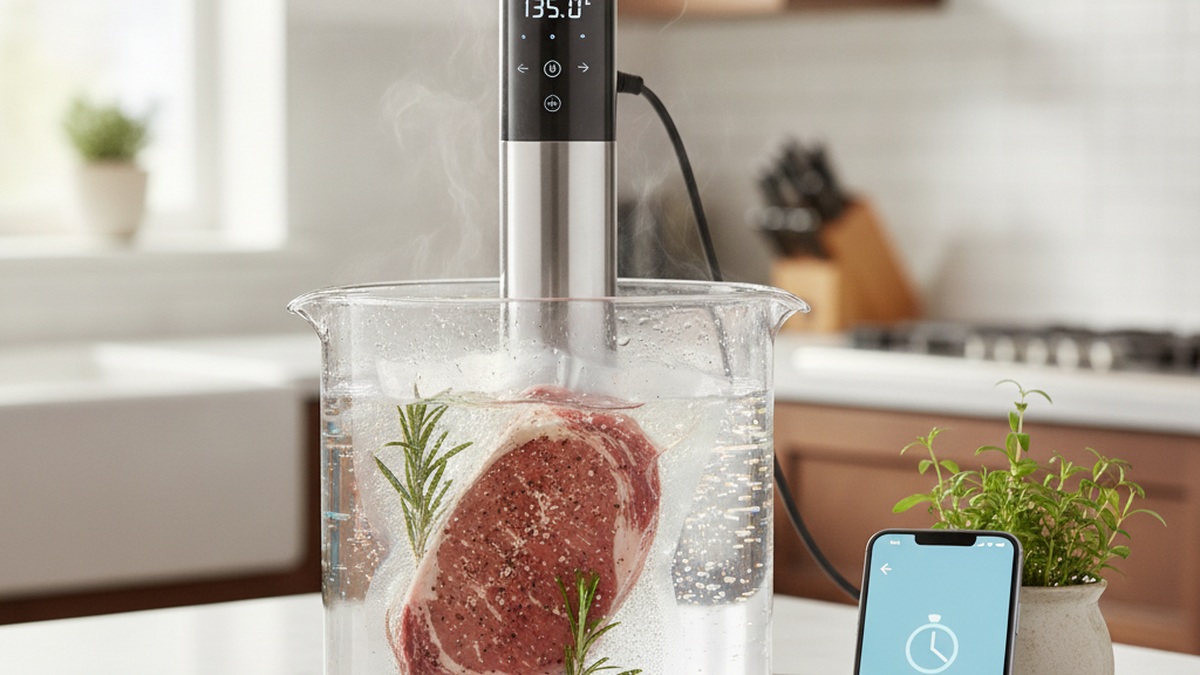
Sous vide used to be a restaurant-only trick. You’d hear about steakhouses cooking a ribeye in a temperature-controlled water bath for hours so it came out edge-to-edge medium-rare, then searing it for 30 seconds to finish. Now that same technique fits on your kitchen counter for less than the price of a nice dinner out — and the best models connect to your phone so you can start a cook, walk away, and get a notification when it’s ready.
The idea is simple. You seal your food in a bag, drop it in a pot of water, and a device called an immersion circulator holds that water at an exact temperature — say 129°F for a perfect medium-rare steak — for as long as you want. Because the water never gets hotter than your target, the food literally cannot overcook. A steak that would go from rare to gray in 90 seconds on a grill can sit in a sous vide bath for an extra hour with no harm done. That’s what makes it so forgiving, and so good for busy people or nervous cooks.
The “smart” part is what separates a $70 gadget from a $270 one. A smart sous vide machine connects over WiFi or Bluetooth to a companion app that holds hundreds of recipes with exact time-and-temperature settings, sends alerts to your phone, and — on WiFi models — lets you monitor the cook from anywhere in the house. No more standing over a pot with a printout of a temperature chart.
We started this guide by verifying every product on Amazon, capturing the exact listing and confirming it’s in stock, then wrote the reviews around that locked list. Below are six precision cookers that genuinely deliver — from a $70 budget WiFi model to a $270 prosumer unit — plus one honest “no-app” pick for people who just want the water bath without the phone. If you’re building out the rest of your setup, a good sous vide pairs naturally with a smart meat thermometer for the sear, and it slots right into a complete smart kitchen.
Our Top Smart Sous Vide Picks
Anova Culinary Sous Vide Precision Cooker 3.0 (WiFi), 1100 Watts, Stainless Steel — Best Overall
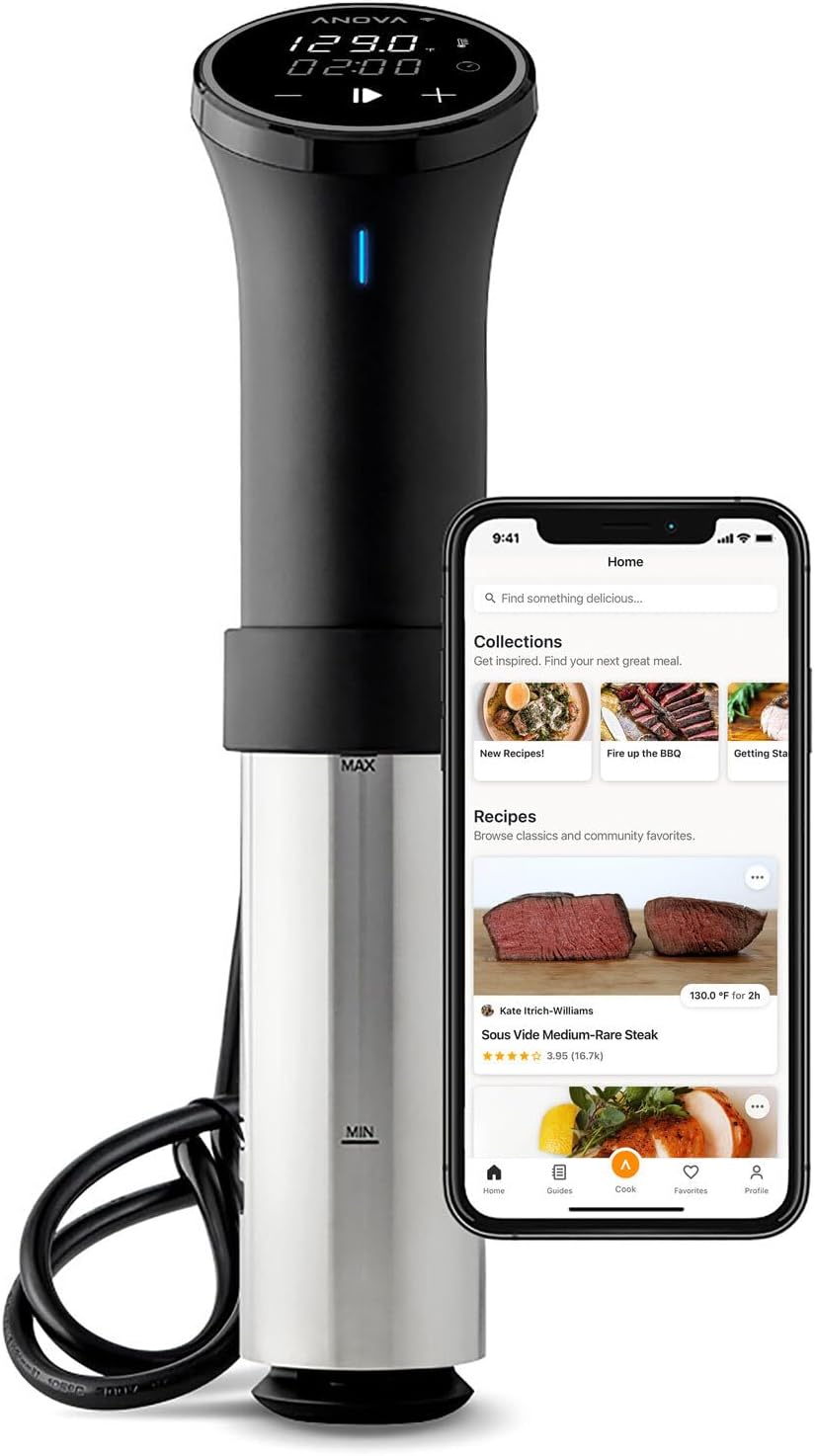
Anova basically invented the home sous vide category, and the Precision Cooker 3.0 is the model we’d hand to almost anyone. It hits the sweet spot: enough power to heat a big pot fast, the most mature app in the business, and rock-solid WiFi so you can check your cook from the couch.
The headline upgrade over older Anovas is dual-band WiFi. Earlier models were notorious for dropping their connection because they only supported 2.4GHz and struggled in homes with mesh routers. The 3.0 handles both bands, which makes the “monitor from anywhere” promise actually reliable instead of aspirational. It pumps out 1100 watts, so it brings a large water bath up to temperature noticeably faster than the 800W budget units, and the 8 liters-per-minute flow rate keeps the temperature even from corner to corner.
The stainless-steel body feels premium and cleans up easily, and the two-line touchscreen on top means you can set time and temperature right on the device without your phone. But the phone is where it shines. The free Anova app carries thousands of recipes with one-tap time-and-temp presets, guided cooks, and push notifications. For anyone new to sous vide, that recipe library removes the entire “what temperature do I use?” learning curve.
The adjustable clamp fits pots and containers of nearly any size, and the whole thing stands about 12.8 inches tall, so it stores in a deep drawer. It’s not the cheapest, but for a do-everything cooker that you won’t outgrow, it’s the one to beat.
Why we picked it: Dual-band WiFi that actually stays connected, 1100W fast heating, the best recipe app in the category, and premium build quality.
Pros:
- Dual-band WiFi is far more reliable than older Anova models
- 1100W heats large baths quickly and evenly
- Best-in-class app with thousands of guided recipes
- On-device touchscreen means you don’t always need your phone
- Sturdy stainless-steel build, easy to clean
Cons:
- Pricier than budget WiFi options
- No standalone display beyond the small on-unit screen
- Slightly heavier than the compact Nano
Breville BSV600PSS Joule Turbo Sous Vide Machine, Polished Stainless Steel — Best App Experience

The Breville Joule Turbo takes the opposite design philosophy from Anova: it has no buttons and no screen at all. Everything runs through the Joule app. That sounds like a downside until you use it — the app is genuinely the best-designed piece of software in this category, and the phone-only approach lets Breville make the unit tiny and elegant, a slim white-and-chrome cylinder that looks more like a designer speaker than a kitchen gadget.
The standout feature is Turbo mode. Breville uses cloud algorithms to cook proteins in as little as half the usual time by running the water hotter at the start and then dialing it back, so a steak that normally takes an hour can be table-ready in about 30 minutes. When you’re hungry on a weeknight, that’s a real quality-of-life win that no other cooker here offers.
The app’s Visual Doneness feature is the other headliner: before you cook, it shows you photos of exactly how done your food will be at a given temperature, so you can pick “medium-rare” by looking at a picture instead of memorizing numbers. It connects over both WiFi and Bluetooth, works with Alexa and Google Assistant for voice control, and guides you step by step through each recipe.
The catch is the no-screen design itself: if your phone dies or the app has a hiccup, you can’t operate the cooker at all. And it needs a solid connection to unlock Turbo mode’s cloud smarts. For people who live in an app and want the smoothest, most hand-holding experience, though, the Joule is a joy.
Why we picked it: The best app in sous vide, exclusive Turbo mode that halves cook times, Visual Doneness previews, and a beautiful compact body.
Pros:
- Best-designed app with Visual Doneness previews
- Turbo mode cooks proteins in roughly half the time
- Slim, elegant, easy to store
- Works with Alexa and Google Assistant
- Both WiFi and Bluetooth connectivity
Cons:
- No screen or buttons — completely dependent on your phone
- Turbo features rely on a good internet connection
- Slightly lower wattage than the Anova Pro
Anova Culinary Sous Vide Precision Cooker Pro, 1200 Watts, Black and Silver — Best for Big Batches
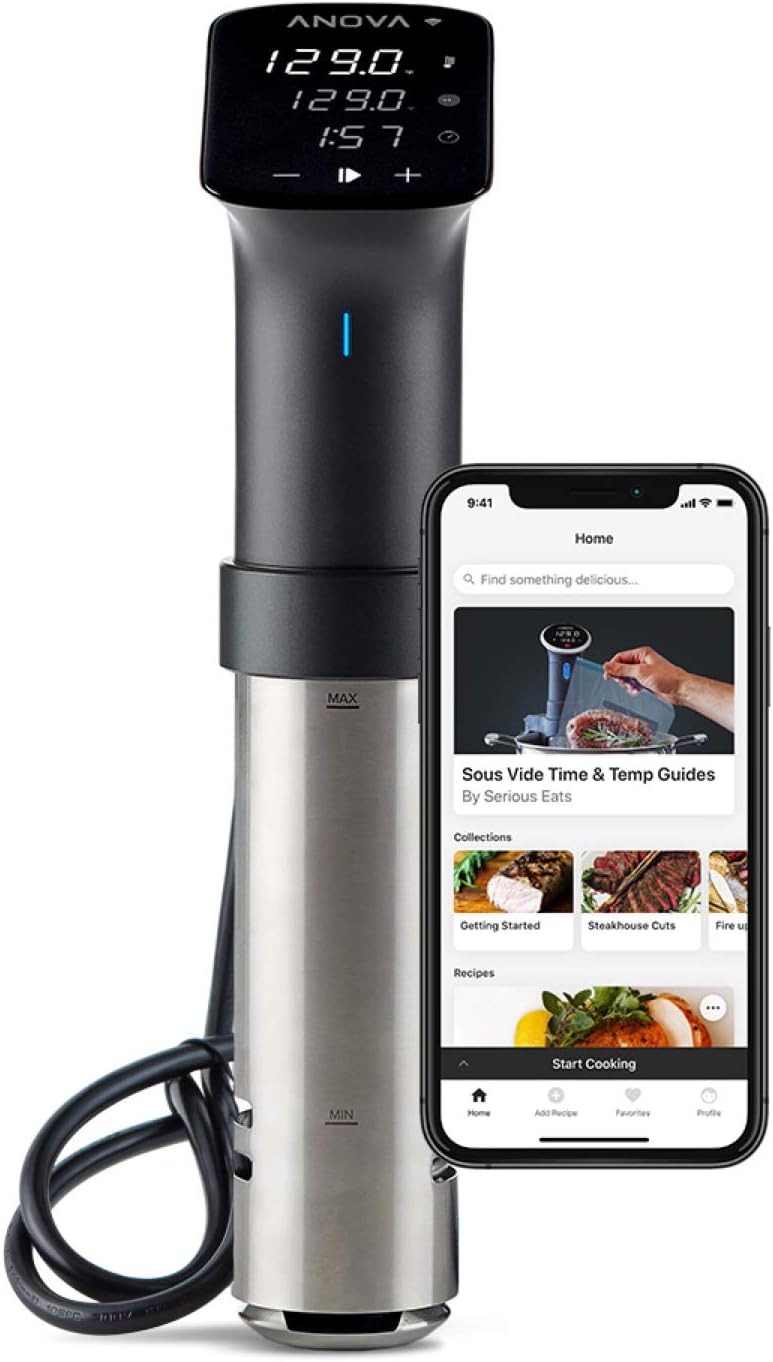
If you cook for a crowd — big family dinners, meal prep for the week, or a chest cooler full of chicken breasts for a party — the Anova Precision Cooker Pro is built for it. This is the heavy-duty member of the Anova lineup, rated to hold up to restaurant-kitchen demands while still being compact enough for home use.
The Pro cranks out 1200 watts, the most powerful in this roundup, which means it can bring a large 20-plus-liter container up to temperature and hold it there without breaking a sweat. It’s also built to run continuously — Anova rates it for far longer duty cycles than the consumer models, so those 24-hour short-rib cooks or overnight batches won’t stress it. It connects over both WiFi and Bluetooth and uses the same excellent Anova app as the 3.0, with the same recipe library and remote monitoring.
Build quality is a step up too. The Pro has an IPX7 waterproof rating and a more industrial housing designed to survive heavy use and the occasional accidental full dunk. The rectangular touchscreen up top shows both the target and current water temperature at a glance.
It’s the priciest pick here, and honestly it’s more cooker than most home cooks need for a couple of steaks. But if you routinely cook large volumes, run long overnight cooks, or just want the most durable unit you can buy, the extra power and heavier-duty build are worth it.
Why we picked it: The most powerful and most durable Anova, built for large batches and marathon cooks, with the same great app.
Pros:
- 1200W — the most powerful cooker in this guide
- Rated for restaurant-level continuous use
- IPX7 waterproof, industrial-grade build
- WiFi + Bluetooth with the full Anova app
- Handles very large water baths with ease
Cons:
- Most expensive option here
- Overkill for cooking one or two portions
- Bulkier and heavier than the Nano or Joule
Anova Culinary Sous Vide Precision Cooker Nano 3.0, 800 watts — Best Compact WiFi
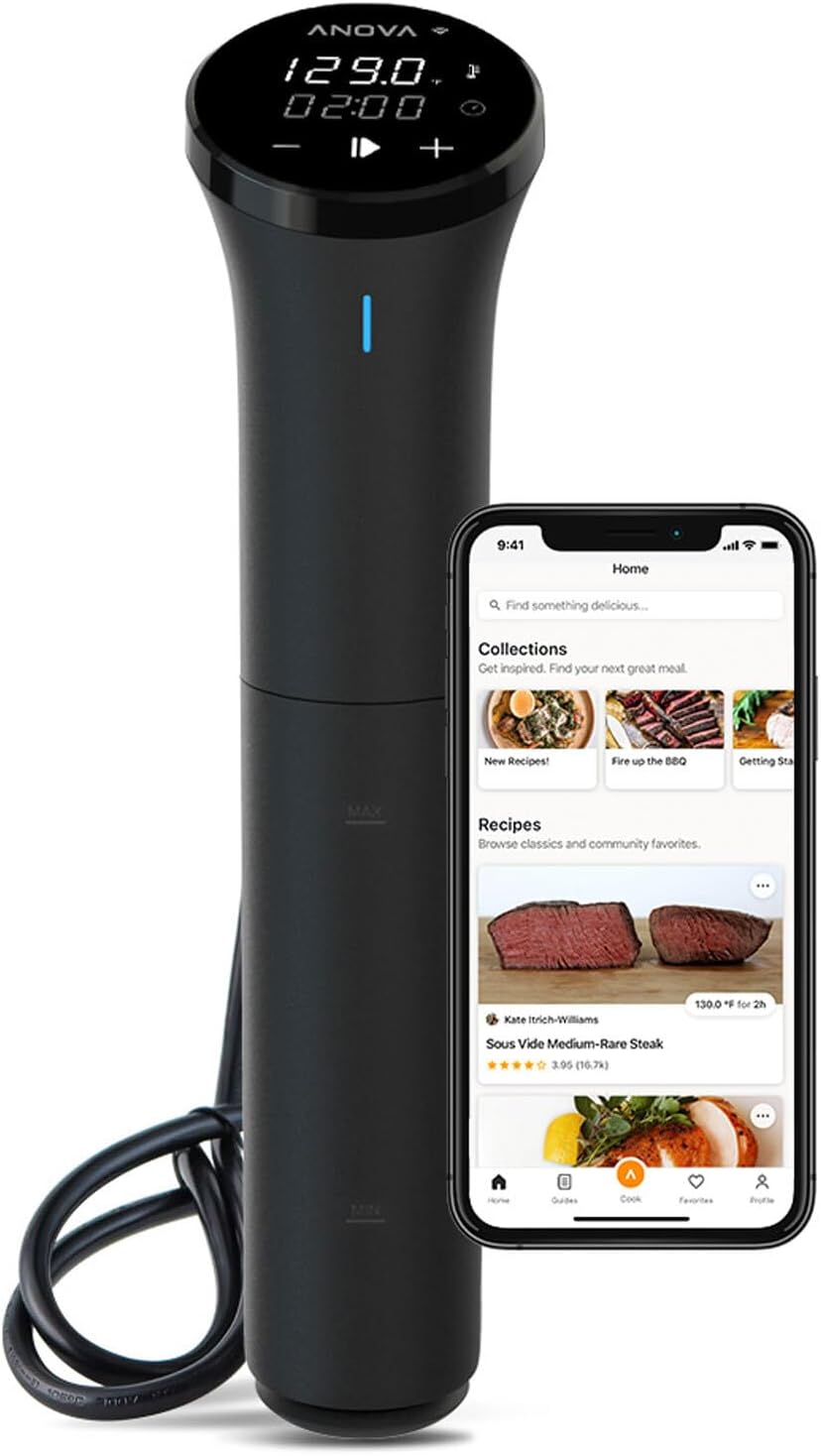
The Nano is Anova’s answer to a common complaint: sous vide cookers are surprisingly bulky. The Nano 3.0 shrinks the whole thing down to about 12.8 inches, small enough to toss in a kitchen drawer, while still delivering the full smart experience. And the big news for this generation is that it upgraded from Bluetooth to dual-band WiFi — earlier Nanos were Bluetooth-only, which limited you to staying within range. Now you get the same remote monitoring as the flagship in a much smaller package.
At 800 watts it’s less powerful than the 1100W and 1200W models, so it takes a bit longer to heat a large pot. In practice, for one to four servings in a normal-sized pot, you won’t notice much difference — the wattage gap matters most when you’re heating 15-plus liters of water. For everyday cooking, the Nano keeps temperature just as accurately as its bigger siblings.
It uses the same polished Anova app with the full recipe library, guided cooks, and phone alerts, and has the same clean two-line touchscreen on top for setting things manually. The all-black finish looks sharp, and the smaller footprint makes it the easiest of these to store and handle.
If you cook for one or two, live in a smaller kitchen, or just want to spend less without giving up WiFi, the Nano 3.0 is the smart budget-conscious pick — you get real Anova quality and true WiFi for around $130.
Why we picked it: True WiFi in a drawer-sized body, the full Anova app, and Anova reliability at a mid-tier price.
Pros:
- Compact enough to store in a drawer
- Now includes dual-band WiFi (older Nanos were Bluetooth-only)
- Same excellent Anova app and recipe library
- On-device touchscreen for manual control
- Great value for a WiFi Anova
Cons:
- 800W is slower to heat very large baths
- Less suited to big-batch or restaurant-volume cooking
- Smaller clamp range than the full-size models
INKBIRD WIFI Sous Vide Cooker ISV-100W, 1000 Watts — Best Budget WiFi
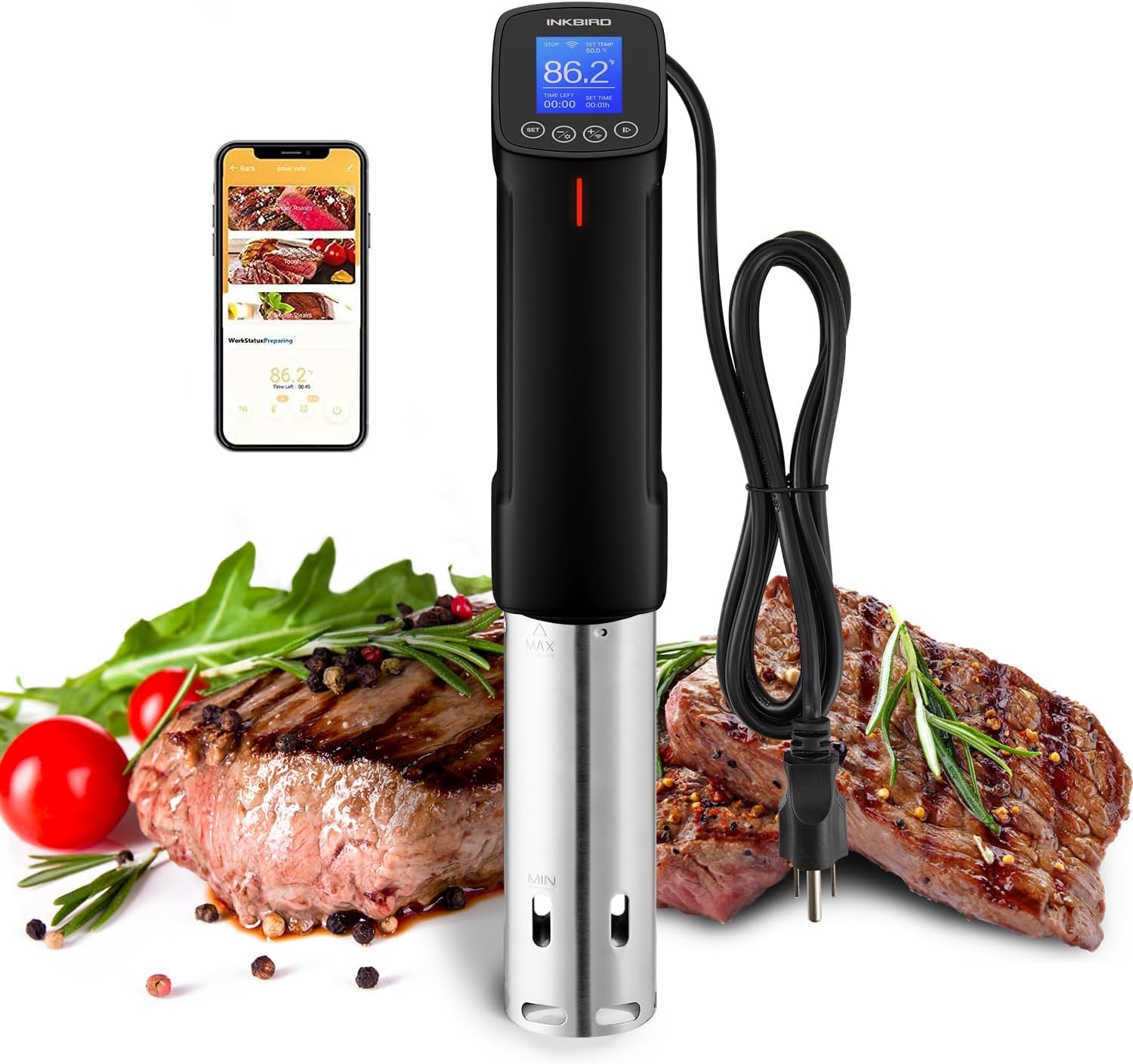
If you want real WiFi app control but don’t want to spend $130-plus, the Inkbird ISV-100W is the value champion. At around $70 it undercuts every other WiFi model here, yet it still delivers the core smart experience: connect it to your 2.4GHz WiFi, control it from the Inkbird app, and get notifications when your cook is done.
Don’t let the price fool you on performance. It runs 1000 watts — more than the Anova Nano — so it heats water quickly, and Inkbird rates its temperature accuracy at an impressive ±0.1°C. It circulates water for baths up to about 20 liters, and the motor is genuinely quiet (under 40dB), which matters more than you’d think for an appliance that might run for hours on your counter.
The unit has a clear color LCD touchscreen for setting temperature and time directly, and a physical timer that goes up to 99 hours for those extreme low-and-slow cooks. The Inkbird app includes 14 preset recipes to get beginners started, plus a calibration function so you can fine-tune accuracy against a reference thermometer. It’s not as polished or recipe-rich as the Anova or Joule apps, but it covers the essentials well.
This is the one to buy if you’re sous-vide-curious and don’t want to gamble $200 to find out if you’ll actually use it. You get genuine WiFi control, strong accuracy, and fast heating for the price of a nice steak dinner.
Why we picked it: Real WiFi app control and 1000W heating at the lowest price here, with surprisingly strong accuracy.
Pros:
- Lowest-priced WiFi model in this guide
- 1000W heats quickly for the price
- Rated ±0.1°C accuracy with a calibration function
- Color touchscreen and up-to-99-hour timer
- Very quiet motor (under 40dB)
Cons:
- Only 2.4GHz WiFi (no dual-band)
- App is basic compared to Anova or Joule
- Recipe library is limited (14 presets)
Instant Pot Accu Slim Sous Vide 800W Precision Cooker — Best No-App Pick
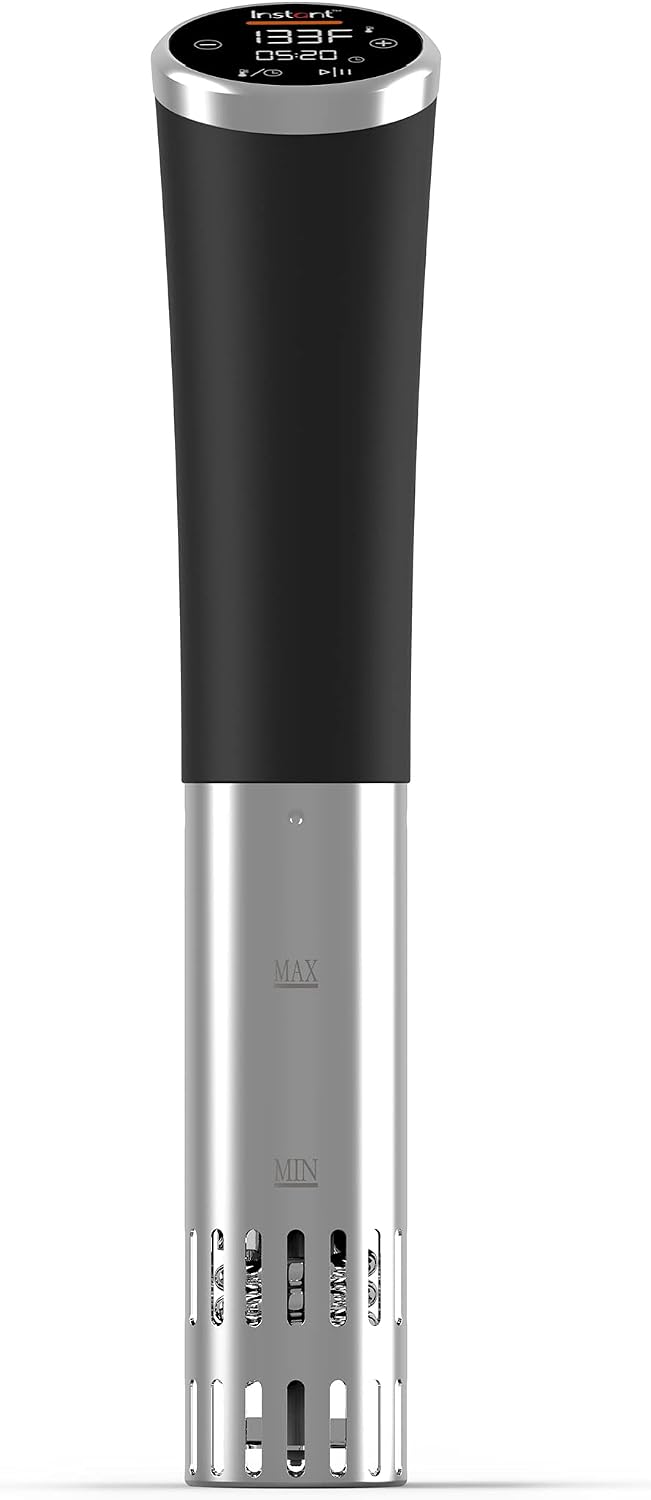
Not everyone wants another app on their phone. If you’d rather just set a temperature, set a timer, and cook, the Instant Accu Slim from the makers of the Instant Pot is the honest pick. To be clear up front: this one has no WiFi, no Bluetooth, and no app — it’s a standalone touchscreen cooker. We’re including it because it’s a genuinely good precision cooker for people who want the sous vide result without the smart-home layer.
Everything happens on the big tilted touchscreen on top of the unit. You set your target temperature and time right there, hit start, and a color-coded status indicator tells you at a glance when the water is heating versus holding at temperature. It runs 800 watts, which is plenty for normal home pots, and the entire unit is waterproof, so an accidental full dunk won’t kill it — a nice safety net that even some pricier models skip.
Physical touches are thoughtful: a one-hand quick-clamp grabs onto the side of your pot easily, the rubber-coated handle doesn’t slip, and the motor is quiet with an auto-stop that kicks in if you lift it out of the water. Because it’s from the Instant brand, it’s widely available, well-supported, and reasonably priced around $80.
The trade-off is obvious — you lose the remote monitoring, push alerts, and recipe library that make the WiFi models so convenient. You’ll want a printed time-and-temp chart or a quick web search for settings. But for a reliable, no-fuss immersion circulator that just works, it’s an easy recommendation.
Why we picked it: A dependable, waterproof precision cooker for people who want great results without any app or WiFi setup.
Pros:
- Simple, honest operation — no app or account required
- Big touchscreen with color-coded status display
- Fully waterproof unit survives accidental dunks
- One-hand quick-clamp and non-slip handle
- Trusted Instant brand, widely available and affordable
Cons:
- No WiFi, Bluetooth, or app — no remote monitoring
- No built-in recipe library or push alerts
- 800W is slower on large water baths
Comparison Table
| Feature | Anova 3.0 | Breville Joule Turbo | Anova Pro | Anova Nano 3.0 | Inkbird ISV-100W | Instant Accu Slim |
|---|---|---|---|---|---|---|
| Price | ~$200 | ~$250 | ~$270 | ~$130 | ~$70 | ~$80 |
| Connectivity | WiFi (dual-band) | WiFi + Bluetooth | WiFi + Bluetooth | WiFi (dual-band) | WiFi (2.4GHz) | None (no app) |
| Wattage | 1100W | ~1100W | 1200W | 800W | 1000W | 800W |
| On-device screen | Yes (touchscreen) | No (app only) | Yes (touchscreen) | Yes (touchscreen) | Yes (color LCD) | Yes (touchscreen) |
| Recipe app | Anova (thousands) | Joule (best in class) | Anova (thousands) | Anova (thousands) | Inkbird (14 presets) | None |
| Voice assistant | No | Alexa + Google | No | No | No | No |
| Standout feature | Reliable dual-band WiFi | Turbo mode (½ time) | 1200W big batches | Drawer-size + WiFi | Cheapest WiFi | Simple, no app |
| Best For | Best overall | App lovers | Big batches | Small kitchens | Budget WiFi | No-app cooks |
How to Choose the Right Smart Sous Vide Machine
WiFi vs. Bluetooth vs. no-app
This is the first decision. WiFi models (Anova 3.0, Anova Pro, Anova Nano 3.0, Inkbird) connect to your home network, so you can start, adjust, and monitor your cook from anywhere in the house — or even from the grocery store. That’s the big advantage for long cooks: you can throw short ribs in before work and check on them from the office. Look for dual-band WiFi (Anova 3.0 and Nano 3.0) if your home uses a mesh router, since single-band 2.4GHz units can be finicky to connect.
Bluetooth (the Joule adds it alongside WiFi) only works within roughly 30 feet, so it’s best when you’re staying in the kitchen. It’s simpler to pair but limits how far you can wander.
No-app models (Instant Accu Slim) skip connectivity entirely. You lose remote monitoring and recipe libraries, but you gain simplicity and never have to fuss with WiFi setup or app accounts. If you already know your temperatures or don’t mind a quick web search, these work great.
Wattage and heating speed
Wattage determines how fast the cooker heats your water and how large a bath it can handle. 800W units (Anova Nano, Instant Accu Slim) are fine for normal pots and one-to-four servings but heat larger volumes slowly. 1000-1100W (Inkbird, Anova 3.0) is the sweet spot for most homes. 1200W (Anova Pro) is what you want for big containers, meal prep, or entertaining. If you’re only ever cooking a couple of portions, don’t overpay for wattage you won’t use.
The app and recipe guidance
For beginners, the app is the whole point — it removes the guesswork. A good app tells you the exact temperature and time for any protein and doneness, sends alerts, and walks you through the process. The Anova app has the deepest recipe library and is the most beginner-friendly; the Joule app is the slickest and adds unique features like Visual Doneness and Turbo mode. Budget apps like Inkbird’s cover the basics with a handful of presets. If you plan to lean on recipes while you learn, favor Anova or Breville.
Water capacity and the clamp
Check the clamp before you buy — it determines what containers you can use. Most cookers here have an adjustable clamp that grabs pots or purpose-built containers of various thicknesses. The full-size Anovas and the Inkbird handle larger baths (up to ~20 liters); the Nano and Accu Slim are happier with normal stockpots. A one-hand quick-clamp (like the Accu Slim’s) is a small but genuinely nice convenience.
Noise
These run for hours, so a loud pump gets old fast. The Inkbird specifically advertises an under-40dB motor, and most modern circulators are fairly quiet, but it’s worth noting if you’ll be running long overnight cooks near a bedroom. Any of the picks here are quiet enough for daytime kitchen use.
Size and storage
Sous vide cookers are taller than you’d expect. The Anova Nano 3.0 is the most storage-friendly at about 12.8 inches — it fits in a drawer. The Joule is slim and easy to tuck away. The full-size Anova 3.0 and Pro are bulkier and want a cabinet shelf. If counter and drawer space is tight, size should weigh heavily in your choice.
What sous vide is actually good for
Sous vide shines on anything where precise doneness matters or where a long, gentle cook improves texture. It’s magic on steak, chicken breast, pork chops, salmon, and eggs — foods that are easy to overcook. It’s also excellent for tough cuts like short ribs and brisket, which turn tender over long low-temperature cooks, and for meal prep, since you can cook a big batch and refrigerate. What it doesn’t do is create a crust — you always finish sous vide meat with a quick, hot sear in a pan or on a grill. That’s why a sous vide machine pairs so well with the rest of a serious cooking setup.
Frequently Asked Questions
Do I really need a smart sous vide, or is a cheap one fine?
A basic, non-connected cooker will produce the same cooked result — the physics of holding water at a set temperature don’t change. What the smart features buy you is convenience: recipe libraries that tell you exactly what settings to use, phone alerts, and remote monitoring for long cooks. If you’re new to sous vide, that guidance genuinely shortens the learning curve. If you’re experienced and don’t mind looking up temperatures, a simpler unit like the Instant Accu Slim saves money.
What do I need besides the cooker itself?
Three things: a pot or container deep enough to submerge your food (a large stockpot works fine to start), a way to seal your food in bags, and something to sear with afterward. For sealing, a vacuum sealer is ideal, but zip-top freezer bags using the water-displacement method work great and cost nothing extra. For the sear, a hot cast-iron pan or a grill finishes the job in under a minute.
Is sous vide cooking safe? What about bacteria?
Yes, when you follow proper time-and-temperature guidelines. The key is that food safety in sous vide is about time and temperature together — holding food at 130-140°F for a sufficient length of time pasteurizes it just as effectively as a quick blast of high heat. The recipe apps on smart models build these safe minimums into their presets, which is another reason the guided apps are helpful for beginners. Just don’t hold food in the “danger zone” (below ~130°F) for extended periods.
How long can food stay in the water bath?
One of sous vide’s best tricks is its forgiveness. Because the water never exceeds your target temperature, a steak can sit an extra hour past “done” with little change. That said, texture does slowly soften over very long cooks, so most recipes give a window (for example, 1-4 hours for a steak). Tough cuts like short ribs are meant to go long — 24 to 48 hours. WiFi monitoring is genuinely useful for those marathon cooks.
Can I use zip-top bags instead of a vacuum sealer?
Absolutely. The water-displacement method works well: put your food in a heavy-duty freezer zip-top bag, lower it into the water slowly so the pressure pushes the air out, then seal it just before it goes under. A vacuum sealer gives a tighter seal and is better for freezing and long storage, but for everyday sous vide, quality zip-top bags are perfectly fine.
Do smart sous vide machines work with Alexa or Google Home?
Most don’t integrate directly with voice assistants — you control them through their own app. The Breville Joule Turbo is the exception in this roundup, offering Alexa and Google Assistant support for voice control. For the Anova and Inkbird models, you’ll use the manufacturer’s app rather than voice commands.
Ready to round out your kitchen? A sous vide machine is only as good as the sear that finishes it, so pair yours with one of our best smart meat thermometers to nail the doneness on the grill or in the pan. For the full lineup of connected gear worth owning, see our Complete Smart Kitchen Guide for 2026, and if you’re building out a serious backyard cooking setup, don’t miss our picks for the best smart grills.