Quick Picks
Short on time? Here are our top window AC recommendations by room size and budget:
- Midea 12,000 BTU U Shaped Smart Inverter Window Air Conditioner (2026 Edition) — Best overall, ultra-quiet inverter that cools 550 sq ft and still lets you open the window
- Frigidaire 8,000 BTU Smart Window Air Conditioner with Wi-Fi — Best mainstream pick for 350 sq ft bedrooms and living rooms
- GE Window Air Conditioner 8,000 BTU Wi-Fi Enabled — Best easy-install option with a familiar app and remote
- TCL 8000 BTU Smart Window Air Conditioner — Best budget Alexa/Google pick under the Frigidaire price
- Windmill Window Air Conditioner 6,000 BTU — Best design and quietest option for small bedrooms up to 250 sq ft
- LG 14,000 BTU DUAL Inverter Smart Window Air Conditioner — Best for large rooms up to 800 sq ft, ENERGY STAR certified
Memorial Day weekend is when most people finally admit it: the room that was tolerable in April is now the room nobody wants to sleep in. A smart window AC fixes that in an afternoon — and the smart part means you stop coming home to a 90-degree bedroom or burning electricity cooling an empty house all day.
The 2026 lineup is the best it’s ever been. Inverter compressors are now mainstream, which means less noise, less power draw, and actual temperature control instead of the old “blast cold then shut off, blast cold then shut off” cycle. Wi-Fi and Alexa/Google support are basically standard at the mid-tier. And the U-shaped designs from Midea and a couple of competitors let you keep using the window — open it for fresh air without uninstalling the unit.
This guide is built around six window AC units we verified are currently on Amazon, in stock, with full smart features. Every product is named exactly as it appears on Amazon, ASINs are checked against the actual product page, and the picks span 6,000 to 14,000 BTU so you can match the unit to your room. No vaporware, no discontinued models, no close-variant substitutions.
How We Picked
Not every “smart” window AC is actually smart, and BTU labels are easy to get wrong. We filtered for four things:
- Real Wi-Fi or Matter support with an app from the manufacturer (not a no-name relabeled controller). Bonus points for Alexa and Google Assistant out of the box.
- Inverter compressor wherever possible, because inverter units run quieter, use 30-40% less electricity, and hold a steady temperature instead of cycling on and off all night.
- Verified Amazon listing with the correct brand and model number on the product page — checked the day this article was published.
- Right-sized BTU options at three room sizes: under 250 sq ft (small bedroom), up to 350 sq ft (standard bedroom or living room), and 500-800 sq ft (large living room or studio apartment).
Our Top Smart Window AC Picks
Midea 12,000 BTU U Shaped Smart Inverter Window Air Conditioner (2026 Edition) — Best Overall
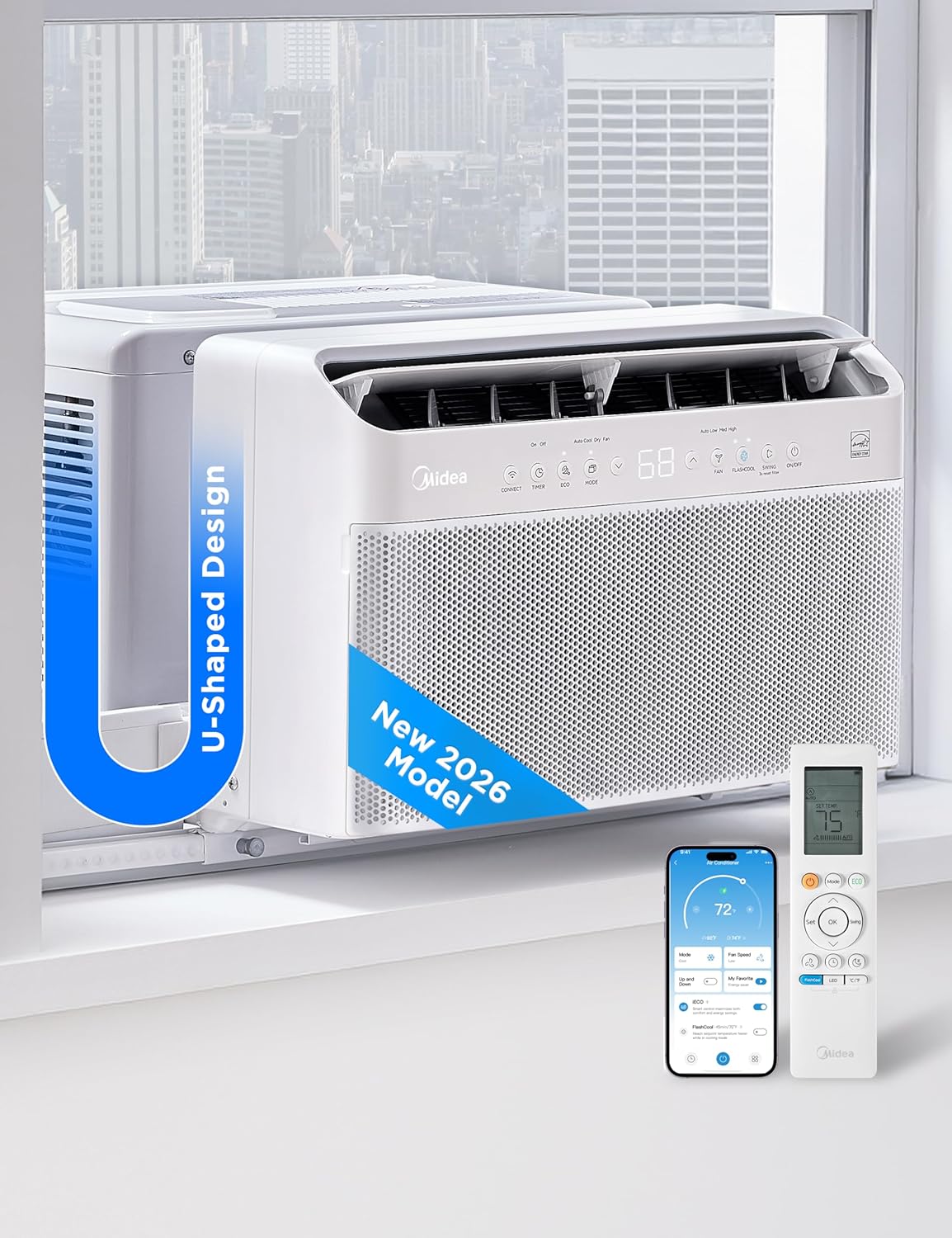
If you only read one section, read this one. The Midea U-Shaped Smart Inverter is the unit that quietly took over the window AC category over the last few years, and the 2026 edition refines the formula instead of reinventing it. The U-shape is the gimmick that turns out to be genuinely useful — the compressor sits outside the window, the indoor portion is short enough that you can close the sash on top of it, and you can still open your window for fresh air without uninstalling anything.
The 12,000 BTU rating cools up to 550 square feet, which covers most master bedrooms and standard living rooms. The inverter compressor is rated to cut energy use by around 37% versus a comparable non-inverter unit. In practice that means the unit ramps up and down smoothly instead of slamming on and off, and you’ll hear it less, especially at night when you’re trying to sleep.
Wi-Fi is built in. The MideaAir app handles scheduling, geofencing (turn it on when you’re 5 minutes from home), and temperature presets. Alexa and Google Assistant are both supported, so “Hey Google, set the bedroom to 68” works out of the box without any extra hub. The unit also has a sleep mode that gradually warms the room overnight so you’re not freezing at 4 a.m.
Why it’s our top pick: It’s the rare appliance that’s quiet enough to actually sleep next to, energy-efficient enough that you won’t dread the July electric bill, and smart enough that you’ll actually use the features instead of just leaving the remote on the nightstand.
Pros:
- U-shape design lets you keep the window functional
- Inverter compressor — quiet, smooth, energy-efficient
- 550 sq ft coverage at 12,000 BTU
- Wi-Fi, Alexa, and Google Assistant all built in
- Around 37% energy savings vs. standard models
- Sleep mode for overnight comfort
Cons:
- Heavier than a comparable non-inverter unit (around 80 lbs)
- Premium price — costs more than a basic 12K BTU window AC
- U-shape installation requires specific window dimensions (verify before buying)
- Installation kit is fiddly the first time
Frigidaire 8,000 BTU Smart Window Air Conditioner with Wi-Fi — Best Mainstream Pick
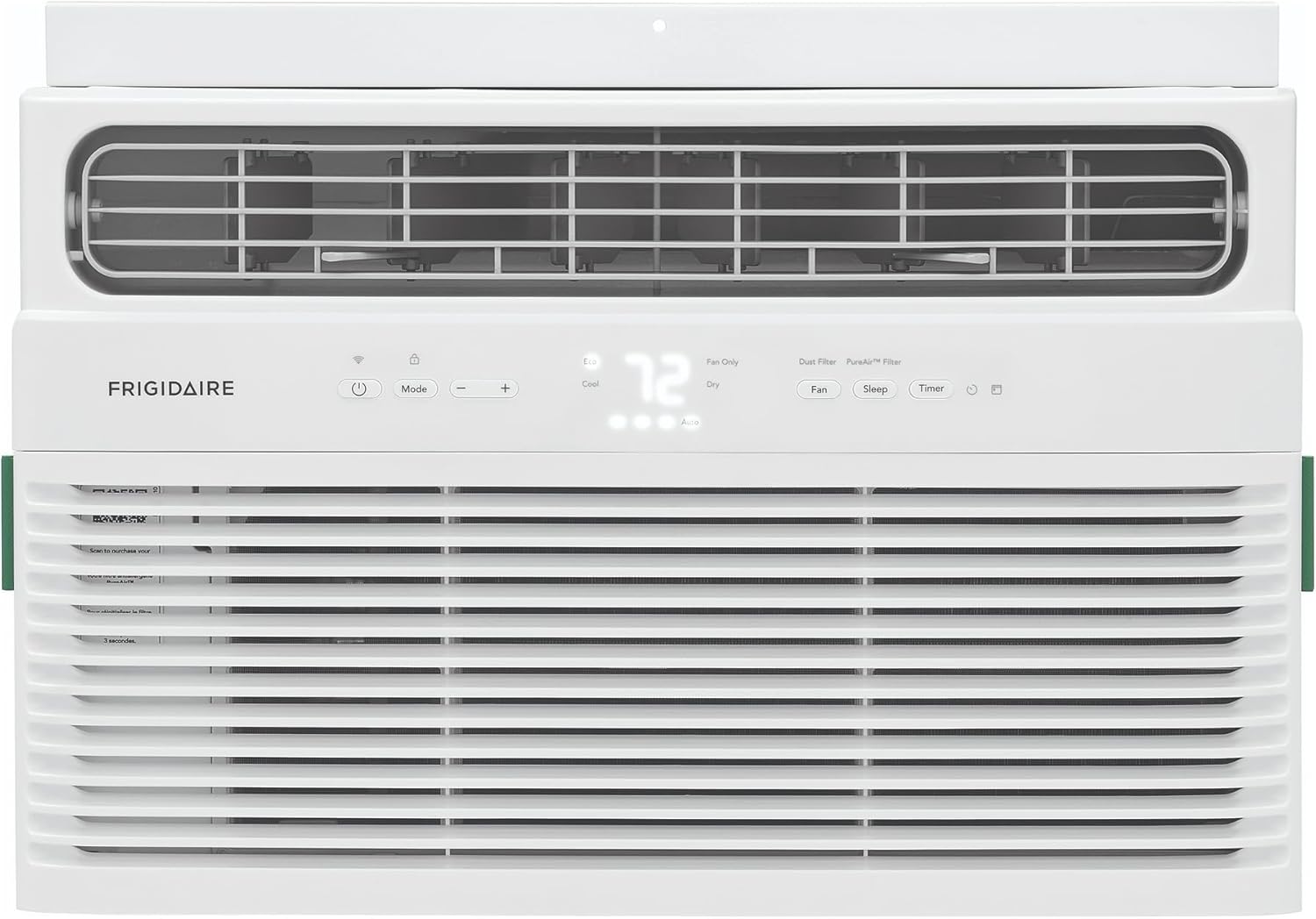
For the most common scenario — a bedroom or living room around 300-350 square feet — the Frigidaire 8,000 BTU Smart Window Air Conditioner with Wi-Fi is the easiest call. Frigidaire has been making window units forever, the install kit is foolproof, and the smart features actually work.
The 8,000 BTU rating is the sweet spot for medium rooms. Too small and the unit runs constantly trying to catch up. Too large and you get clammy air because the compressor cycles off before pulling enough humidity. Frigidaire sizes this one right for 350 sq ft, and you can run it on three fan speeds plus an Eco mode that throttles the compressor when the room is close to setpoint.
Wi-Fi setup is through the Frigidaire 2.0 app, which is honestly better than it has any right to be — clean scheduling interface, temperature presets, and a “weekly” mode that lets you set different comfort levels for different days. Remote control is also included for the times when you’d rather not pull out your phone.
Why it earned the mainstream pick: It’s the unit you’d recommend to your parents. Trusted brand, well-sized BTU, real smart features, and a price that doesn’t sting.
Pros:
- Strong 350 sq ft coverage at 8,000 BTU
- Frigidaire 2.0 app is genuinely good
- Three fan speeds plus Eco mode
- Includes remote control as a backup to the app
- Easy install with the included window kit
- Quieter than most non-inverter units in this class
Cons:
- No inverter compressor — cycles on/off more than the Midea
- No native Matter support yet (Wi-Fi only via app)
- Window kit feels a bit plasticky
- Filter is washable but small — clean it monthly during heavy use
GE Window Air Conditioner 8,000 BTU Wi-Fi Enabled — Best Easy-Install Option
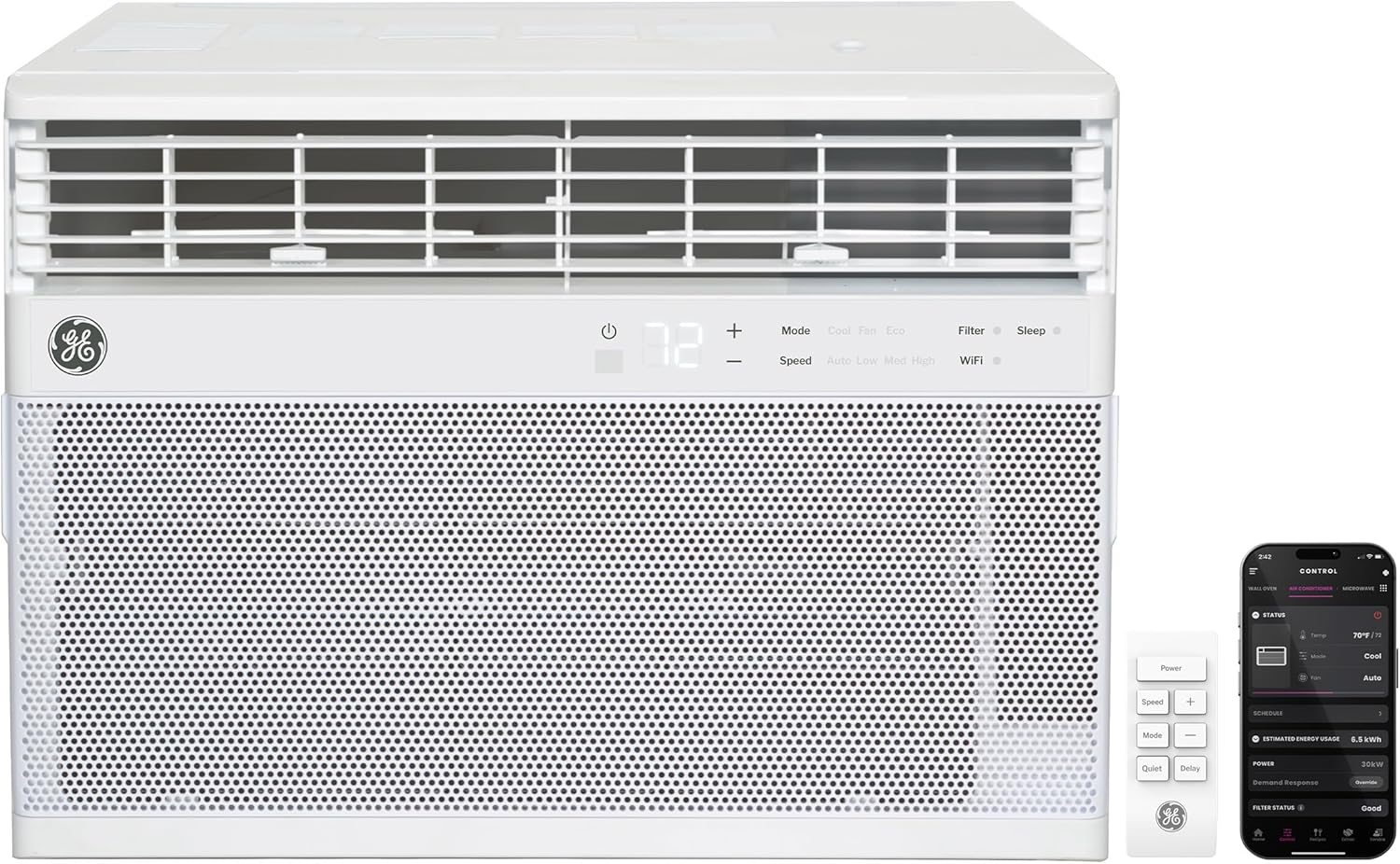
GE has spent the last few years quietly rebuilding their connected appliance lineup, and the GE Window Air Conditioner 8,000 BTU Wi-Fi Enabled is a beneficiary. It’s a head-to-head competitor with the Frigidaire — same 8,000 BTU class, same 350 sq ft coverage, similar feature set — but with a few details that make it the easier first window AC for a smart-home beginner.
The install kit is the best part. GE includes a one-piece foam side panel and pre-cut screws, so you’re not improvising a seal with weatherstripping the way you do with some units. The energy-efficiency rating is also competitive with the Frigidaire, and the unit hits 350 square feet without straining.
The smart side runs through the SmartHQ app — same app that controls GE laundry, dishwashers, and ovens, so if you have any other GE Profile or Cafe appliances you already know the drill. Wi-Fi setup is the standard scan-the-QR-code routine. The app supports schedules, energy-saver mode, and remote start. Alexa and Google Assistant work via the SmartHQ skill.
Why it earned easy-install pick: The install kit is genuinely the most forgiving in this guide. If you’ve never installed a window AC and you’re nervous, this is the one.
Pros:
- Best-in-class install kit with pre-cut foam panel
- 350 sq ft coverage at 8,000 BTU
- SmartHQ app is shared with other GE appliances
- Alexa and Google Assistant supported
- Solid build quality you’d expect from GE
- Quieter than the cheap no-name units
Cons:
- No inverter compressor in this model
- SmartHQ app can be slow to reconnect after power outages
- Higher price than a non-connected 8K BTU GE
- No Matter support
TCL 8000 BTU Smart Window Air Conditioner — Best Budget Smart Pick
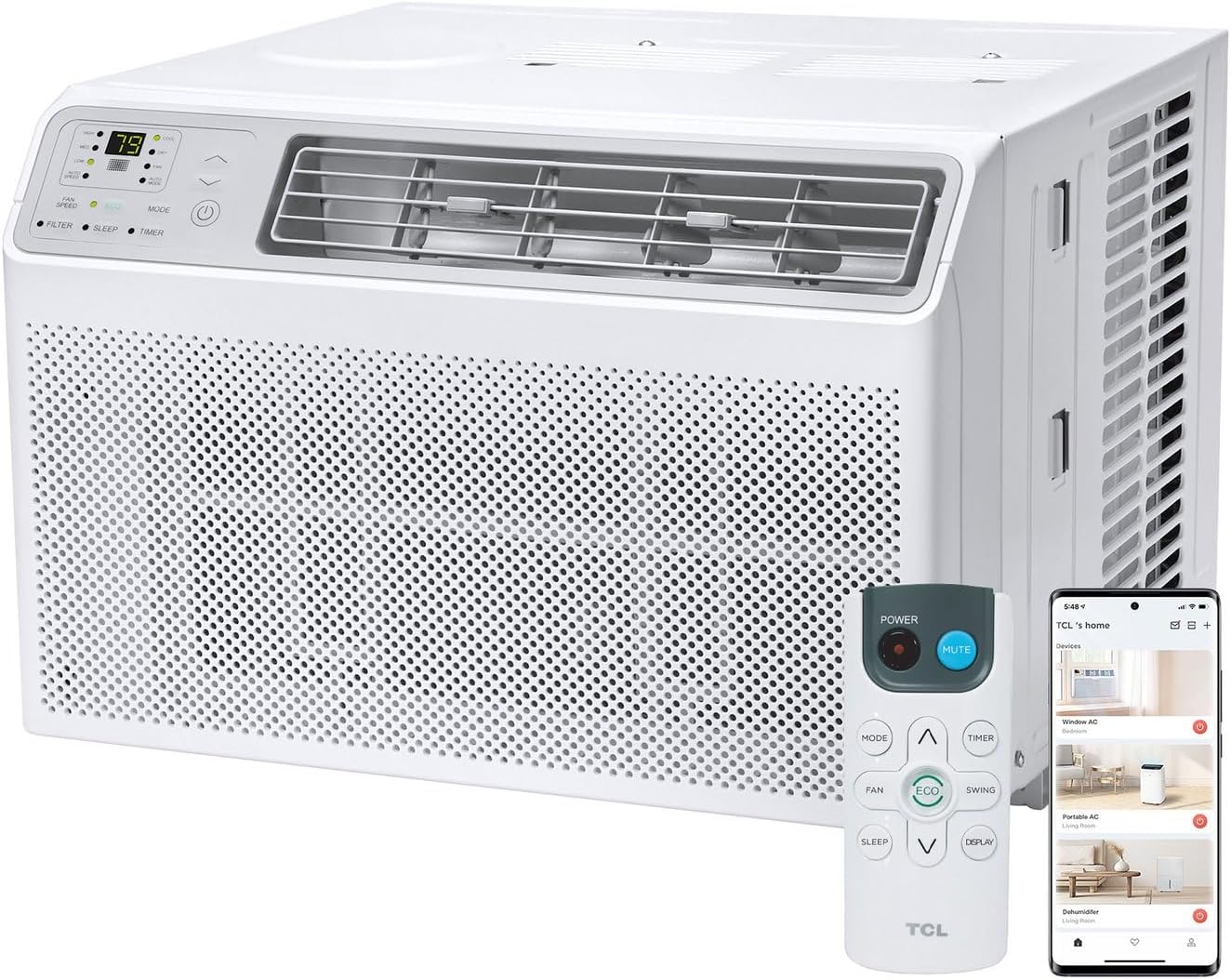
If you want full smart features without paying the Frigidaire or GE premium, the TCL 8000 BTU Smart Window Air Conditioner is the value play. TCL is best known for budget TVs, but their appliance lineup has been catching up fast, and this unit delivers most of what the bigger brands charge a premium for.
You get 8,000 BTU, 350 sq ft coverage, three fan speeds, a fan-only mode, a dehumidifier mode, and full Alexa, Google Assistant, and TCL Home app control. The TCL Home app isn’t as polished as Frigidaire’s, but it covers the basics — remote on/off, scheduling, temperature setpoint, and mode switching.
The big trade-off is build quality. The plastic feels lighter, the control panel is a step behind, and the install kit isn’t as refined as GE’s. But the cooling performance is genuinely competitive in a 350 sq ft room, and if budget is the deciding factor, this is the smart window AC that gets you the most cooling-per-dollar without giving up Wi-Fi or voice control.
Why it earned the budget pick: It does 90% of what the mainstream picks do for noticeably less money. The compromise is build quality, not features.
Pros:
- Lowest price for an 8,000 BTU smart window AC with full voice support
- Works with Alexa, Google Assistant, and TCL Home app
- Includes dehumidifier and fan-only modes
- 350 sq ft coverage
- Remote control included
Cons:
- Build feels cheaper than Frigidaire/GE
- TCL Home app has some rough edges
- No inverter compressor — louder cycling
- Install kit is the weakest in this guide — buy weatherstripping foam
Windmill Window Air Conditioner 6,000 BTU — Best Design and Quietest
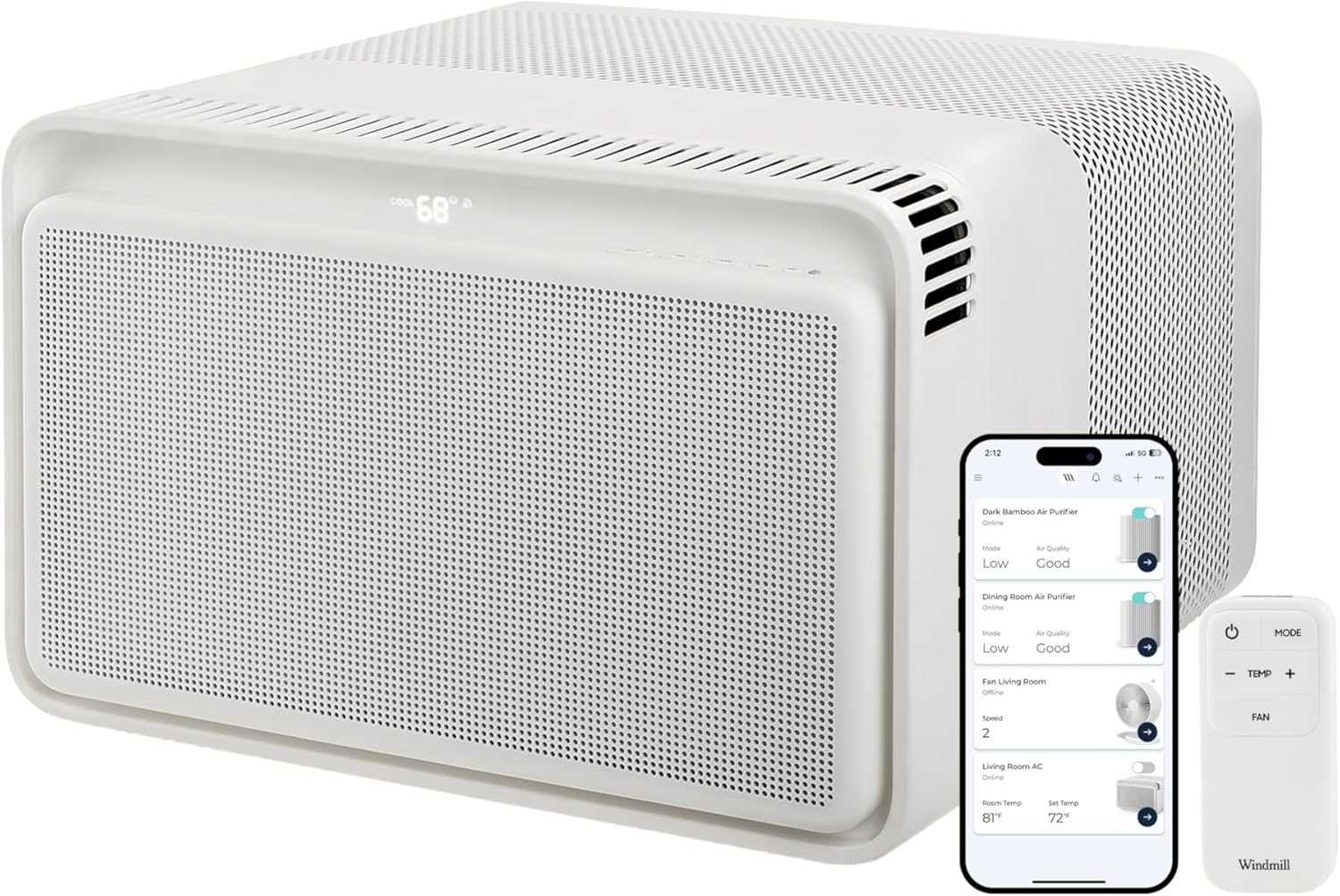
Windmill is the startup that decided window ACs didn’t have to look terrible, and the Windmill Window Air Conditioner 6,000 BTU is the result. The front panel is a sleek matte finish with a hidden display — no garish red LED clock blinking 12:00 at 2 a.m., no fake-wood plastic accents. It’s the only window AC in this guide that you wouldn’t want to hide behind curtains.
The 6,000 BTU rating covers up to 250 square feet — small bedrooms, home offices, nurseries. The unit is designed to be genuinely quiet (Windmill rates it at around 51 dB on low fan), which matters in a bedroom because cheap window ACs are loud enough to wake you up when the compressor kicks on.
Smart features are full-stack: Wi-Fi via the Windmill app, Alexa and Google support, scheduling, and a fast-cooling boost mode. The app also tracks your energy use, which is a nice touch nobody else is bothering with at this price.
The unit ships with a side panel that adheres to the window for a cleaner seal, so cold air doesn’t leak in (or out in summer). Windmill also offsets the carbon footprint of every unit sold, if that matters to you.
Why it earned the design and quiet pick: It looks like an Apple product, sleeps quieter than most ACs in this category, and the smart features are actually polished. The only reason it’s not our top overall is the 6,000 BTU size — too small for most living rooms.
Pros:
- Cleanest design of any window AC on the market
- Genuinely quiet (~51 dB on low fan)
- Full Wi-Fi, Alexa, and Google Assistant support
- Energy tracking built into the app
- Carbon-offset by the manufacturer
- Better install kit than the budget options
Cons:
- 6,000 BTU is too small for rooms over 250 sq ft
- Price is higher than comparable 6K BTU units
- No inverter compressor
- Front panel hides the manual controls (good aesthetically, annoying if the app is down)
LG 14,000 BTU DUAL Inverter Smart Window Air Conditioner — Best for Large Rooms
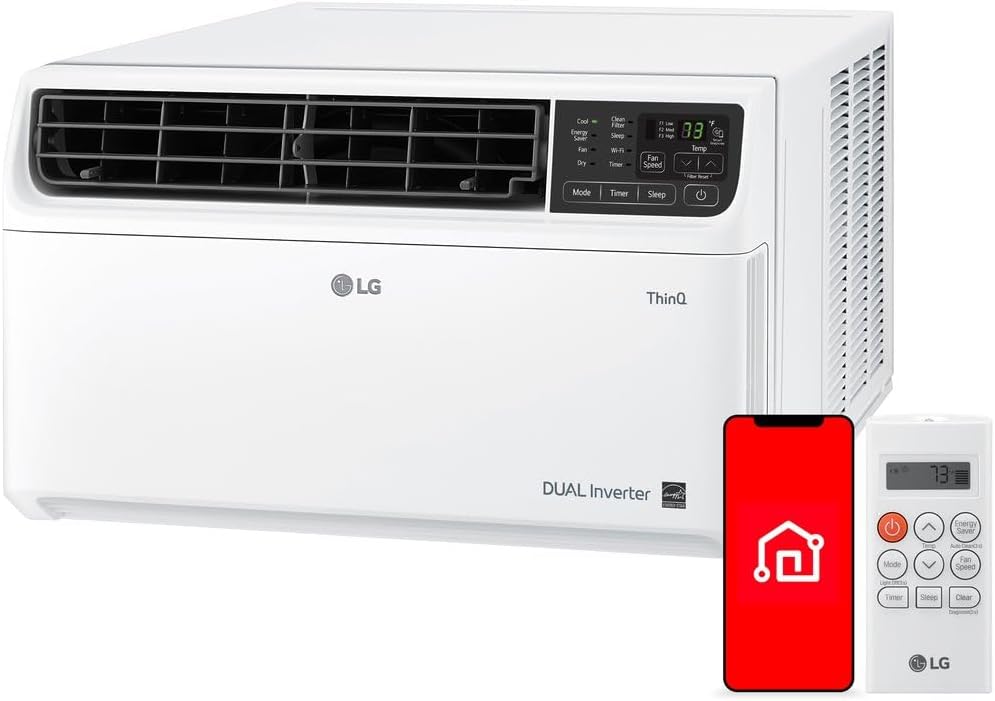
When the room is over 500 square feet — open-concept living rooms, studio apartments, finished basements — you need real BTU, and the LG 14,000 BTU DUAL Inverter Smart Window Air Conditioner is the heaviest hitter in this guide. It cools up to 800 square feet while still being quiet enough to live with, thanks to LG’s dual inverter compressor design.
The dual inverter is the headline feature. Most inverter window ACs use one variable-speed compressor; LG uses two, which gives it more usable range — gentler at low loads (saves electricity, runs quiet) and stronger at high loads (knocks down a hot room fast). It’s also ENERGY STAR certified, which is harder to come by in the 14,000 BTU class than it sounds.
Smart features run through LG ThinQ, the same app that handles their laundry and refrigerators. Wi-Fi setup is straightforward, and Alexa plus Google Assistant (“Hey Google”) are both supported. ThinQ has a “smart diagnosis” feature that listens to the unit and flags potential issues, which is the kind of thing you don’t realize is useful until your AC starts making a noise at midnight and you want to know if it’s serious.
Heads up: this unit is heavy and tall. Measure your window opening before you buy. It’s a real 115V plug (works with a standard outlet, no special wiring needed), but the unit’s footprint is bigger than the 8,000 BTU class.
Why it earned the large-room pick: 14,000 BTU plus dual inverter plus ThinQ smart features is a combo nobody else matches at this size. If you have a big room to cool, this is the one.
Pros:
- 800 sq ft coverage — handles large living rooms and studios
- Dual inverter compressor: quieter and more efficient
- ENERGY STAR certified
- LG ThinQ app with smart diagnosis
- Alexa and Google Assistant supported
- Standard 115V outlet (no special wiring)
Cons:
- Heavy and bulky — needs a strong window frame
- Premium price (highest in this guide)
- Overkill for rooms under 500 sq ft
- Install requires two people
Smart Window AC Comparison
| Model | BTU | Coverage | Inverter | Voice Assistants | Best For |
|---|---|---|---|---|---|
| Midea U-Shaped Smart Inverter (2026) | 12,000 | 550 sq ft | Yes | Alexa, Google | Best overall |
| Frigidaire 8,000 BTU Smart Wi-Fi | 8,000 | 350 sq ft | No | Alexa, Google | Mainstream pick |
| GE 8,000 BTU Wi-Fi | 8,000 | 350 sq ft | No | Alexa, Google | Easy install |
| TCL 8000 BTU Smart | 8,000 | 350 sq ft | No | Alexa, Google | Budget |
| Windmill 6,000 BTU | 6,000 | 250 sq ft | No | Alexa, Google | Quietest, best design |
| LG 14,000 BTU DUAL Inverter | 14,000 | 800 sq ft | Yes (dual) | Alexa, Google | Large rooms |
Buying Guide: How to Pick a Smart Window AC
Match BTU to Room Size
The single most common mistake is buying the wrong-size unit. Use this as a starting point and adjust up if your room gets full sun, has high ceilings, or you live somewhere that hits the high 90s for weeks at a time:
- 150-250 sq ft (small bedroom, home office): 5,000-6,000 BTU
- 250-350 sq ft (standard bedroom, small living room): 7,000-8,000 BTU
- 350-550 sq ft (large bedroom, medium living room): 10,000-12,000 BTU
- 550-800 sq ft (large living room, studio apartment): 13,000-14,000 BTU
- 800+ sq ft (open concept): consider a portable AC, a second window unit, or mini-split
Going bigger than you need is worse than going smaller. Oversized units cool the room fast, then shut off before they’ve pulled enough humidity. The result is a cold, clammy room. Right-sized units run longer at lower power and pull more moisture.
Inverter vs. Standard Compressor
Inverter compressors are worth the premium if you’re going to run the unit a lot. The compressor variable-speeds instead of clicking on and off, which means:
- 30-40% less electricity during typical use
- Quieter operation — no loud kick-on every 10 minutes
- More stable temperature — closer to 1°F variance instead of 3-4°F
- Longer lifespan — fewer compressor start cycles
If the unit will only run a few weeks a year, a standard compressor is fine and saves you $100-200 upfront. If it’s going to run all summer, the inverter pays for itself in electricity by year two or three.
What “Smart” Actually Gets You
Smart features sound like a gimmick until you use them. The features that genuinely matter:
- Geofencing: the AC kicks on when you’re a few minutes from home and shuts off when you leave. This alone can cut your summer cooling bill 15-25% versus leaving it on a timer.
- Scheduling: cool the bedroom down before you go to bed, warm it back up before you wake. Sleep is better, electric bill is lower.
- Remote shutoff: you’ll use this every time you leave for the weekend and realize four hours in that you forgot to turn the AC off.
- Voice control: nice-to-have rather than essential. The novelty wears off, but “Alexa, set the bedroom to 70” in the middle of the night without finding your phone is genuinely useful.
- Energy monitoring: only Windmill bothers with this at a useful level in our picks, but it helps you understand which usage patterns are blowing up your bill.
Pairing a smart plug from our energy-saving guide with a non-Wi-Fi window AC is a workaround, but it can only turn the unit fully on or off — it can’t change temperature. Built-in Wi-Fi is worth paying for if you want real control.
Installation Tips
- Measure twice. Window opening width and height matter. So does sill depth (the unit needs to tilt back slightly for drainage).
- Two people. Anything over 6,000 BTU is heavy enough that you want a second person holding the unit while you secure the brackets.
- Use the included support bracket for heavy units (10,000 BTU and up). If your unit didn’t come with one, buy one — a 70-pound AC unsupported on a window sill is a structural risk.
- Seal gaps. Use the foam included in the install kit, plus weatherstripping if there are any visible gaps. Air leaks defeat the whole point of the unit.
- Tilt slightly outward. About 1/4 inch over the length of the unit. This lets condensation drain outside instead of pooling inside.
If you’re cooling a multi-room space, a window AC plus a smart ceiling fan is the cheapest way to extend the cooled air without buying a second AC.
Energy Costs
A typical 8,000 BTU window AC running 8 hours a day at 12 cents/kWh costs roughly $25-35/month. A 12,000 BTU unit closer to $40-55/month. Inverter models knock 30-40% off both numbers. A smart thermostat doesn’t directly control a window AC, but pairing one with a smart window unit lets you balance whole-home cooling intelligently if you’ve got central air on one floor and a window unit on another.
Frequently Asked Questions
Do smart window ACs need a hub? No. All six picks in this guide connect over standard 2.4 GHz Wi-Fi straight to your router. Alexa and Google Assistant integrations also work without a hub — they piggyback on your existing Echo or Nest speaker.
Will a smart window AC keep working if my Wi-Fi goes down? Yes. The unit still runs on its own thermostat, and the included remote works as a backup. You just lose the app and voice control until Wi-Fi is back.
Can I control a smart window AC when I’m away from home? Yes — that’s the main reason to buy one. The manufacturer apps (MideaAir, Frigidaire 2.0, SmartHQ, TCL Home, Windmill, LG ThinQ) all connect through the manufacturer’s cloud, so you can adjust the temperature, start it before you get home, or shut it off remotely from anywhere with cell service.
Are smart window ACs more expensive than regular ones? About $50-150 more, depending on the model. The smart features pay for themselves in 1-2 summers if you use scheduling or geofencing to avoid cooling an empty house.
Do these work with Apple HomeKit? Not natively in this guide. LG ThinQ has limited Apple support for some appliances, but window ACs aren’t currently included. If HomeKit matters to you, the Midea U-shaped also has a Matter-compatible variant — verify Matter support on the listing before you buy.
Will it work in a sliding window or casement window? No. All six picks are designed for standard double-hung windows. For sliders and casements you need a casement-specific window AC or a portable unit with a vent kit.
How loud is “quiet”? The quietest in this guide (Windmill on low fan) is about 51 dB — slightly louder than a refrigerator hum, quieter than a normal conversation. Inverter units (Midea, LG) stay quieter when running at partial load because the compressor isn’t constantly cycling. A 1980s-era window AC by comparison is around 60-65 dB, which is loud enough to interrupt TV.
What about portable air conditioners? Portable ACs are easier to install (no window bracket, just a vent hose) but typically use 20-40% more electricity for the same cooling, and they’re louder because the compressor is inside the room with you. A window unit is the better pick if your window can fit one.
Bottom Line
The Midea 12,000 BTU U Shaped Smart Inverter Window Air Conditioner (2026 Edition) is our top pick for most readers. It’s quiet, energy-efficient, smart-home-ready out of the box, and the U-shape design solves the biggest annoyance of window ACs — you can still open your window.
If your room is smaller and you want the cleanest-looking, quietest option, the Windmill 6,000 BTU is the easy call. For a standard 300-350 sq ft bedroom or living room, Frigidaire’s 8,000 BTU Smart Wi-Fi is the most forgiving choice and won’t surprise you with bad software. GE’s 8,000 BTU Wi-Fi is the friendlier install if you’re nervous about putting a window unit in for the first time. TCL’s 8,000 BTU Smart is the budget play if app polish matters less than getting Wi-Fi and Alexa for less money. And if you’ve got a big open room, the LG 14,000 BTU DUAL Inverter is the only pick on this list that can handle 800 square feet without straining.
Buy the right BTU for your room, prioritize an inverter compressor if you’ll run it all summer, and use the scheduling and geofencing features — they’re the entire reason a smart AC pays for itself.