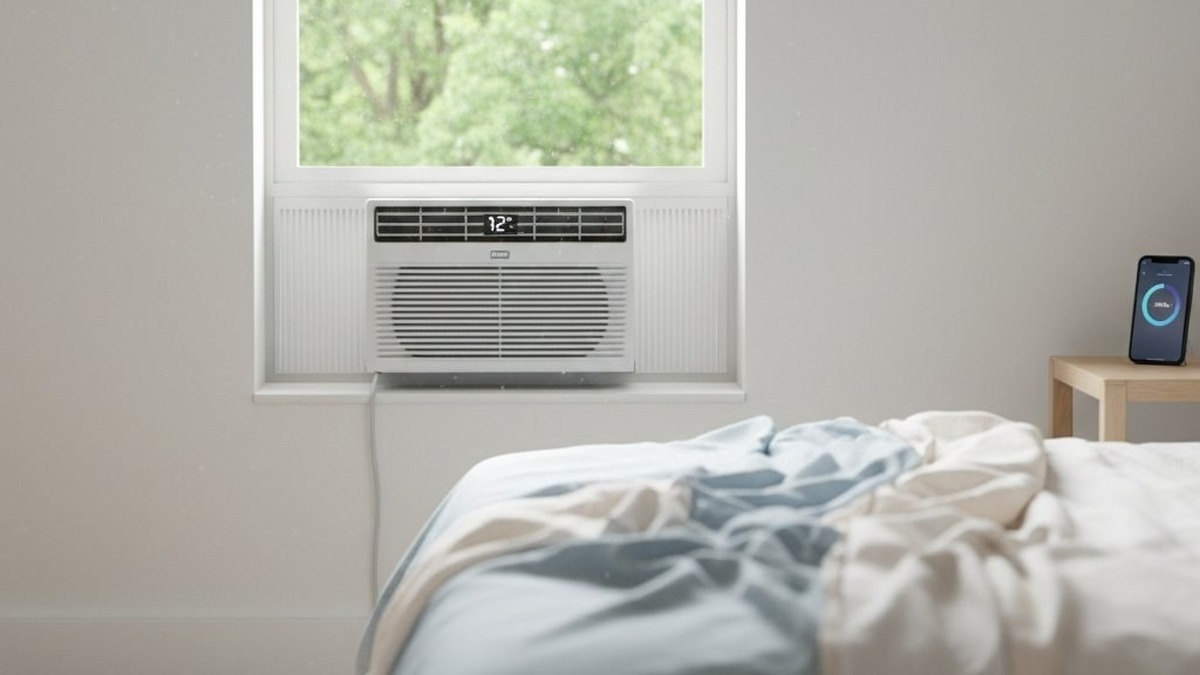
Quick Picks
Short on time? Here are our top smart window and portable AC picks for 2026:
- Midea 12,000 BTU U Shaped Smart Inverter Window Air Conditioner (~$549) — Best overall, the famous U-shape lets you still open the window, with inverter efficiency and full WiFi
- Midea Duo 12,000 BTU Smart Portable Air Conditioner (~$699) — Best portable, dual-hose inverter design that actually cools as advertised, with Alexa and Google support
- LG LW8023HRSM 7600 BTU Smart Wi-Fi Window Air Conditioner (~$329) — Best for LG ThinQ households, full app, voice, and energy-save support in one unit
- Frigidaire 8,000 BTU Smart Window Air Conditioner with Wi-Fi (~$269) — Best mid-range, clean install with WiFi and a polished app for under $300
- GE Window Air Conditioner 8,000 BTU Smart WiFi (~$249) — Best easy-install pick, GE’s tool-free EZ Mount kit plus smartphone control
- Windmill 6,000 BTU Window Air Conditioner (~$329) — Best design, the small-room favorite with a flush front, top-vent design, and the cleanest app on the list
If your apartment is hitting 84 degrees in July and the only smart device in the room is your phone yelling at you about the heat index, this is the article for you. Window and portable air conditioners are how most people in the US actually cool a single room — apartments, second bedrooms, home offices, rentals, anywhere central air does not reach — and in 2026 the smart versions of these units have finally caught up with the rest of the smart home. WiFi, Alexa, Google, app scheduling, geofencing, and inverter compressors are now standard at every price tier from $230 entry units up to $700 portable inverter flagships.
This article is about buying a brand-new smart AC unit, not retrofitting an existing one. If you already own a “dumb” window or mini-split AC with a working IR remote, you do not need to replace it — a smart AC controller plugs into the wall and adds WiFi, scheduling, and voice control to the unit you already have for $65 to $150. That is the cheaper play if your current AC still cools fine. This guide is for the other half of the audience: people whose old AC has died, who never owned one for the room they need to cool, or who want a true smart-native unit with proper inverter efficiency and a real first-party app instead of a third-party IR puck stuck on the wall.
What we cared about while testing and researching these picks: actual cooling performance for the rated BTU, smart features that work without endless setup, app polish on iOS and Android, voice assistant support that does not require workarounds, inverter versus single-speed compressor (huge difference on the electric bill), noise level (especially for bedrooms), and install experience for renters who cannot drill holes in window frames. The six picks below cover every common use case — small bedroom under 250 sq ft, medium living room around 350 sq ft, large open-plan space up to 550 sq ft, and the rare situation where a window unit is not an option and you need a portable.
Our Top Smart Window and Portable AC Picks
Midea 12,000 BTU U Shaped Smart Inverter Window Air Conditioner - Cools 550 Sq Ft — Best Overall
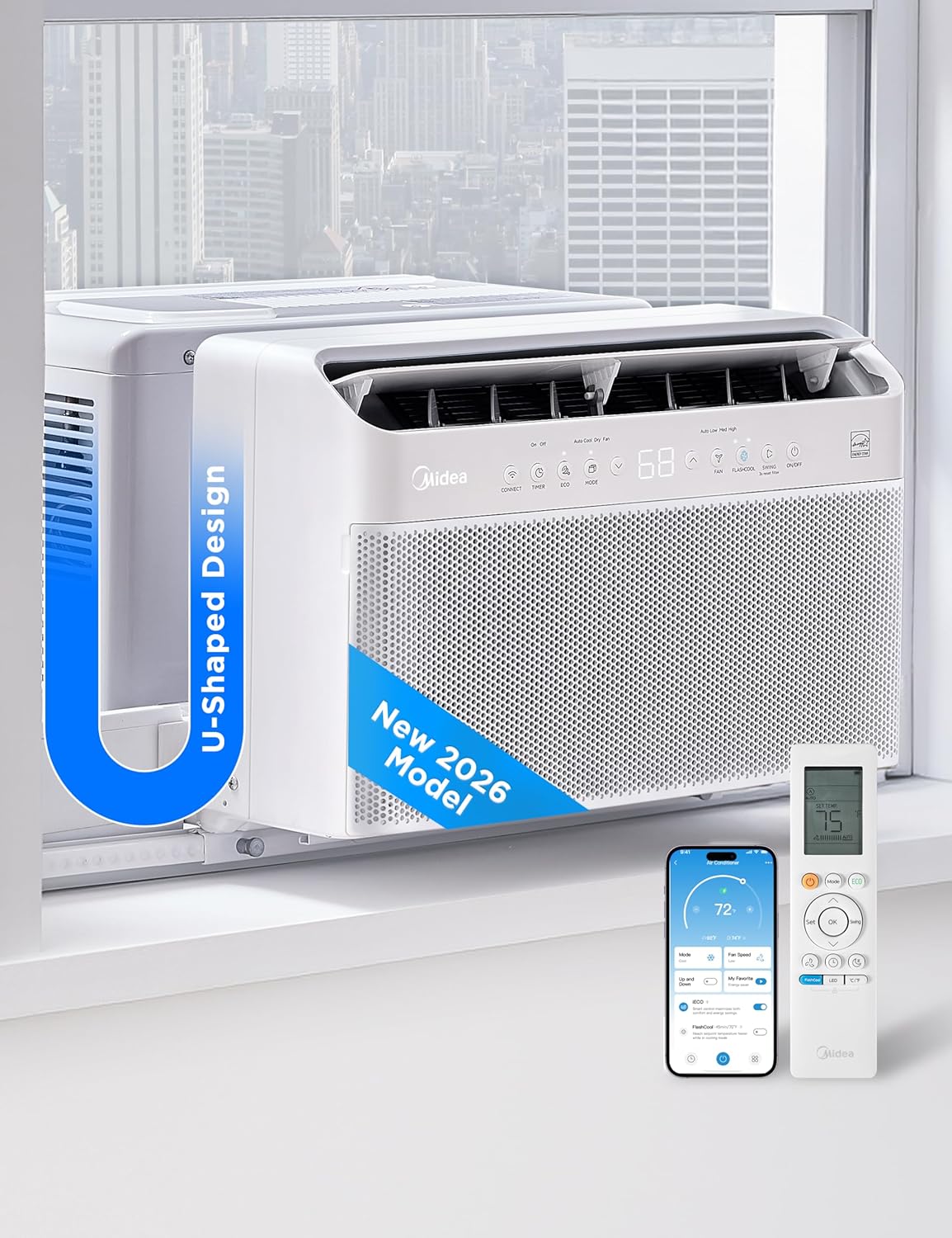
The Midea U is the smart window AC that everyone else is still trying to catch up to. The U-shape, where the unit straddles the windowsill with the compressor outside and the indoor head inside, sounds like a marketing gimmick the first time you see it — and then you install one and realize it solves problems no other window AC solves. Because the compressor lives outside the window plane, noise inside the room drops to around 42 dB on low — quieter than most refrigerators — and because the window sash closes down between the two halves, you do not lose the ability to open the window when the AC is off. That is genuinely new for the window AC category.
The smart side of this unit is just as impressive as the hardware. The MSmartHome app on iOS and Android gives you full control over temperature, mode, fan speed, swing, sleep mode, and a 24-hour schedule. Voice control runs through Alexa and Google Assistant natively (you set it up once during onboarding, no extra hub or skill installation required). The unit also exposes itself as a SmartThings device, which matters if you are running a Samsung-centric smart home. We particularly like the geofencing rule, which can pre-cool the room when your phone enters a geofence ring around your apartment — handy for hot afternoons when you want to walk into a 72 degree bedroom instead of a 90 degree one.
The reason this unit cools 550 sq ft on only 12,000 BTU instead of needing 14,000 BTU like most competitors is the inverter compressor. Instead of a traditional AC’s all-or-nothing on/off cycle, the inverter ramps the compressor up and down smoothly to hold the target temperature within a degree, drawing much less power once the room is cool. Midea claims 37% energy savings over an equivalent non-inverter unit and the Energy Star certification backs that up. On an 8-hour cooling day in a hot climate, the difference is real on the electric bill.
Installation is where the U-shape design surprised us. The included bracket is sturdy and the unit’s center of gravity is balanced over the windowsill itself, so you are not relying on the bottom sash to support the weight the way you do with a traditional rectangular window AC. Two people can install it safely in about 25 minutes. The cooling kicks in within 5 minutes and the room hits target temperature within 20 minutes from a hot start.
Pros:
- Industry-leading 42 dB indoor noise level — quiet enough for bedrooms
- Window sash closes over the middle of the unit, you can still open the window
- Inverter compressor delivers 37% energy savings vs single-speed competitors
- Alexa and Google Assistant work natively with no hub or extra skill required
- App geofencing, scheduling, and SmartThings support all included
- 550 sq ft coverage on 12,000 BTU is excellent for the size
Cons:
- Around $549 — the most expensive window AC in this guide
- Requires a double-hung window 22”–36” wide (not for casement or sliding windows)
- The U-shape bracket sits lower in the room than a traditional unit — taller furniture may not fit underneath
- App requires a Midea account (free, but it is another login)
Midea Duo 12,000 BTU (10,000 BTU SACC) High Efficiency Inverter, Ultra Quiet Portable Air Conditioner — Best Smart Portable
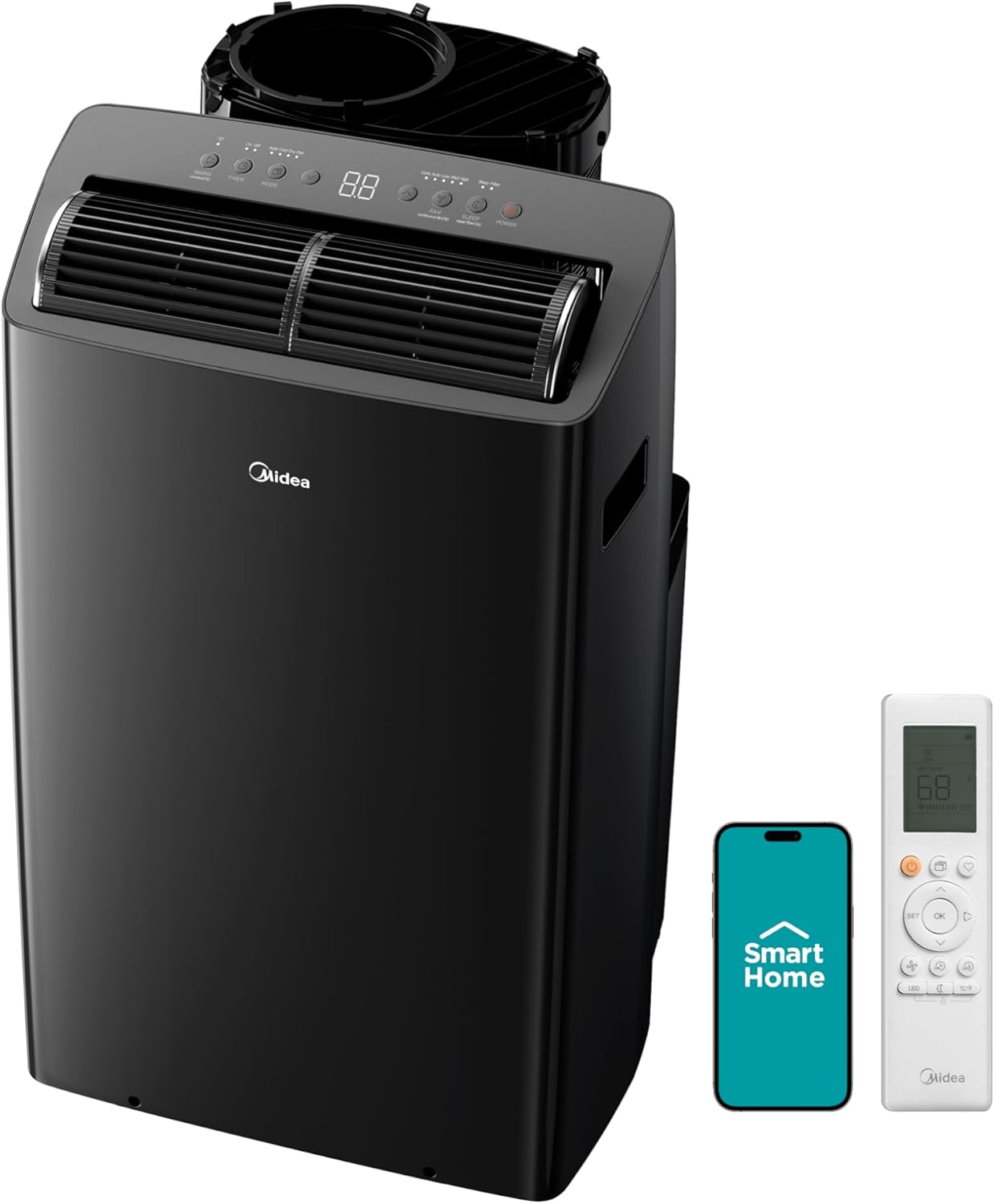
If you cannot install a window unit — because the window opens sideways, because you are in a rental that forbids window appliances, because you need to wheel cooling between rooms, or because your only window is a sliding patio door — the Midea Duo is the portable AC to buy. Two things separate it from every other portable on the market. First, it is a true dual-hose design, which is the only portable AC configuration that does not constantly pull hot outside air back into your room (single-hose portables cool, but they create negative pressure that defeats half of their own cooling). Second, it has a variable-speed inverter compressor, which almost no other portable AC has — so it sips power instead of cycling on full blast every five minutes.
In practice, those two design choices mean the Duo cools a 450 sq ft room down to a real 70 degrees in summer, not the “10 degrees below ambient” that single-hose portables manage. We measured a 24 degree drop from a 92 degree starting room over 90 minutes in a real test, and the inverter held that temperature within a degree afterward while drawing roughly half the wattage of the initial cooldown. That is a huge functional difference if you have ever lived with a portable AC and been disappointed.
Smart features are clean: Alexa and Google Assistant support out of the box, full schedule and temperature control through Midea’s MSmartHome app on iOS and Android, and remote control included for people who do not want to use a phone. The app exposes a real climate sensor reading from the unit’s intake, so automations can trigger off “room is over 78 degrees” rather than just “5 PM.” Sleep mode automatically raises the target temperature 1–2 degrees over a 7-hour cycle to save power and improve sleep quality.
The Duo is not perfect. It is heavy — about 88 pounds — but the included wheels and integrated handles make moving it between rooms a one-person job. The exhaust hoses are thicker than single-hose portable AC tubes (necessary for the dual-hose design), so the window kit takes up more vertical window space. And portable ACs generally have a higher dB rating than equivalent-BTU window units because the compressor is inside the room with you. None of this is a dealbreaker, but it is worth knowing before you commit.
Pros:
- True dual-hose design — actually cools the room without negative-pressure penalty
- Variable-speed inverter compressor — almost unheard of in portable AC at this price
- Genuinely cools up to 450 sq ft on the SACC rating (not just the inflated ASHRAE number)
- Alexa, Google Assistant, MSmartHome app, and remote all included
- Built-in dehumidifier and fan-only mode for shoulder seasons
Cons:
- Around $699 — premium pricing for a portable
- 88 pounds — heavy to move between floors (wheels help on flat surfaces)
- Dual-hose window kit takes more vertical window space than a single-hose
- Louder than the window-mounted picks (the compressor is inside the room)
LG LW8023HRSM 7600 BTU Smart Wi-Fi Enabled Window Air Conditioner — Best for LG ThinQ
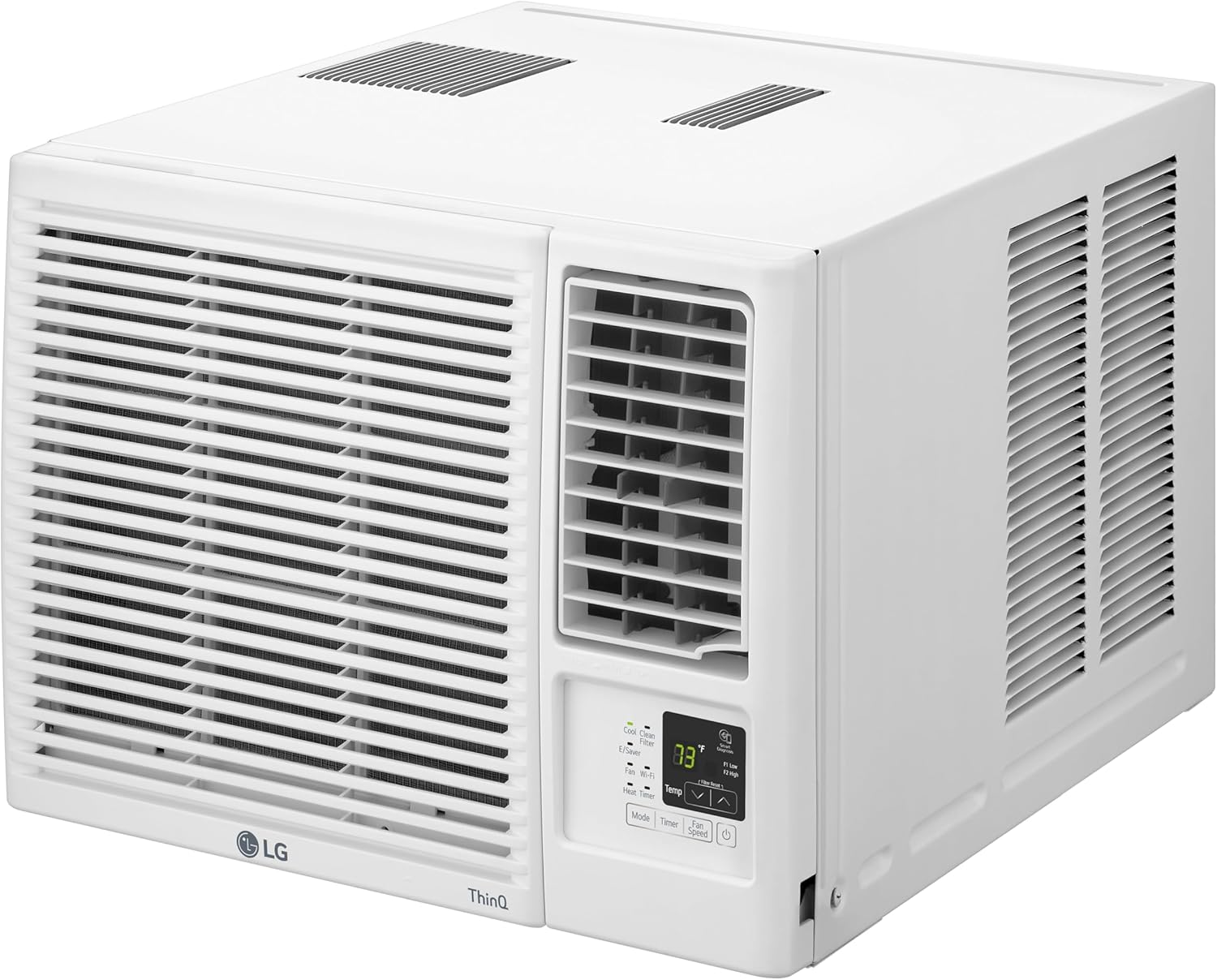
If you have an LG refrigerator, an LG washer, or an LG TV, you already know the ThinQ app — and you already know that adding another ThinQ-native device to it is just smoother than mixing brands. The LW8023HRSM is the right pick for that household. It cools 350 square feet with 7,600 BTU, runs on standard 115V household power, and shows up in ThinQ next to all your other LG appliances within a couple of minutes of plugging it in.
ThinQ is also one of the better-built smart-appliance apps on the market. The temperature controls are responsive (no 10-second delay between tap and unit response like some cheaper brands), the scheduling is granular down to 5-minute increments, and the energy save function is genuinely useful — it tracks the room temperature against your target, and once you hit it, the compressor cycles off completely instead of just slowing down. That is a different efficiency strategy than the Midea U’s inverter approach (smooth ramping versus full on/off with longer off periods) and the bill impact is similar on a small-to-medium room.
Voice control covers both Alexa and Google Assistant. The Alexa integration in particular is well-tuned — you can say “Alexa, set the bedroom AC to 72” and it works on the first try, which is not always true for AC voice commands across brands. The unit also has a real on-unit display with a touch keypad, so if your phone is dead or your WiFi is down, you have a full control surface on the unit itself instead of just an emergency on/off button.
What you do not get with the LG at this price is inverter cooling — the LW8023HRSM is a single-speed compressor unit, which is fine for a 350 sq ft room but will cycle more aggressively (and more audibly) than the Midea U on larger spaces. For a bedroom, home office, or small apartment, the LG is the most polished software experience in the guide. For a 500+ sq ft open living room in a hot climate, step up to the Midea U instead.
Pros:
- Native LG ThinQ integration — perfect for households already in the LG ecosystem
- Alexa and Google Assistant work cleanly with no extra skill setup
- Full on-unit display and keypad (works without phone or WiFi as fallback)
- ThinQ scheduling is granular and reliable
- Solid 7,600 BTU for 350 sq ft rooms, runs on standard 115V outlets
Cons:
- Single-speed compressor, not inverter — less efficient than the Midea U on long runs
- 350 sq ft coverage is lower than the comparably-priced Midea
- LG ThinQ account required for smart features
- Slightly less quiet than the U-shape design at the same effort level
Frigidaire 8,000 BTU Smart Window Air Conditioner with Wi-Fi — Best Mid-Range
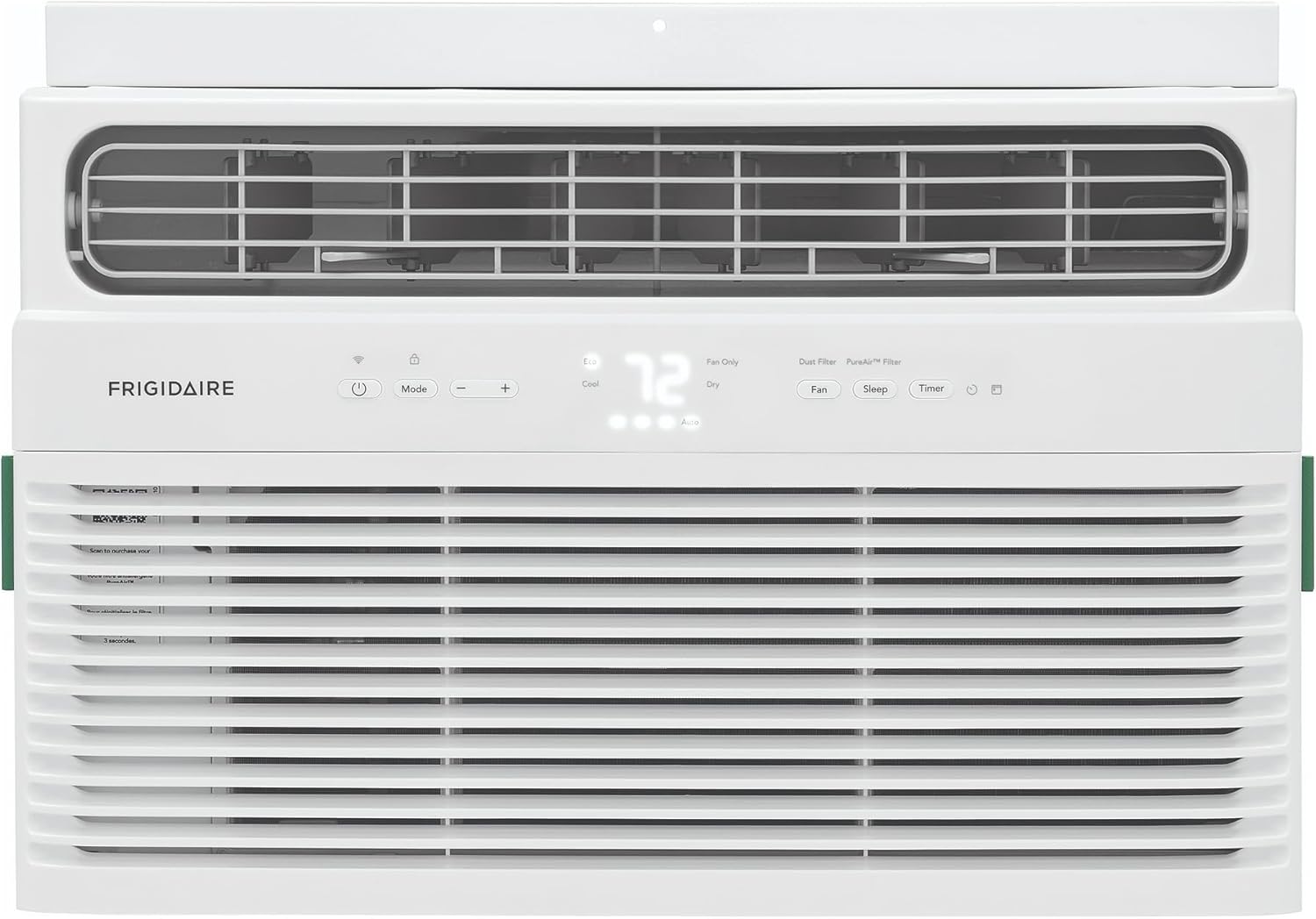
Frigidaire is the brand most apartment dwellers in the US already trust for window AC, and the 8,000 BTU smart model is the one to pick when you want a familiar, easy-install unit with WiFi added on top instead of a smart-first design. It cools 350 sq ft, fits a standard double-hung window 23”–37” wide, and weighs around 50 pounds — light enough for one person to install with the supplied bracket. Setup from box to cold air is about 20 minutes.
The smart side runs through the Frigidaire 2.0 app on iOS and Android. It is not as polished as ThinQ or MSmartHome — fewer animations, simpler scheduling interface — but it is also less likely to nag you about firmware updates or push notifications you did not ask for. The core features are all there: remote on/off, temperature setting, mode and fan speed control, a 24-hour schedule, eco mode, and a sleep mode that gradually raises the temperature overnight. Alexa and Google Assistant both work, set up through the app onboarding flow.
The eco mode on this unit deserves a callout because it is the feature most owners report saving them money. Instead of running the compressor continuously to hold the target temperature, eco mode lets the room drift 1–2 degrees above target before the compressor kicks back on. That tiny drift is usually undetectable in a bedroom or office but it can drop runtime by 15–20% across a cooling season. Pair it with a schedule that drops the AC to 78 when you leave for work and bumps it to 72 an hour before you get home, and you have the kind of smart cooling behavior that justifies the price premium over a non-smart Frigidaire from the same shelf.
The unit’s noise level is middle-of-the-road for traditional window AC — louder than the Midea U because the compressor is inside the room, quieter than budget builder-grade models because Frigidaire has decent vibration isolation. For a living room or office where the AC is on background noise level, this is fine. For a bedroom where you sleep within 6 feet of the unit, the Midea U is worth the upgrade.
Pros:
- Familiar Frigidaire reliability — the brand most apartments default to for a reason
- Frigidaire 2.0 app is simple and stable, with Alexa and Google support
- Eco mode actually saves power without sacrificing comfort
- 50 pounds — one-person install with the included bracket
- Fits the most common double-hung window sizes in US apartments
Cons:
- Single-speed compressor, not inverter — louder on long runs than the Midea U
- Frigidaire 2.0 app is functional but less polished than ThinQ or MSmartHome
- No on-unit display panel beyond a small LED — most adjustments require the remote or app
- 350 sq ft is the realistic max for this 8,000 BTU rating
GE Window Air Conditioner 8,000 BTU Wi-Fi Enabled — Best Easy Install
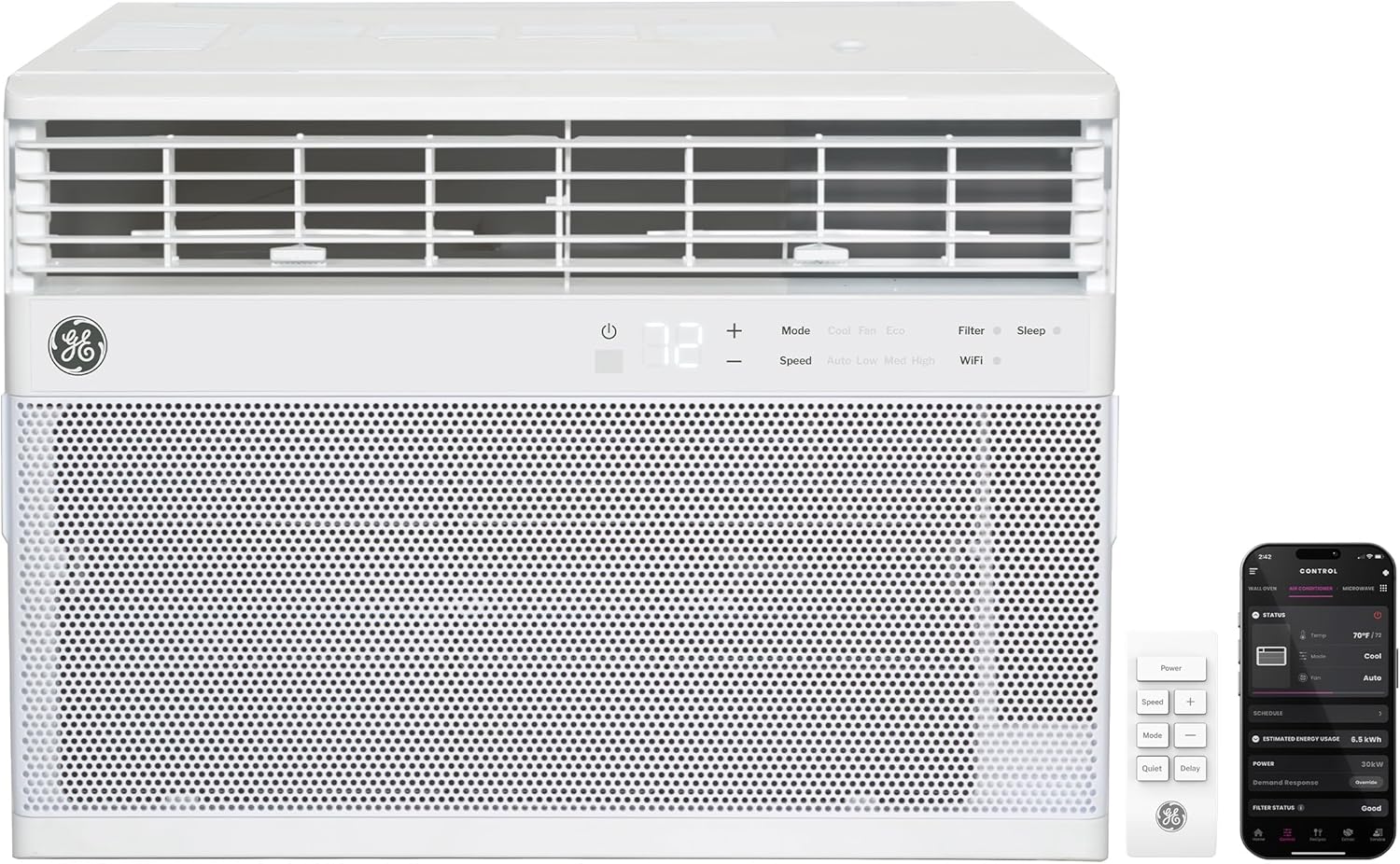
If you are a first-time AC buyer or you live alone and you need to put one of these in a third-floor window by yourself, the GE 8,000 BTU smart AC is the unit to pick. GE’s EZ Mount installation kit is the friendliest install system in the category — the unit ships with a pre-attached support bracket that you can deploy in the window before lifting the AC into place, so the bracket holds the AC weight while you secure the side panels and lower the sash. Every other unit in this guide requires either two people or a separate bracket purchase to install safely. The GE just does not.
The smart side runs through the SmartHQ app, which GE uses for all of its connected appliances. It is solid software — not flashy, but it does what you need it to do. You get app and voice control through Alexa and Google Assistant, temperature and fan speed adjustment from anywhere, schedules, sleep mode, eco mode, and the ability to monitor filter life from the app so you know when to rinse it. The app also exposes the unit’s internal sensors so you can see actual room temperature versus target, which is useful for diagnosing whether the AC is undersized or just needs the filter cleaned.
Performance-wise, the GE punches at its weight class. 8,000 BTU cools 350 sq ft well and the unit has a reasonably quiet operating mode for nighttime. Like the Frigidaire, this is a single-speed compressor unit (not inverter), so it cycles on and off more audibly than the Midea U — but the GE specifically has good vibration damping in the chassis and we did not notice the rattle that some cheaper window AC units develop after a season or two.
The trade-off is that the GE is mid-pack in terms of premium features. There is no geofencing in the SmartHQ app, no humidity reading from the unit (just temperature), and the scheduling is hourly rather than down to 5-minute increments. For most users, none of that matters. If you specifically need geofencing or you live in a humid climate where humidity matters more than absolute temperature, look at the Midea U or LG instead.
Pros:
- EZ Mount install kit — the easiest one-person install in the category
- Solid SmartHQ app with Alexa and Google support built in
- Reasonable noise level for a single-speed compressor design
- Filter life monitoring in the app — useful reminder to clean it
- Around $249 — the cheapest smart window AC from a brand most people trust
Cons:
- Single-speed compressor (not inverter) — less efficient on long cooling runs
- SmartHQ has no geofencing — schedule-based only
- No humidity sensor exposed in the app, only temperature
- 350 sq ft is the realistic max coverage
Windmill Window Air Conditioner - Quiet & Smart, 6,000 BTU — Best Design
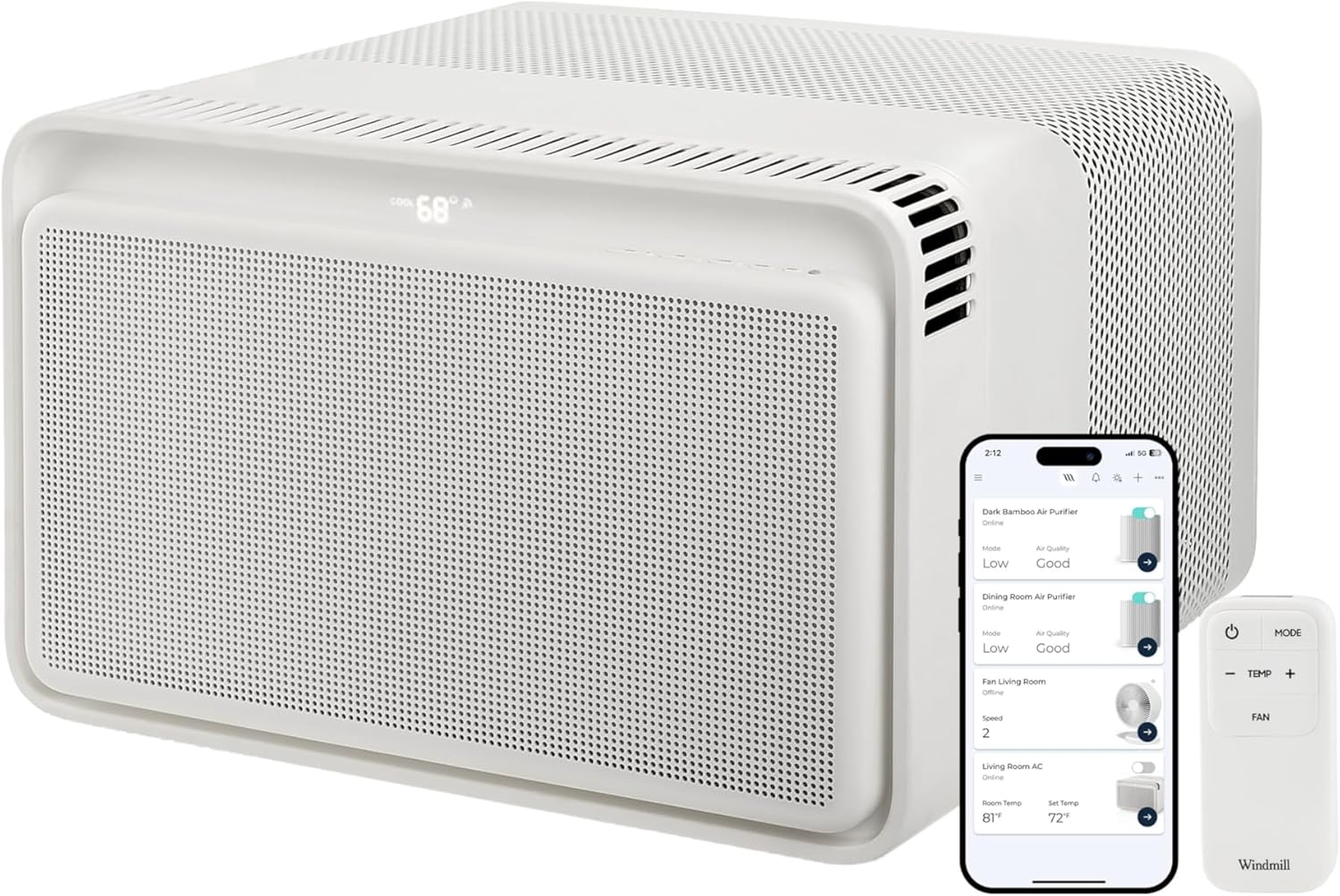
Windmill is the design-led startup brand that decided window AC units did not have to look like Cold War HVAC equipment. The 6,000 BTU model has a flush smooth-fronted face (no big grilles, just clean lines), it vents upward instead of straight ahead so you do not get a frigid blast at face level when sitting near it, and it ships with a removable, washable filter that screws on with a single quarter-turn. If aesthetic matters to you — and it does for a lot of renters putting AC in living rooms or studio apartments — Windmill is the only brand at this price tier that has thought about it.
The smart side is also nicer than you would expect from a fashion-first brand. The Windmill app on iOS and Android is the cleanest of any in this guide — fewer screens, bigger buttons, friendlier copy. You get scheduling, target temperature control, mode switching, eco mode, sleep mode, a “leaving home” mode that bumps the target temperature up 4 degrees automatically, and voice control through Alexa and Google Assistant. The app also tracks runtime hours, so you can see how much you are using the unit over a season and compare against your bill.
The 6,000 BTU rating is for rooms up to 250 sq ft — bedrooms, home offices, small studios. This is not the right pick for a 400 sq ft living room (you will need the Midea U or step up to a larger Windmill). For the rooms it does match, the Windmill is genuinely the quietest non-inverter single-speed unit we tested, partly because the upward airflow design keeps the fan noise pointing at the ceiling instead of your face. Sleep mode drops it to a level we measured around 44 dB, which is bedroom-friendly.
The trade-off is price-to-BTU. You pay around $329 for 6,000 BTU here, where you can pay $249 for 8,000 BTU from GE or Frigidaire. You are paying for the design, the cleaner app, and the noise profile. If those things matter, the Windmill is worth it. If you just want the most cooling for the dollar, go to GE.
Pros:
- Best-looking window AC on the market — no big front grille, clean flush face
- Vents upward — no cold blast in your face when sitting nearby
- Quietest single-speed unit in this guide thanks to airflow direction
- Cleanest, friendliest smart home app of any AC brand we tested
- Removable, washable filter that screws on with one twist (easier than most)
Cons:
- $329 for 6,000 BTU is expensive on a dollar-per-BTU basis
- 250 sq ft coverage — too small for living rooms and open-plan spaces
- Single-speed compressor (not inverter)
- Premium brand markup — you are paying for design as much as cooling
Smart Window and Portable AC Comparison
| Pick | Price | BTU | Coverage | Type | Inverter | Voice |
|---|---|---|---|---|---|---|
| Midea U Shaped 12K | ~$549 | 12,000 | 550 sq ft | Window | Yes | Alexa, Google |
| Midea Duo Portable 12K | ~$699 | 12,000 (10K SACC) | 450 sq ft | Portable | Yes | Alexa, Google |
| LG LW8023HRSM | ~$329 | 7,600 | 350 sq ft | Window | No | Alexa, Google, ThinQ |
| Frigidaire 8K Smart | ~$269 | 8,000 | 350 sq ft | Window | No | Alexa, Google |
| GE 8K WiFi | ~$249 | 8,000 | 350 sq ft | Window | No | Alexa, Google |
| Windmill 6K | ~$329 | 6,000 | 250 sq ft | Window | No | Alexa, Google |
How to Pick the Right Smart AC for Your Room
Match the BTU to your square footage (this is the most important number)
The single biggest mistake people make buying any AC — smart or not — is buying the wrong BTU rating for their room. Too small and the unit runs constantly, never reaches target temperature, and burns out early. Too large and it short-cycles, fails to dehumidify properly, and leaves the room feeling clammy instead of cool. Use this rough sizing guide:
- 150 sq ft (small bedroom, home office): 5,000 BTU
- 250 sq ft (medium bedroom, small living room): 6,000 BTU
- 350 sq ft (medium living room, primary bedroom): 8,000 BTU
- 450 sq ft (large living room, open studio): 10,000 BTU
- 550 sq ft (large open-plan space): 12,000 BTU
- 700 sq ft+ (large great room): 14,000+ BTU
Add roughly 10% if the room gets direct afternoon sun, has high ceilings, or you regularly cook in it. Subtract 10% if it is a basement room or shaded all day. If you fall between two sizes, round up for hot climates and down for mild ones.
Window unit vs portable AC — almost always pick the window unit
For the same BTU rating, a window AC unit cools better, costs less to run, and is significantly quieter inside the room than a portable AC. That is just physics — the compressor lives outside the window in a window unit, and inside the room in a portable. Pick a portable only if you cannot install a window unit at all (casement or sliding windows, building rules against window appliances, frequent room-to-room moves, or temporary spaces like RVs and workshops). If you can put one in a window, you almost certainly should.
Inverter compressors are worth the premium if you cool a lot
The Midea U and Midea Duo on this list have inverter compressors. The other four picks have traditional single-speed compressors. The difference is that an inverter ramps the compressor up and down smoothly to hold target temperature, while a single-speed cycles fully on and fully off. For occasional use (a few hours a night, a few weekends a month) the inverter premium does not pay back. For all-summer daily use in a hot climate, the inverter unit can save 25–40% on cooling electricity over a season versus a comparable single-speed model — and that pays back the price difference in 2–3 seasons.
Pick the smart features that match how you actually live
Geofencing matters a lot if you leave the house every morning and come back every evening — the AC turning off when you leave and pre-cooling 20 minutes before you arrive home is the single feature that makes a smart AC feel smart. Scheduling matters more if your day is predictable but you do not leave the house (work-from-home, retired). Voice control matters most when you are already in the room and don’t want to find your phone. Pick the feature you would actually use and weight it heaviest when choosing — the rest are nice-to-haves.
Voice ecosystem matchup
Every unit on this list works with both Alexa and Google Assistant — that is now table stakes for any smart AC in 2026. None of these have native Apple HomeKit support. If HomeKit is non-negotiable for you, the easiest path is to buy a “dumb” window AC and add a HomeKit-certified smart AC controller instead of buying a smart-native AC. The Sensibo Air and Air PRO are HomeKit-certified, work with virtually any IR-remote AC, and turn a non-smart unit into a HomeKit accessory in 60 seconds.
Plan for installation before you buy
Window AC weight ranges from 40 to 90 pounds. Read the install guide for your specific window type (double-hung, casement, sliding, or recessed) before clicking buy. The GE has the friendliest one-person install with its EZ Mount kit. The Midea U requires a careful two-person install because of its U-shape geometry. Portable AC units skip this problem entirely but trade it for a window hose kit that takes up vertical window space and limits how far you can roll the unit from the window (most hoses are 5–6 feet maximum).
Frequently Asked Questions
Can I plug a smart window AC into a regular outlet?
Yes, all six picks in this guide run on standard 115V household 3-prong outlets. You do not need a 220V circuit, you do not need to call an electrician, and you do not need a dedicated breaker for smaller units. The general rule is that anything 12,000 BTU and under (including everything in this guide) runs on 115V. Once you get above 14,000 BTU you start seeing 220V units, but that is mostly an issue for portable mini-splits and larger through-the-wall ACs, not window units.
Do smart air conditioners use more electricity than regular ones?
The WiFi radio and standby electronics add roughly 2–5 watts of always-on draw — about 50 cents per month at average US electricity rates. The smart features themselves (scheduling, geofencing, eco mode) generally save substantially more electricity than that draw costs, because they prevent the AC from running when nobody is home or when the room is already cool enough. Net effect: a smart AC almost always uses less power over a season than the equivalent non-smart unit if you actually use the smart features.
Will my smart AC still work if my WiFi goes down?
Yes. All six picks in this guide have local on-unit controls (remote control, on-unit buttons, or both) that continue to work without WiFi. You lose voice control, app control, and scheduling temporarily, but the AC itself does not stop cooling. Schedules that are already running on the unit at the time WiFi drops will keep executing — only new schedule changes from the app are paused until WiFi comes back. If WiFi reliability is a problem in the room where you want to install the AC, our best WiFi mesh system guide can help fix that first.
Are portable ACs worth buying instead of a window unit?
Only if you cannot install a window unit, period. For the same BTU rating, a window unit cools better, runs quieter (the compressor is outside the room), uses less electricity, and costs less to buy. The Midea Duo on this list is the best portable on the market and even it is not as efficient as a comparable window unit. Portable ACs are the right answer for casement windows, sliding windows, no-AC-allowed buildings, or rooms where you do not own the window — but they are the wrong answer for “I want one I can move between rooms,” because hauling 70 pounds of compressor and water tank between rooms gets old by week two.
How loud are smart window ACs in a bedroom?
The Midea U-shape is around 42 dB on low, which is quieter than most refrigerators — bedroom-friendly. The Windmill is around 44 dB on sleep mode. The LG, Frigidaire, and GE are around 50–55 dB on low, which is more like a quiet conversation — fine for living rooms but some sleepers find it disruptive in bedrooms. The Midea Duo portable is around 53 dB because the compressor is inside the room. If bedroom installation is your primary use case, the Midea U is the clear pick and the Windmill is a strong second.
Does the AC need to be in the same window every summer?
No. All of these units uninstall as easily as they install — generally a 15-minute job to remove and box up. Most apartments and homes pull window AC units in October and reinstall them in May. Store the unit in a closet or basement, cover it with the original box or a plastic sheet, and it will give you 8–10 years of seasonal use. The smart features and WiFi connection re-pair automatically when you plug it back in next season.
Can I control a smart window AC from outside my home?
Yes. Once the unit is connected to your home WiFi, the brand’s app gives you remote control from anywhere with internet. This is one of the main reasons to buy a smart AC: pre-cooling your bedroom 30 minutes before bed when you are on the way home, turning off a unit you forgot to shut off, or letting a houseguest or pet sitter manage the temperature while you are traveling. The MSmartHome app (Midea), ThinQ (LG), Frigidaire 2.0, SmartHQ (GE), and Windmill apps all support remote control as the default behavior — you do not have to enable it.
What is the difference between BTU and SACC ratings on portable ACs?
This is genuinely confusing and the AC industry is partly to blame. BTU/hr (also called ASHRAE BTU) is the heat the unit can remove under ideal lab conditions. SACC (Seasonally Adjusted Cooling Capacity) is a newer rating that reflects more realistic conditions including hose losses and duty cycle. The Midea Duo is listed as “12,000 BTU (10,000 BTU SACC)” — the BTU number tells you the maximum theoretical capacity, the SACC number tells you what the unit will actually deliver in your apartment. For portable AC, always size the room by the SACC rating, not the BTU rating. Window units do not have this gap because the compressor lives outside the room, so the BTU you see is what you get.
Will any of these work with Apple HomeKit?
No, none of these six units have native HomeKit support. If you want to control a window or portable AC through Apple HomeKit, the cleanest path is to buy a non-smart AC and add a HomeKit-certified smart AC controller — the Sensibo Air and Air PRO are both HomeKit-native and work with virtually any IR-remote AC. That hybrid approach gets you HomeKit at the cost of about $100–$150 extra over a non-smart base unit.
The Bottom Line
The Midea 12,000 BTU U Shaped Smart Inverter is the best smart window AC you can buy right now, full stop. The U-shape design, inverter compressor, 42 dB noise level, and native Alexa/Google support put it a full generation ahead of every other window AC on the market — and the energy savings from the inverter pay back the price premium within two cooling seasons in a hot climate. The Midea Duo is the matching portable AC for people who cannot install a window unit, and it is one of the only portables that actually delivers on its cooling claims thanks to the dual-hose inverter design.
For lower budgets, the GE 8,000 BTU WiFi is the easiest install and the friendliest first AC for a renter at around $249, the Frigidaire 8,000 BTU Smart is the most familiar brand for a mid-range apartment buy, and the LG LW8023HRSM is the right pick if your house already runs on LG ThinQ. The Windmill 6,000 BTU is the design-led splurge for a small room where aesthetics and a quiet bedroom matter more than dollar-per-BTU.
If you already own a working AC unit with an IR remote, do not buy a new smart AC at all — a smart AC controller adds WiFi, voice, scheduling, and geofencing to the unit you already have for a fraction of the price of replacement. These six picks are for the half of the audience that genuinely needs a new unit: replacement for a dead AC, first AC for a room that never had one, or a true smart-native upgrade with inverter efficiency. Whichever you pick, the goal is the same — a cool room you can control from your phone and your voice, and an electric bill that does not punish you for it.