Quick Picks
Short on time? Here are our top sunrise alarm clock picks for 2026:
- Hatch Restore 3 (~$200) — Best overall, full sleep-and-wake routines with sunset wind-down and a huge sound library
- Philips SmartSleep Wake-up Light, HF3520/60 (~$160) — Best classic wake-up light, clinically tested sunrise simulation
- Lumie Bodyclock Shine 300 (~$150) — Best mid-range, simple, no app, no subscription
- Lumie Bodyclock Luxe 700FM (~$300) — Best premium light therapy lamp with FM radio and Bluetooth
- Dreamegg Sunrise 1 (~$80) — Best budget pick, customizable routines and 29 sounds without breaking $100
- REACHER Wood Grain Sunrise Alarm Clock (~$50) — Best for bedroom aesthetic, warm wood grain finish, big easy controls
If you have ever tried to drag yourself out of bed in a pitch-black room with a phone alarm screaming in your ear, you already know why sunrise alarm clocks exist. A good wake-up light gradually brightens over 20 to 60 minutes before your alarm, gently nudging your body out of deep sleep so you wake up feeling rested instead of jolted. The science behind this is solid — exposure to gradually increasing light suppresses melatonin and lifts cortisol naturally, which is exactly what your body is supposed to do at sunrise.
The catch is that “sunrise alarm clock” covers everything from a $25 dimming nightlight to a $300 medical-grade light therapy lamp. The cheap ones often barely get bright enough to make a difference, the brightest ones can be overkill for a small bedroom, and the smart ones can lock features behind a subscription. We sorted through the current top sellers on Amazon, focused on models with verified availability and strong real-world track records, and narrowed it down to six picks that cover every use case and budget.
Whether you’re a heavy sleeper who needs serious brightness, a Mother’s Day shopper looking for a thoughtful gift, or just somebody who wants to stop hating mornings, there’s a wake-up light here that will fit your room and your wallet.
Our Top Sunrise Alarm Clock Picks
Hatch Restore 3 — Best Overall
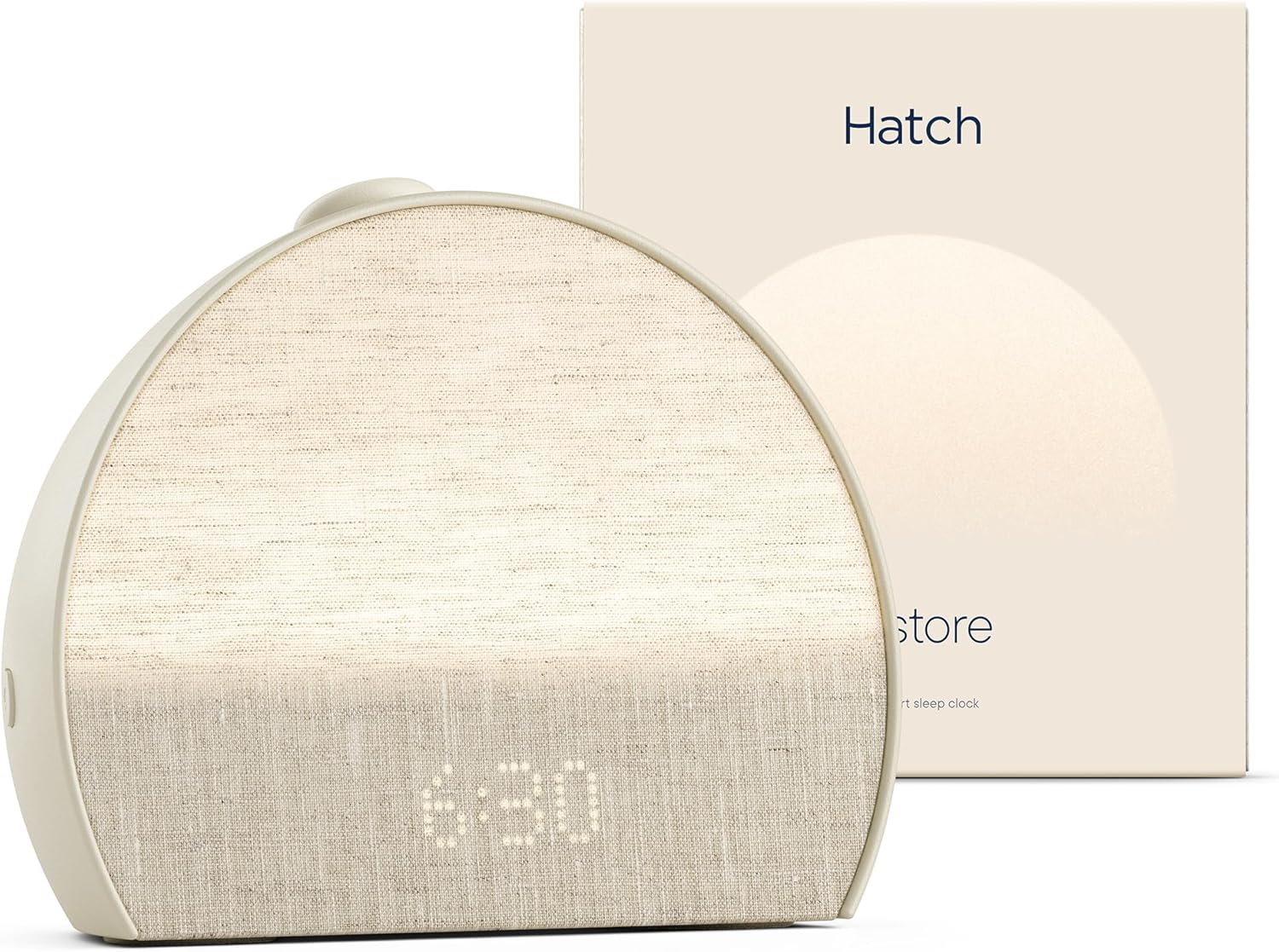
The Hatch Restore 3 is the closest thing to a complete sleep system you can buy without a sleep clinic. It is a sunrise alarm, a sunset light, a sound machine, a smart night light, and a sleep-tracker companion all in one screen-free puck that sits on your nightstand. The whole experience is built around routines: a wind-down routine that dims to a warm sunset, a sleep routine with white noise or rain or whatever sound you pick, and a wake-up routine that fades the light from a deep amber dawn to bright morning while a chosen sound rises with it.
The Restore 3 is controlled almost entirely through the Hatch Sleep app, which is the device’s biggest strength and also its main caveat. The app lets you stack content like guided meditations, sleep stories, and curated soundscapes, and it makes setting up multiple alarms (one for weekdays, a different one for weekends) genuinely easy. A premium subscription called Hatch Sleep Membership unlocks the bigger content library, but the included free content is plenty if all you want is sunrise plus white noise. The hardware itself does not require the subscription to function as a sunrise alarm clock — that part is always free.
What sets the Restore 3 apart from cheaper sunrise lights is the sunset side. The vast majority of wake-up lights only handle the morning. The Hatch handles your whole evening too — the same warm amber dome can run a 30-minute reading-light wind-down, then transition into a low-brightness night light, then run your sleep sound until your wake-up sequence kicks in. If you have trouble both falling asleep and waking up, this is the one to buy.
Pros:
- Full sunrise and sunset routines, not just morning
- Huge built-in library of sounds, white noise, and meditations
- Screen-free design — no glowing numbers staring at you all night
- Works as a reading lamp, night light, and sound machine
- Three physical buttons on top for quick control without the app
- Wide brightness range, dim enough for a bedside and bright enough to actually wake you
Cons:
- Premium content library requires the Hatch Sleep Membership subscription (~$70/year)
- Setup is app-only — there is no on-device-only mode for the wake-up
- USB-C powered, not battery — needs to stay plugged in
- Light is warm-toned only, no bright white light therapy mode
Philips SmartSleep Wake-up Light, HF3520/60 — Best Classic Wake-Up Light
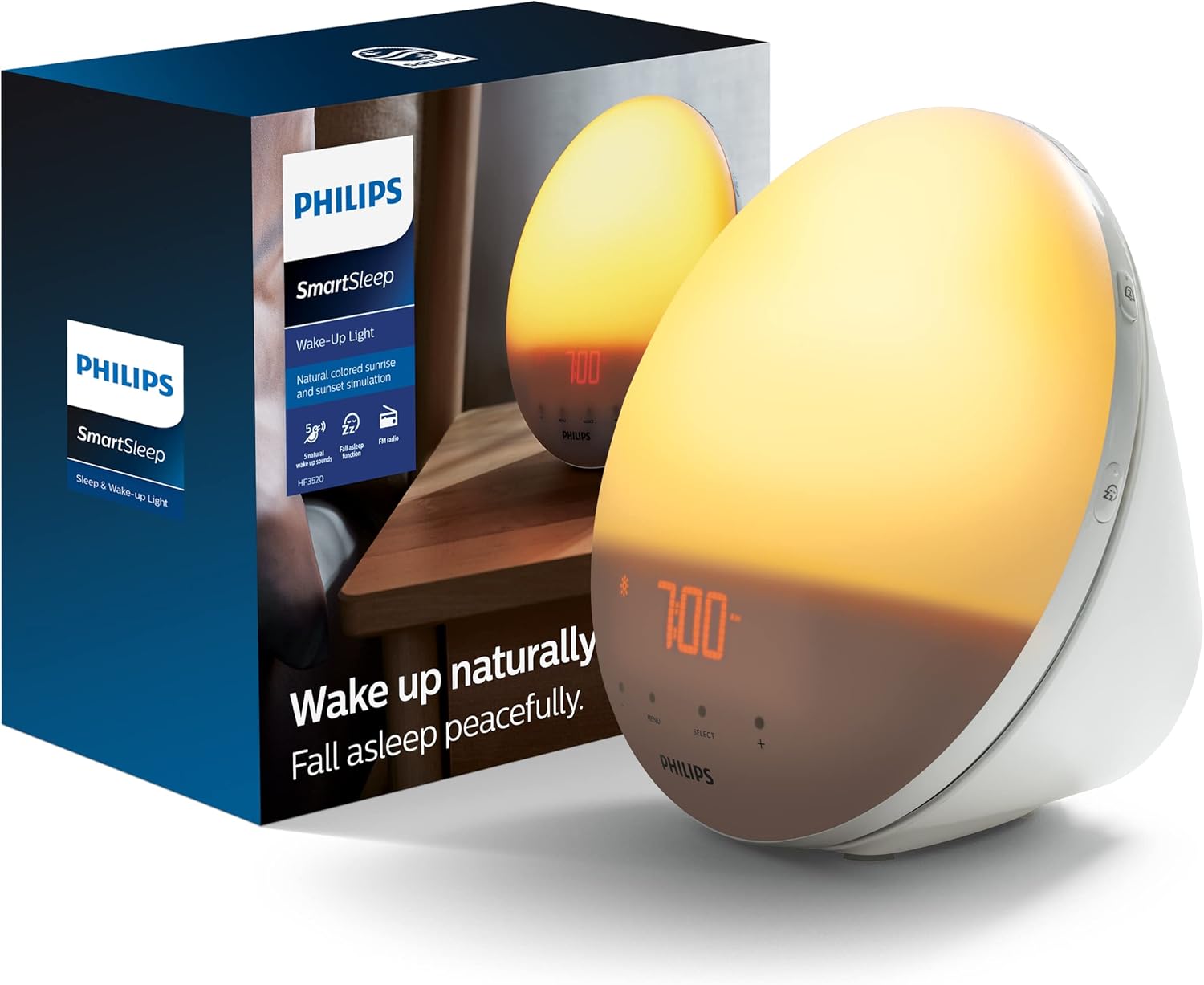
Philips invented the modern wake-up light category, and the HF3520/60 is the model that most sleep researchers, reviewers, and physical therapists still recommend by name. It is a half-dome lamp the size of a small grapefruit that gradually brightens from dim red to full warm-white over 30 minutes, simulating an actual sunrise — not a generic “fade up” but a colored gradient designed by Philips’ lighting engineers. There is also a 30-minute sunset wind-down that fades back through the same colors at bedtime.
What makes this one quietly excellent is that it does the basics extremely well. There are five natural wake-up sounds (birds, ocean, piano, gentle melody, and a wood chime style alarm), an FM radio for waking up to a station of your choice, a tap-to-snooze top, and an automatic display dimmer that detects ambient light so the digital clock face does not glare at you while you are trying to fall asleep. No app, no subscription, no Wi-Fi, no account. You set the alarm with physical buttons and it just works.
The HF3520 puts out around 300 lux at the brightest setting, which is enough for most bedrooms but not as intense as a dedicated SAD light therapy lamp. If you live somewhere with very dark winters and use a wake-up light partly to combat seasonal blues, the brighter Lumie Luxe 700FM below is the better pick. For everyone else, the Philips is the proven, no-nonsense, “just works” option.
Pros:
- Clinically tested sunrise simulation with realistic color gradient
- Five built-in wake-up sounds plus FM radio
- Tap-to-snooze top is genuinely useful in the morning
- No app required — fully controlled by physical buttons
- Doubles as a reading lamp on the brightest setting
- The Philips brand has been refining this product for over a decade
Cons:
- Power cord is short and exits the side, can be awkward on small nightstands
- Maximum brightness (~300 lux) is good but not light-therapy strong
- Original startup chime when you plug it in cannot be disabled
- Only one alarm at a time — does not store separate weekday/weekend alarms
Lumie Bodyclock Shine 300 — Best Mid-Range, No-App Pick
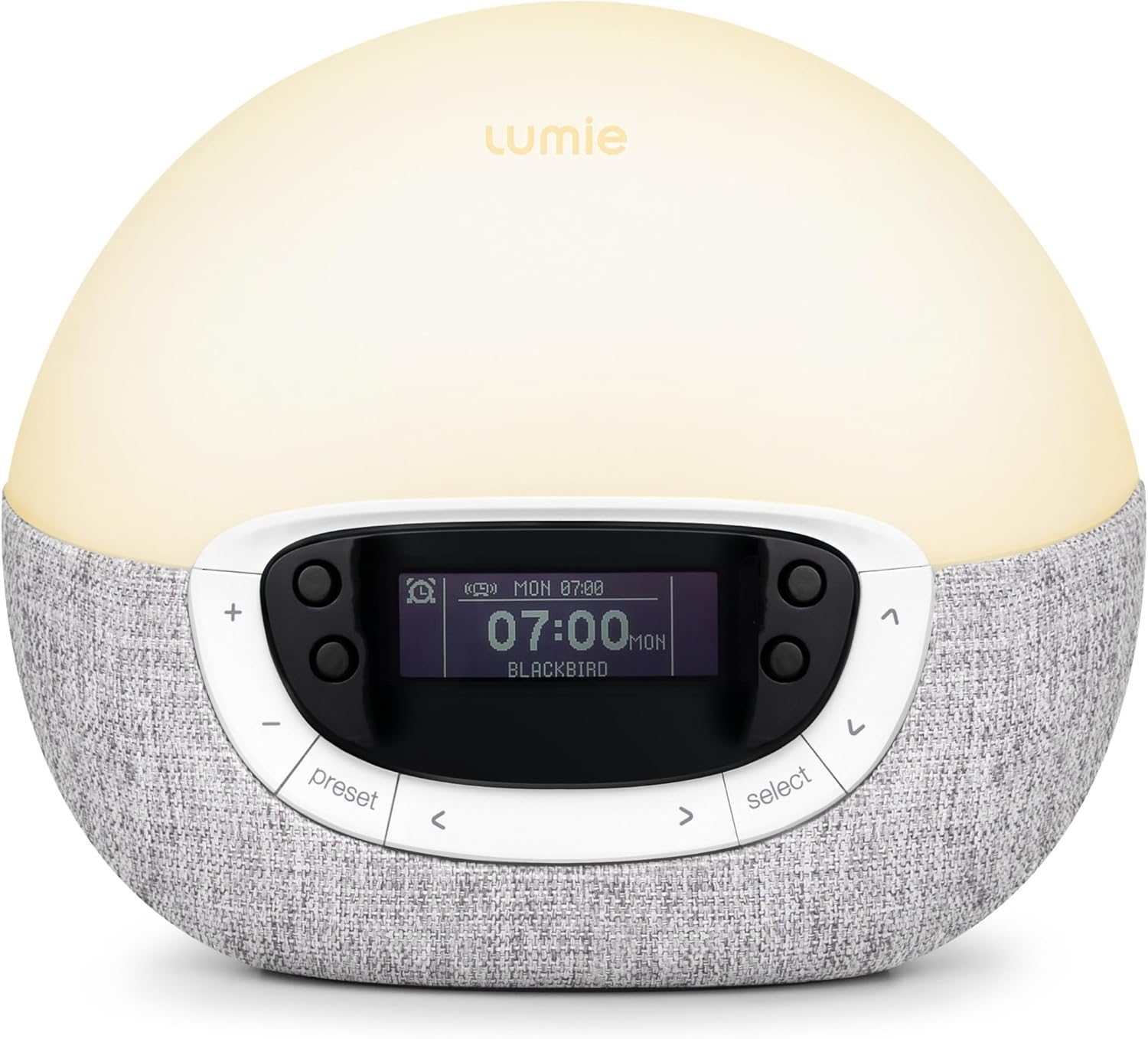
Lumie is the British brand that licensed the original sunrise simulation patent to Philips back in the day, and they still make some of the best-engineered wake-up lights on the market. The Bodyclock Shine 300 is their mid-range model, built around the same idea as the Philips but with a more flexible light-duration setting (you can pick anywhere from 15 to 90 minutes for the sunrise) and a true bedside-lamp mode that lets you run the warm LED at any brightness independently of the alarm.
The Shine 300 has a clean, almost retro design — a tall white shade with physical buttons across the top and a small digital readout. There is no app and no Bluetooth. Everything is set on the device itself: alarm time, fade duration, brightness cap, choice of beep alarm or one of several built-in sounds (white noise, rainforest, sea waves), and an optional sunset fade-out at bedtime. If app-controlled smart devices feel like more friction than they are worth, this is the wake-up light for you.
The downside of being app-free is that you do not get a content library, sleep stories, or smart-home integration. But for a lot of people that is the point — fewer notifications, fewer accounts, fewer subscriptions. Lumie also gives the Shine 300 a longer warranty than most of the competition, which speaks well of how confident they are in the hardware.
Pros:
- Adjustable sunrise length from 15 to 90 minutes
- Functions as a normal warm-LED bedside lamp at any brightness
- Built-in sunset fade-out for winding down at bedtime
- No app, no Wi-Fi, no account — physical buttons only
- Tap-to-snooze function on the top of the unit
- Excellent build quality and a generous warranty
Cons:
- Limited sound library compared to app-driven competitors
- No FM radio
- Display is fairly bright at default and needs manual dimming
- US plug version is harder to find than the UK version
Lumie Bodyclock Luxe 700FM — Best Premium Light Therapy Lamp
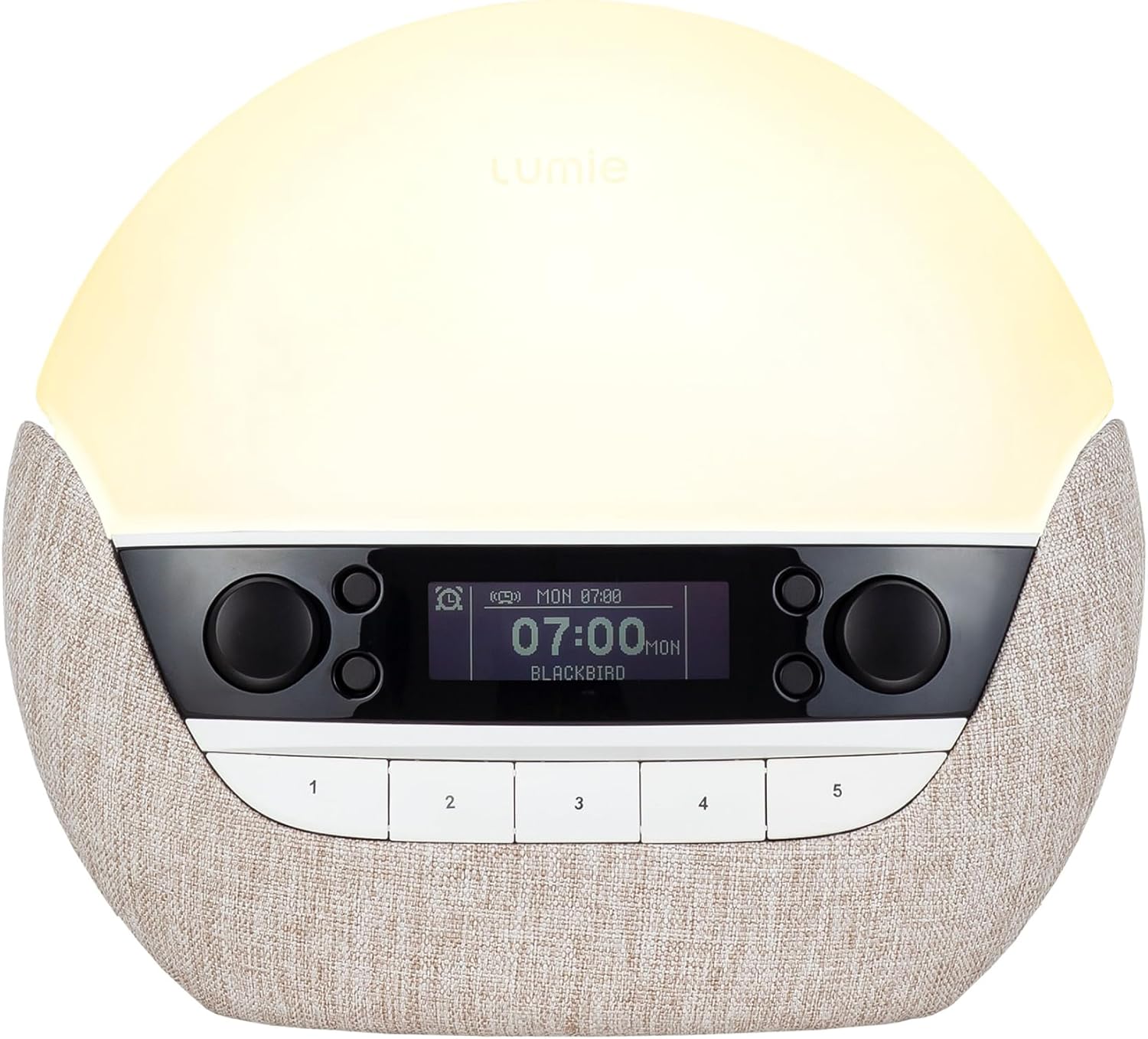
The Lumie Bodyclock Luxe 700FM is the top of Lumie’s range and is what you buy when you want a wake-up light that doubles as a real light therapy lamp. The Luxe 700FM hits a noticeably higher peak brightness than the Shine 300 or the Philips HF3520, with a wider color range that runs from a deep red dawn through to a clean cool morning white. That cooler peak is the part that matters for light therapy — it is the closest thing to actual midday sunlight you can produce on a nightstand, and it makes a real difference in dark winter mornings.
Beyond the light, the Luxe 700FM adds Bluetooth speakers (so you can stream from your phone), FM radio, a low-blue-light reading mode for evening, and 20 built-in sleep and wake sounds. The dim sunset mode shifts entirely to red wavelengths in the last few minutes, which is exactly what you want before bed — red light has the smallest impact on melatonin production. There are also separate weekday and weekend alarms, which the basic Lumie and the Philips do not offer.
This is the most expensive pick on the list, but if you are buying a wake-up light to address seasonal mood issues, dark mornings, or genuinely difficult sleep patterns, this is the one with the medical-adjacent specs to actually move the needle. It also makes a stunning Mother’s Day gift if you want to splurge — it photographs like a high-end design lamp.
Pros:
- Brightest peak output on this list, true light-therapy capable
- Full color range from deep red dawn to cool morning white
- Built-in Bluetooth speakers and FM radio
- Separate weekday and weekend alarm settings
- Low-blue-light reading mode designed not to disrupt melatonin
- Premium design that genuinely looks good on a nightstand
Cons:
- Significantly more expensive than the Shine 300 or Philips
- Larger footprint, takes up more nightstand real estate
- Bluetooth speaker quality is fine but not premium-audio-grade
- No companion app — all setup is on the device
Dreamegg Sunrise 1 — Best Budget Pick
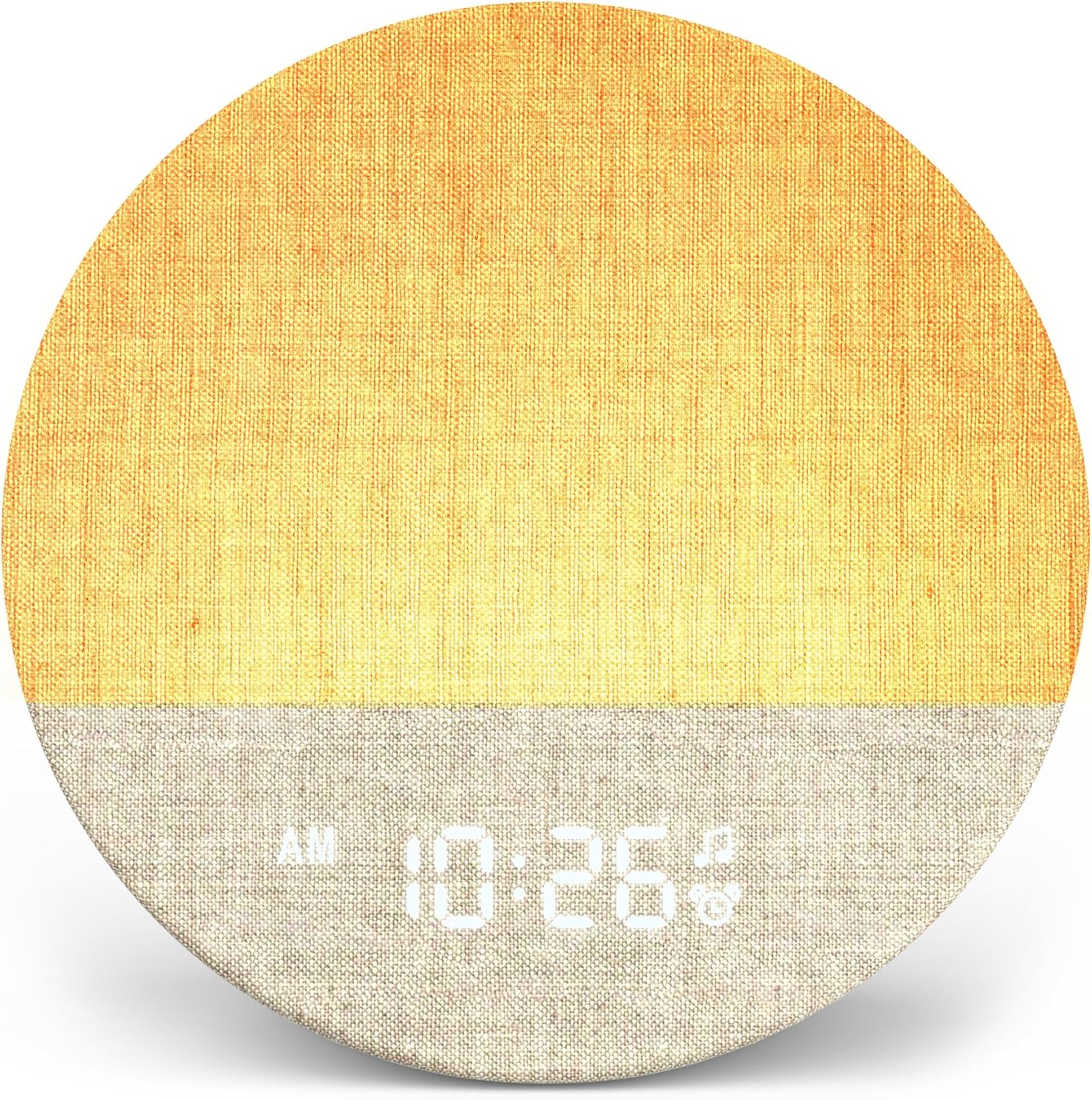
The Dreamegg Sunrise 1 is the surprise of this category. Dreamegg is best known for cheap, well-reviewed white noise machines, and the Sunrise 1 takes that white-noise-machine DNA and adds a proper sunrise alarm light around it. You get 29 sleep sounds, a customizable wake-up routine with adjustable fade duration, a dimmable warm night light, and a real digital clock face — all for less than half the price of the Philips or the basic Lumie.
The light output is not as crisp as the premium picks, and the color gradient is more of a smooth warm fade than a true colored sunrise. But for most people in most bedrooms, it is bright enough at peak to wake you up gently, and the sound library is genuinely good — better, frankly, than the five-sound library on the Philips. The build quality and finish feel a step below the Lumie or Philips, but at this price you are not really expected to compare them directly.
If you are buying your first wake-up light and you do not want to commit $200 to find out whether the concept works for you, the Dreamegg Sunrise 1 is the smartest place to start. If it changes your mornings, you can always upgrade later.
Pros:
- Best price-to-feature ratio on this list
- 29 built-in sleep sounds, including high-quality white noise
- Customizable sunrise duration and brightness
- Dimmable warm night light works as a low-level bedside light
- Snooze button is large and easy to find half-asleep
- Good fallback gift idea if you are not sure how serious the recipient is about wake-up lights
Cons:
- Light is warm-fade rather than true colored sunrise
- Display is brighter than ideal at default and needs manual dimming
- Build feels plasticky compared to the Lumie or Philips
- No smart-home integration or app
REACHER Wood Grain Sunrise Alarm Clock — Best for Bedroom Aesthetic
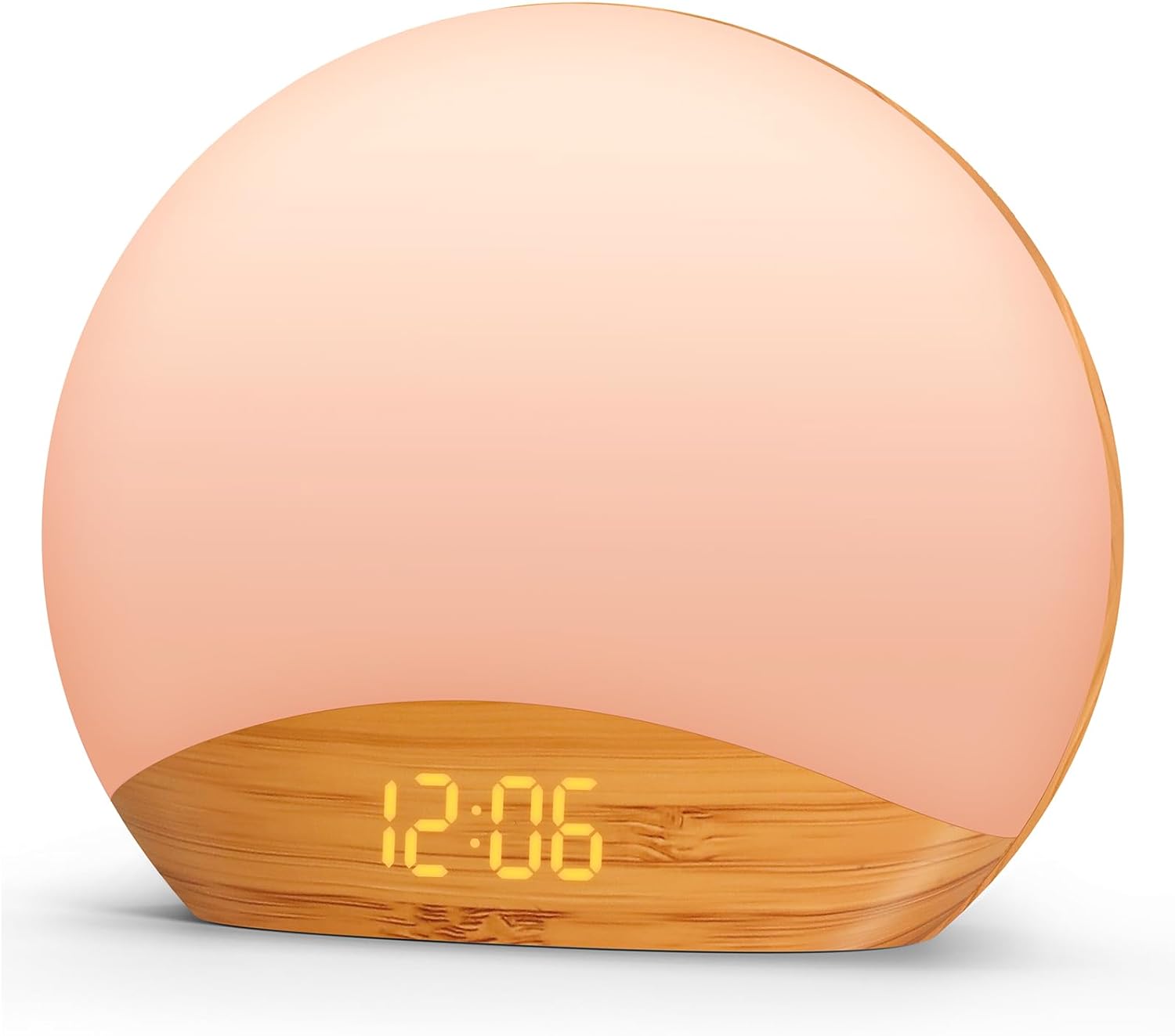
The REACHER Wood Grain Sunrise Alarm Clock takes a different approach — instead of a tall lamp dome, it is a compact bedside cube wrapped in a wood-grain finish, with the digital clock face on the front and a soft warm light that glows up through the top. It looks much more like a piece of bedroom decor than a piece of tech, which is why it is on this list. If your nightstand is already busy and you do not want a giant lamp competing with it, this is the form factor you want.
The REACHER does the full set of basics: a sunrise alarm with adjustable fade time, 26 built-in sleep sounds with white noise and nature options, a dimmable display so the time is not glaring at you all night, a snooze button on top, and a USB charging port on the back so you can charge a phone from the same outlet. The wood grain finish is laminate over plastic — it is not real wood — but at a glance and in normal bedside light, it reads as natural and warm.
Where it falls short of the higher-end picks is in pure light power: the top-glow design throws less light into the room than a Lumie or Philips dome, so it is not the right choice for a bigger bedroom or for a heavy sleeper who needs maximum brightness. But for a small to medium bedroom, a guest room, or a Mother’s Day gift where the aesthetic matters as much as the function, it punches well above its price.
Pros:
- Wood-grain finish that actually looks at home on a nightstand
- 26 sleep sounds and white-noise options
- Dimmable display, USB charging port, snooze button on top
- Compact footprint, fits anywhere
- Excellent value at around $50
- Great gift presentation right out of the box
Cons:
- Top-glow light is gentler than dome-style picks — less punch in bigger rooms
- Wood grain is laminate, not real wood
- Not loud enough for the deepest sleepers without supplementing
- No app, no smart-home integration
Sunrise Alarm Clock Comparison
| Pick | Price | Best For | Sunrise Length | Sound Library | App Required |
|---|---|---|---|---|---|
| Hatch Restore 3 | ~$200 | Full sleep + wake routines | Adjustable | Huge (with subscription) | Yes |
| Philips SmartSleep HF3520/60 | ~$160 | Proven, simple, no app | 20–40 min | 5 sounds + FM radio | No |
| Lumie Bodyclock Shine 300 | ~$150 | Mid-range, no app | 15–90 min | Several built-in | No |
| Lumie Bodyclock Luxe 700FM | ~$300 | Light therapy + premium | 15–90 min | 20 sounds + FM + Bluetooth | No |
| Dreamegg Sunrise 1 | ~$80 | Best budget | Adjustable | 29 sounds | No |
| REACHER Wood Grain | ~$50 | Bedroom aesthetic | Adjustable | 26 sounds | No |
How to Pick the Right Sunrise Alarm Clock
Match the brightness to your room and sleep style
A small bedroom (under 120 sq ft) and a light sleeper can get away with a budget pick like the Dreamegg or REACHER. A bigger bedroom, a heavy sleeper, or anyone using the wake-up light as light therapy for dark winters wants a brighter dome-style lamp — the Philips HF3520 or, at the top end, the Lumie Luxe 700FM. The basic rule: if you wake up to a 5 a.m. alarm in pitch dark in February and want to actually feel awake by 6 a.m., spend the money on the brighter unit. If you mostly want a gentler way to wake up in a normally lit room, the budget picks are plenty.
Decide whether you want an app or not
This is the real philosophical split in the category. App-driven clocks like the Hatch Restore 3 give you huge sound libraries, sleep stories, programmable routines, and family sharing — but they also lock some of that behind a subscription, want a Wi-Fi connection, and add a notification surface to your bedroom. App-free clocks like the Lumie and Philips do less, but they do it forever without an account, a subscription, or an app update breaking your alarm. There is no wrong answer; there is just what fits your relationship with your phone.
Sunrise-only vs. full sunset routines
Most wake-up lights only handle the morning. The Hatch Restore 3 and the Lumie Luxe 700FM also handle the evening — they dim down through warm/red light to help you fall asleep, then run your sleep sound through the night, then sunrise you in the morning. If you struggle more with falling asleep than waking up, paying extra for a sunset-capable model is worth it.
Pay attention to the display
Almost every wake-up light has a digital clock face, and almost every clock face is too bright at default settings. Before you buy, check that the model lets you fully dim the display (or even turn it off entirely) at night. The Hatch Restore 3 is fully screen-free by design, the Lumies and Philips dim well, and the budget picks generally need manual adjustment.
Smart home integration
If you already use a smart home ecosystem, factor that in. The Hatch app supports IFTTT-style routines and works alongside other smart home gear, but none of these wake-up lights are deeply integrated with Alexa, Google, or Apple Home in the way a smart light bulb or a smart light strip is. If full voice and routine control matter to you, you may want to pair a basic wake-up light with a smart bulb on a smart switch and program your own sunrise from your existing ecosystem.
Frequently Asked Questions
Do sunrise alarm clocks actually work?
Yes — and the science is well-supported. Multiple peer-reviewed studies show that gradual light exposure before waking reduces the grogginess (sleep inertia) most people feel after a sudden alarm. The effect is strongest in winter or in very dark bedrooms, where you would otherwise be waking into total darkness. People who sleep with curtains open in well-lit rooms get less benefit because they already get some of the natural cue.
How bright does a sunrise alarm clock need to be?
For waking up gently, anywhere from 100 to 300 lux at the eye is plenty. For light therapy purposes (treating seasonal mood dips, shifting your sleep schedule, or adjusting after travel), you generally want a unit that can hit 300 lux or higher at your sleeping position. The Lumie Luxe 700FM is the brightest pick on this list and is the most light-therapy-capable. The Philips HF3520, Lumie Shine 300, and Hatch Restore 3 are all in the comfortable wake-up range, while the Dreamegg and REACHER are gentler and best for normal wake-ups in smaller rooms.
Are sunrise alarm clocks good for heavy sleepers?
They can be, but heavy sleepers should not rely on the light alone. The light wakes you gently, but you still want a sound alarm as a backup. Look for models with a strong audible alarm or a wide volume range — the Lumie Luxe 700FM, Philips HF3520, and Hatch Restore 3 all have plenty of volume headroom. If you regularly sleep through phone alarms, also consider running the sunrise fade over a longer window (60+ minutes) so the light has more time to lift you out of deep sleep before the sound kicks in.
Is a sunrise alarm clock a good Mother’s Day gift?
Yes, and it is one of the most thoughtful smart home gifts in this price range — much more personal than a generic gadget. Pick the Hatch Restore 3 if she likes routines and apps, the REACHER wood grain if you want a beautifully presented gift that does not look like tech, or the Lumie Luxe 700FM if you want to splurge on something genuinely high-end. For more gift ideas, our Best Smart Home Gifts for Mom guide has eight more picks across every budget.
Can I use a sunrise alarm clock without Wi-Fi?
Most of them, yes. The Philips, both Lumies, the Dreamegg, and the REACHER work entirely standalone — no Wi-Fi, no app, no account. The Hatch Restore 3 is the exception: it requires a one-time Wi-Fi setup through the Hatch Sleep app and continues to use the app for routine changes. Once it is set up, it will continue to run your scheduled wake-up even if Wi-Fi drops temporarily, but ongoing use without Wi-Fi is not really the design.
How long does the sunrise fade need to be?
For a gentle, gradual wake-up, 30 minutes is the sweet spot for most people. Heavy sleepers can benefit from 45 to 60 minutes — the longer ramp gives the light more time to act on your circadian system before any sound triggers. Lighter sleepers can comfortably use a 15 to 20 minute fade. The Lumies are the most flexible (15 to 90 minutes) and the Hatch is fully customizable in the app.
Do I need a separate sound machine if I get a sunrise alarm clock?
In most cases, no. Almost every pick on this list (every one except the Philips, which has only five sounds) doubles as a competent sound machine with white noise, nature sounds, or both. The Hatch Restore 3 and the Dreamegg Sunrise 1 in particular have sound libraries that meet or exceed dedicated sound machines. If you need premium audio quality you might still want a dedicated unit, but for most bedrooms a good sunrise alarm is also a good sound machine.
The Bottom Line
The Hatch Restore 3 is the most complete pick on this list and the easiest one to recommend if you want one device to handle your evening wind-down, your night sounds, and your morning wake-up. The Philips SmartSleep Wake-up Light, HF3520/60, is the proven classic and the right choice if you do not want an app or a subscription anywhere near your bedside. The Lumie Bodyclock Luxe 700FM is for the person who is buying once and buying right, especially if dark winter mornings are part of the problem. And the Dreamegg Sunrise 1 and REACHER Wood Grain are the smart starting points if you want to find out whether wake-up lights work for you before committing real money.
If you are shopping for Mother’s Day specifically, the Hatch Restore 3 and REACHER Wood Grain both photograph beautifully and present well as a gift. If you want to expand the rest of the bedroom into smart lighting too, our guides on the best smart light bulbs and the best smart LED strip lights are good next stops.
Whichever you pick, the goal is the same — wake up to light instead of panic. Mornings get a lot better.