
Quick Picks
Short on time? Here are our top recommendations:
- Airthings 2960 View Plus (~$321) — Best overall, the only one that tracks radon, PM2.5, CO2 and VOCs together
- SAF Aranet4 Home (~$189) — Best for CO2, the gold standard for tracking ventilation
- Amazon Smart Air Quality Monitor (~$70) — Best budget pick if you live in Alexa land
- GoveeLife Smart Air Quality Monitor (~$60) — Best ultra-budget pick with WiFi and a real app
Why Bother Tracking Indoor Air Quality?
The air inside your house is usually two to five times more polluted than the air outside — sometimes a hundred times worse, according to the EPA. Cooking, candles, cleaning products, off-gassing from new furniture, mold, pets, and even your own breath all push pollutants into a space that doesn’t get a fresh breeze the way the outdoors does. And if you have allergies, asthma, or a kid with either, that hidden indoor chemistry matters a lot.
A smart indoor air quality monitor tells you what’s actually in your air, in real time, on your phone. Most track some mix of CO2 (a proxy for ventilation and stuffiness), PM2.5 (fine particulate matter from cooking, candles, wildfire smoke, dust), VOCs (volatile organic compounds from cleaners, paint, and plug-in fresheners), and a few also track radon — a radioactive gas that’s the second-leading cause of lung cancer in the US after smoking.
We pulled the six smart indoor air quality monitors people actually buy and that hold up to scrutiny in 2026. Each one connects to a real app, gives you historical data (not just a current reading), and works as part of a broader smart home if you have one. We’re heading into allergy season and Memorial Day cookout weather — the time of year when indoor air gets the most chaotic between AC running, windows closed, and cooking ramping up — so this is a useful one to lock in now.
The 6 Best Smart Indoor Air Quality Monitors
1. Airthings 2960 View Plus — Best Overall
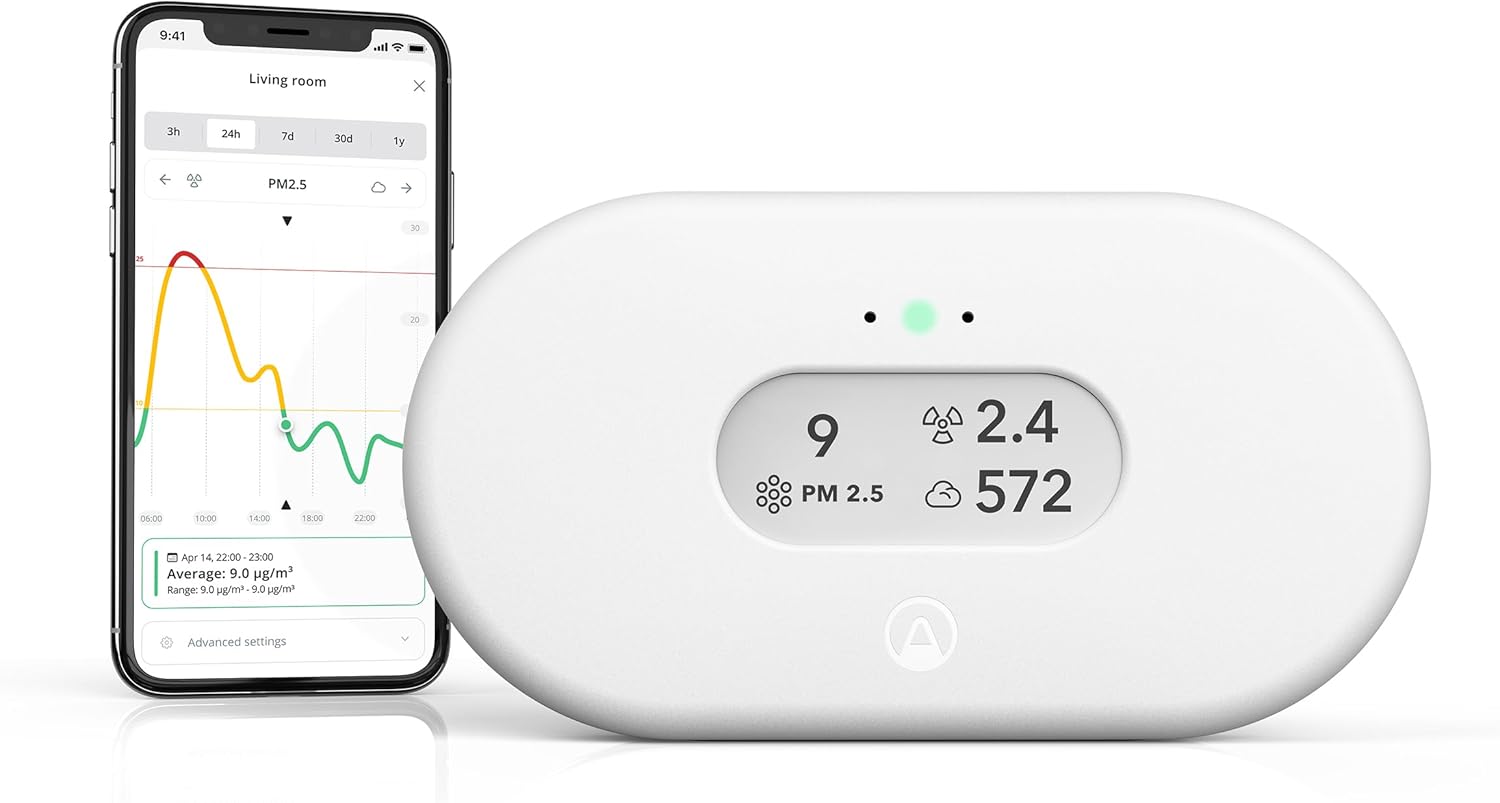
The Airthings View Plus is the only monitor on this list that tracks all seven of the things you actually want to know about indoor air: radon, PM2.5, CO2, VOCs, humidity, temperature, and air pressure. Nothing else at this price point combines a continuous radon sensor with a full pollutant suite, and that’s the whole reason it stays at the top of every serious indoor air quality list.
The e-ink display is genuinely useful — at a glance you can see the current “good / fair / poor” rating without pulling out your phone. When you do want depth, the Airthings app gives you graphs going back days, weeks, or months, lets you set notifications when any pollutant crosses a threshold, and breaks down which rooms or times of day are worst. It’s battery powered (six AA, ~2 years of life) so you can stick it anywhere — basement, bedroom, garage — without running cables.
It works with Alexa, Google Assistant, and IFTTT, so you can trigger automations like turning on a smart air purifier when PM2.5 spikes during cooking, or kicking on the bathroom fan when CO2 climbs in the bedroom overnight. The Wave Mini and other Airthings hubs can pool readings from multiple monitors across the house into one dashboard.
The big caveat is the price — at around $320 it’s roughly double what most monitors cost. But if radon is on your radar (and in roughly 1 in 15 US homes it should be), this is the device that pays for itself. Standalone home radon test kits are accurate but slow and one-off; the View Plus monitors continuously and tells you when something changes.
Specs: Tracks radon, PM2.5, CO2, VOCs, humidity, temp, pressure | E-ink display | 6x AA, ~2-year battery | WiFi | Alexa, Google, IFTTT | ~$321
Pros:
- The only monitor here with a continuous radon sensor
- Tracks every major indoor air pollutant in one device
- Battery powered with a 2-year life — put it anywhere
- Clean e-ink display and well-designed app with long-term graphs
- Strong smart home integration (Alexa, Google, IFTTT)
Cons:
- Most expensive monitor on this list by a wide margin
- Radon readings take 7 days to calibrate when you first set it up
- VOC sensor is broad — doesn’t distinguish which chemical is the culprit
2. SAF Aranet4 Home — Best for CO2 Tracking
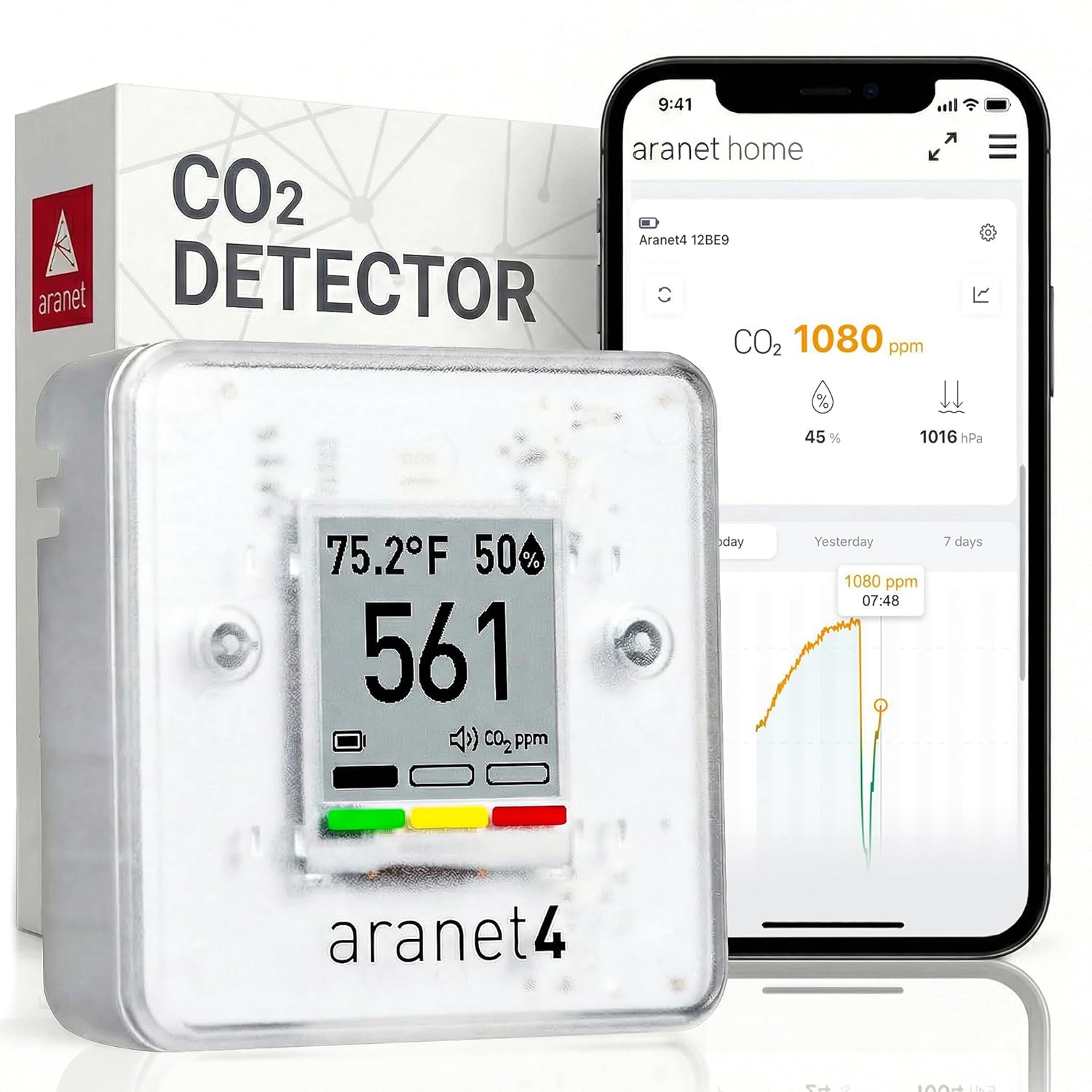
The Aranet4 has become the go-to CO2 monitor for everyone from indoor-air researchers to teachers to people who just sleep poorly when their bedroom gets stuffy. The reason: it uses a non-dispersive infrared (NDIR) CO2 sensor, which is the same technology used in commercial HVAC and lab equipment. Cheaper monitors typically use an “eCO2” reading estimated from VOCs, which can be wildly inaccurate — the Aranet4 measures CO2 directly and gets it right.
CO2 is the single best proxy for how well-ventilated a room is. Outdoor air sits around 420 ppm. A poorly-ventilated bedroom with the door closed can easily climb past 1,500 ppm overnight — high enough to mess with sleep quality and morning alertness. Once you have an Aranet4, you start noticing patterns: which rooms get stuffy fastest, how long it takes a window crack to fix it, whether your HVAC’s “fresh air” mode actually delivers any.
The Aranet4 also reads temperature, humidity, and barometric pressure. It’s Bluetooth-only (no WiFi), which means you pull readings via the Aranet Home app on your phone, but it logs continuously and stores up to 90 days of data on-device. Two AA batteries last about two years. The e-ink display is huge for its size and works in pitch dark with a quick tap.
For a pure CO2-and-comfort monitor, nothing else comes close at this price. The trade-off is no PM2.5 and no VOC sensor — if you want those, pair it with the Amazon monitor or the Qingping below.
Specs: Tracks CO2 (NDIR), temp, humidity, pressure | E-ink display | 2x AA, ~2-year battery | Bluetooth (no WiFi) | iOS & Android apps | ~$189
Pros:
- True NDIR CO2 sensor — research-grade accuracy
- 2-year battery on two AAs
- Big, readable e-ink display works in the dark
- 90 days of logging stored on the device itself
- Loved by HVAC pros, teachers, and indoor-air nerds for a reason
Cons:
- Bluetooth only, no WiFi or cloud sync (pulls when phone is nearby)
- No PM2.5, VOC, or radon sensor — CO2-focused
- Limited smart home integration compared to WiFi options
3. Qingping Air Quality Monitor Gen 2 — Best Smart Features
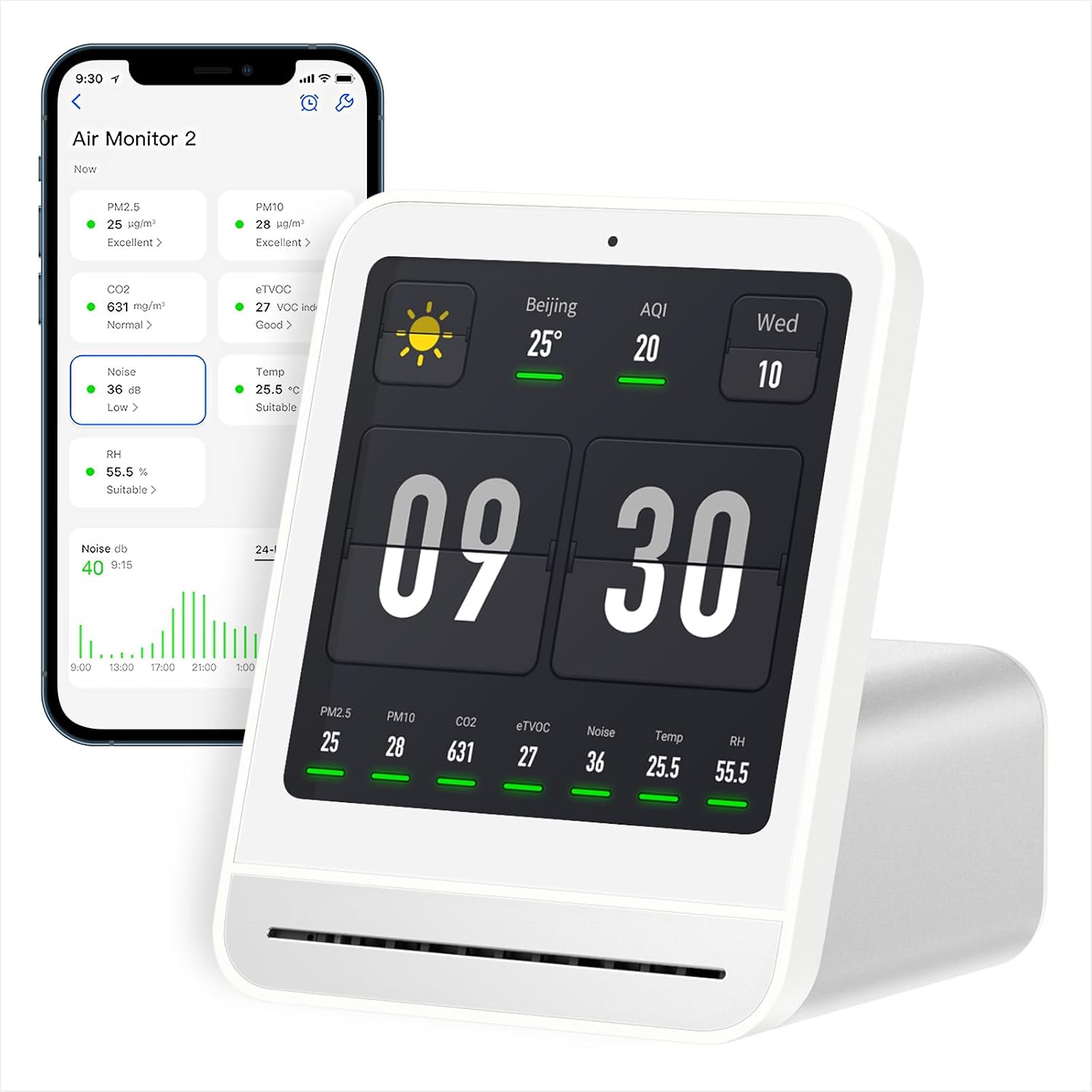
The Qingping Air Quality Monitor Gen 2 is the most feature-dense monitor under $150. It tracks PM2.5, PM10, CO2, noise levels, temperature, and humidity, and shows all of them on a sharp 3.5-inch color IPS touchscreen that doubles as a small ambient dashboard for the room. It looks more like a small smart display than a sensor.
What sets the Gen 2 apart is the new alarm feature — you can set custom thresholds and have it visually and audibly alert when any pollutant goes out of range. Combined with the noise sensor (handy for tracking how loud your kid’s playroom or your home office actually gets), it covers more variables than almost anything in this category.
The Qingping+ app is clean, gives you historical graphs, and supports Apple HomeKit, Mi Home, and works with Alexa. If you live in a HomeKit household, this is a solid mid-priced pick because Qingping has stuck with HomeKit support across all their devices.
The Gen 2 plugs in via USB-C (no battery), so it lives on a shelf or desk rather than getting moved around. Accuracy on PM2.5 and CO2 is good, though it’s a NDIR-CO2 sensor rated slightly less precise than the Aranet4’s — fine for normal home use, less ideal if you want laboratory-grade readings.
Specs: Tracks PM2.5, PM10, CO2, noise, temp, humidity | 3.5” color touchscreen | USB-C powered | WiFi + Bluetooth | HomeKit, Alexa, Mi Home | ~$150
Pros:
- Beautiful color touchscreen — works as an ambient room dashboard
- Custom alarms when any pollutant crosses your threshold
- Tracks noise alongside air pollutants
- Apple HomeKit, Alexa, and Mi Home support
- Best value for breadth of sensors
Cons:
- Plug-in only, no battery
- Some smart home automations require Mi Home account
- CO2 sensor is good but not lab-grade like the Aranet4
4. Eve Room — Best for Apple HomeKit Households
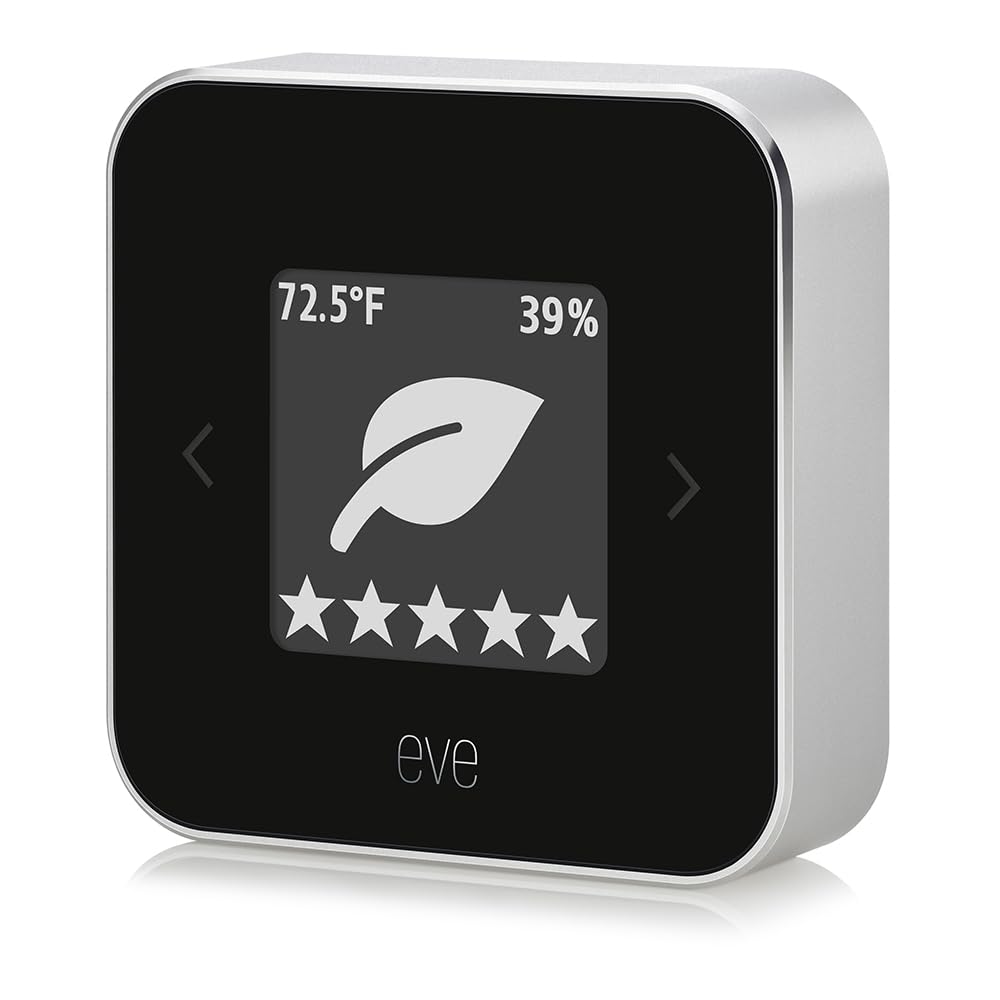
The Eve Room is the cleanest pick if your house is built around Apple HomeKit. It connects directly via Bluetooth and Thread (no separate hub for Apple users), shows up natively in the Home app on your iPhone, and feeds VOC, temperature, and humidity data into HomeKit automations alongside every other Apple-compatible device you own.
It’s also the best-looking monitor on the list — anodized aluminum body, a soft e-ink display that shows current VOC level, humidity, and temperature, and a footprint about the size of a Hue dimmer. No app screen here looks out of place on a nightstand or bookshelf, which matters more than it probably should.
The Eve app gives you historical graphs going back months and lets you set up complex HomeKit-only automations like “if Eve Room detects high VOCs in the kitchen, turn on the bathroom fan or the air purifier.” Because it uses Thread, range and reliability are far better than Bluetooth-only sensors — you can put it anywhere in the house and it stays connected.
The big caveat: VOC is the only pollutant it tracks (no CO2, no PM2.5, no radon). For HomeKit users who just want a clean, native, well-integrated air sensor for VOC plus comfort, it’s perfect. For broader air quality tracking, look at the Airthings or Qingping above.
Specs: Tracks VOC (eVOC index), temp, humidity | E-ink display | Battery (USB-C rechargeable) | Bluetooth + Thread | Apple HomeKit only | ~$110
Pros:
- Best-looking monitor here — premium aluminum design
- Native Apple HomeKit integration with Thread support
- Rechargeable battery, no plugs needed
- Works inside HomeKit automations alongside the rest of your Apple smart home
- Excellent Eve app with months of historical data
Cons:
- VOC only — no CO2, PM2.5, or radon sensor
- HomeKit-only — doesn’t work with Alexa or Google
- “eVOC” reading is an index, not parts-per-million calibrated
5. Amazon Smart Air Quality Monitor — Best for Alexa Households
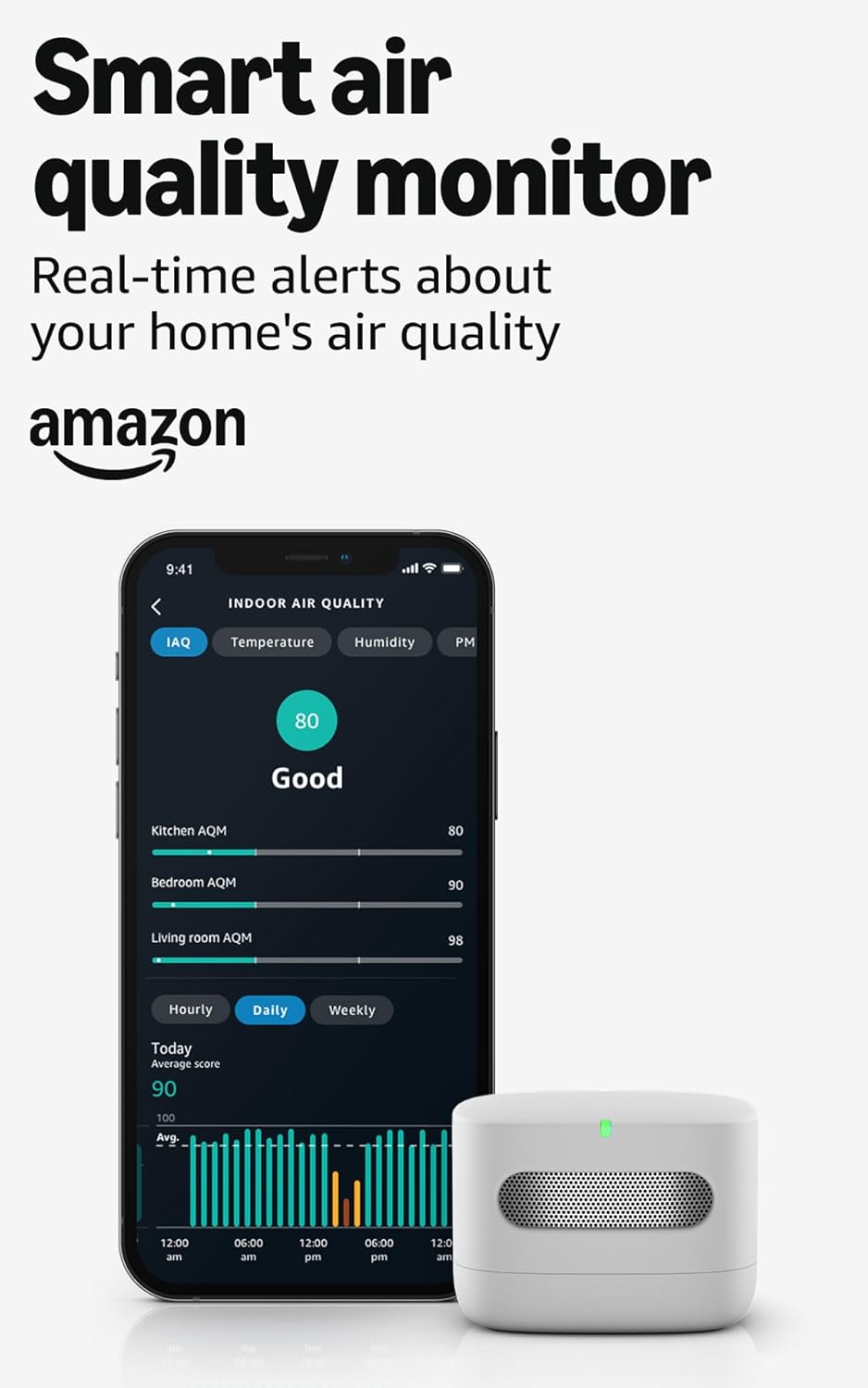
If you’re in the Alexa world, this is the cheapest way to get a credible air quality monitor that wires straight into your existing setup. The Amazon Smart Air Quality Monitor tracks PM2.5, VOCs (described as “indoor chemicals”), humidity, temperature, and carbon monoxide, and reports it all through the Alexa app and any Echo display you own.
The hook is voice integration. You can say “Alexa, what’s the air quality in the kitchen?” and get a current reading. Echo Show devices can display a live air-quality dashboard, and you can build Alexa routines that trigger a smart air purifier, fan, or notification when pollutants spike. If you have other Alexa-aware sensors, the routines stack nicely.
It’s a small puck — no display on the device itself, all readings happen in the Alexa app or on an Echo Show — and it plugs in via USB-C, so it stays put. The sensors are good for the price: PM2.5 readings track well against pricier monitors during cooking and candle tests, though the VOC reading is broad (Alexa just calls it “elevated” or “good,” not a number).
The trade-off compared to the Airthings or Qingping is detail. You won’t see graphs going back weeks on Amazon’s side — the data is mostly current-state. For people who want to know “is the air bad right now?” and use it as a trigger for Alexa routines, that’s enough. For people who want to study patterns over months, look at Airthings, Aranet4, or Qingping.
Specs: Tracks PM2.5, VOC, CO, humidity, temp | No on-device display | USB-C powered | Alexa-only | ~$70
Pros:
- Cheapest credible monitor that integrates deeply with Alexa
- Voice queries for current air quality on any Echo
- Triggers Alexa routines based on air thresholds
- Compact, unobtrusive design
- Solid PM2.5 accuracy for the price
Cons:
- Alexa-only — no Google, HomeKit, or third-party app
- No on-device display (need an Echo Show or phone)
- Limited historical data compared to Airthings or Aranet4
- VOC reading is qualitative, not numeric
6. GoveeLife Smart Air Quality Monitor for Home — Best Budget Pick
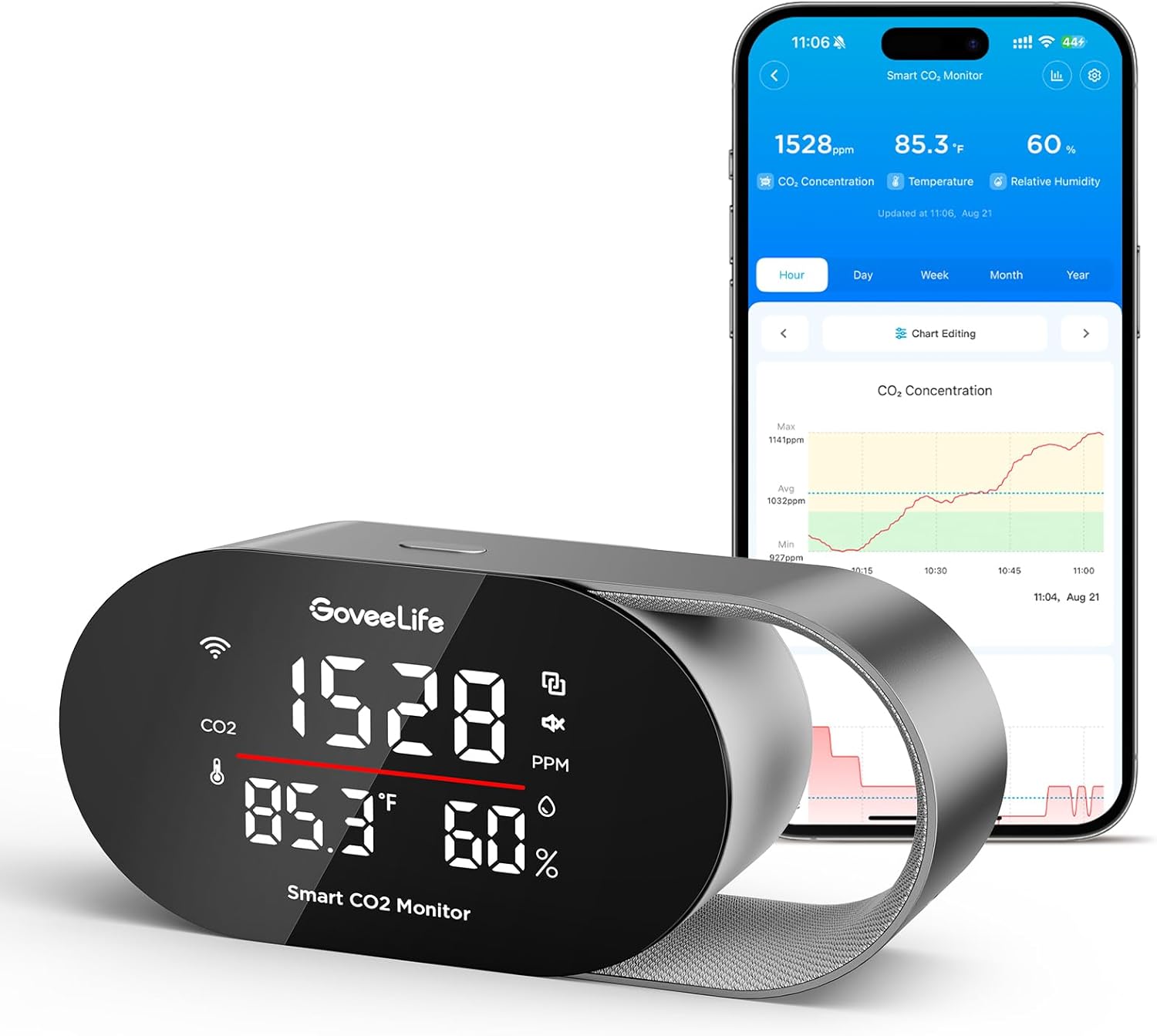
GoveeLife has quietly become one of the best brands for affordable smart home sensors, and this air quality monitor is their air-focused flagship under $60. It tracks CO2, temperature, and humidity, shows it all on a clean color display, and connects to WiFi for full Govee Home app access.
The big surprise at this price is the app. Govee Home is genuinely good — it gives you graphs going back days and weeks, lets you set notification thresholds, and integrates with Alexa and Google Assistant for voice queries and automations. You can build routines like “if CO2 climbs above 1,200 ppm, send me a notification” or “turn on the smart plug for the air purifier when readings get bad.”
CO2 is measured via NDIR (the accurate kind), not eCO2, which is the spec that matters most for this price. It’s not as precise as the Aranet4’s research-grade sensor, but it tracks the same trends and triggers the same insights about ventilation. The “energy efficiency” angle in Govee’s marketing is real — when you can see how much your sealed-up home traps CO2 overnight, you make smarter decisions about cracking windows or running the HVAC fresh-air cycle.
The trade-off vs. pricier monitors: no PM2.5, no VOC, and no radon. This is a CO2-and-comfort monitor that happens to be smart, not a full pollutant tracker. For most people new to air quality monitoring who just want to see if their bedroom is stuffy and want a real app behind the data, it’s the easiest entry point at any price.
Specs: Tracks CO2 (NDIR), temp, humidity | Color display | USB-C powered | WiFi | Govee Home app, Alexa, Google | ~$60
Pros:
- Most affordable smart monitor with real NDIR CO2 (not eCO2)
- Genuinely good Govee Home app with historical data
- Alexa and Google Assistant compatible
- Color display shows everything at a glance
- Easiest entry point into air quality tracking
Cons:
- No PM2.5, VOC, or radon sensor
- Plug-in only — no battery
- Govee Home account required for cloud features
- Less precise CO2 sensor than the Aranet4
Comparison Table
| Model | What It Tracks | Display | Power | Smart Home | Price |
|---|---|---|---|---|---|
| Airthings View Plus | Radon, PM2.5, CO2, VOC, humidity, temp, pressure | E-ink | 6x AA (~2 yr) | Alexa, Google, IFTTT | ~$321 |
| Aranet4 Home | CO2 (NDIR), temp, humidity, pressure | E-ink | 2x AA (~2 yr) | Bluetooth app only | ~$189 |
| Qingping Air Monitor Gen 2 | PM2.5, PM10, CO2, noise, temp, humidity | Color touchscreen | USB-C | HomeKit, Alexa, Mi Home | ~$150 |
| Eve Room | VOC, temp, humidity | E-ink | Rechargeable | Apple HomeKit, Thread | ~$110 |
| Amazon Smart AQM | PM2.5, VOC, CO, humidity, temp | None (Alexa app) | USB-C | Alexa only | ~$70 |
| GoveeLife Smart AQM | CO2 (NDIR), temp, humidity | Color | USB-C | Alexa, Google, Govee | ~$60 |
How to Choose the Right Smart Air Quality Monitor
Start With What You Actually Want to Track
Every monitor here is good at something different. The trick is matching its sensors to your situation:
- Worried about cooking, candles, wildfire smoke, or pets? PM2.5 is the number you care about. The Airthings View Plus, Qingping Gen 2, and Amazon Smart AQM all track it.
- Sleep poorly or work from a closed-up home office? CO2 is the variable that explains stuffy headaches and 3 PM brain fog. Aranet4, Airthings, Qingping, and GoveeLife all measure it — and stick to NDIR sensors, not eCO2.
- Live in a house with a basement, a slab foundation, or in a known radon zone? Get the Airthings View Plus. Radon is the only pollutant that’s actually dangerous in concentrations you can’t smell, and continuous monitoring beats one-off test kits.
- Just bought new furniture, painted, or use a lot of cleaning products? VOCs are your story. The Eve Room and Airthings catch this best.
Match the Monitor to Your Smart Home
If you have smart speakers and a beginner’s smart home built around Alexa, the Amazon Smart AQM is the cheapest path to voice queries and routines. For Google Home, the GoveeLife and Airthings are the broadest fit. For Apple HomeKit, the Eve Room and Qingping Gen 2 are the cleanest native integrations.
Picking the wrong ecosystem is the most common buying mistake — a fantastic monitor that won’t talk to your existing setup is a worse experience than a budget one that’s wired in.
Battery vs. Plug-In
Battery-powered monitors (Airthings, Aranet4, Eve Room) can go anywhere — bedroom, basement, garage, attic — without running a USB cable. Plug-in monitors (Qingping, Amazon, GoveeLife) live on a shelf or desk and need an outlet. If you want to move a monitor between rooms to spot-check different spaces, go battery. If you want a permanent room dashboard, plug-in is fine.
Don’t Skip the App
The hardware reading is half the story. The app is where you actually understand what’s happening — graphs over days and weeks, alerts when something spikes, the ability to tag events (“we cooked dinner, see how PM2.5 climbed for 90 minutes”). Airthings, Aranet4, Qingping, and Govee all have genuinely good apps. The Amazon monitor leans hard on Alexa for visualization, which is fine if you live in an Echo household.
Pair It With the Fix
A monitor tells you the air is bad. It doesn’t fix it. The natural pairing is a HEPA smart air purifier that you can trigger automatically when PM2.5 climbs, plus a smart smoke and CO detector for the threats a monitor alone won’t catch. Together they cover the “what’s wrong” and “what do I do about it” sides of indoor air.
FAQ
What’s the difference between PM2.5 and PM10?
Both are particulate matter — tiny pieces of stuff floating in the air. PM10 is anything up to 10 microns wide (think dust, pollen, larger smoke particles). PM2.5 is anything up to 2.5 microns — small enough to bypass your body’s natural filters and lodge deep in your lungs, which is why it’s the more health-relevant number. Cooking, candles, fireplaces, wildfire smoke, and exhaust all produce PM2.5. The EPA “healthy” threshold is under 12 µg/m³ over a 24-hour average.
Is “eCO2” the same as real CO2?
No, and this matters more than most people realize. A real CO2 sensor (NDIR — non-dispersive infrared) measures carbon dioxide directly. An “eCO2” sensor measures VOCs and estimates CO2 from them. The estimate can be off by hundreds of ppm. Cheap monitors and most smartwatch-style sensors use eCO2. The Aranet4, Airthings View Plus, Qingping Gen 2, and GoveeLife on this list all use NDIR — that’s part of why they’re more expensive than $30 Amazon monitors but worth it if CO2 actually matters to you.
Do I need a radon monitor, or is a one-time test kit enough?
If you’ve never tested for radon, do a one-time test kit first — they’re cheap and accurate. If your home tested high (above 4 pCi/L is the EPA action level, though many experts now flag 2.7 pCi/L), or if you live anywhere in EPA Radon Zone 1 (basically the northern Plains, Appalachia, and large parts of the Midwest), a continuous monitor like the Airthings View Plus is worth the cost. Radon levels fluctuate with weather, season, and how often you run the HVAC. A monitor catches the highs that a 48-hour test might miss.
Can I use a smart air quality monitor to automate a purifier?
Yes — that’s one of the best practical reasons to get a smart one over a “dumb” $40 PM2.5 reader. With Alexa, Google Home, or IFTTT, you can build routines like “if PM2.5 goes above 25 µg/m³, turn on the air purifier on high for one hour.” The Airthings View Plus, Amazon Smart AQM, GoveeLife, and Qingping all support this kind of automation. The Aranet4 doesn’t — it’s app-only.
Where should I put the monitor for the most accurate reading?
Out of direct airflow (so not right under an AC vent, ceiling fan, or open window), away from heat sources (stove, radiator, sunny window), and at roughly head-height when you’re sitting or sleeping — typically a side table, bookshelf, or dresser. For CO2 specifically, the bedroom is the most informative spot because CO2 buildup overnight tells you whether your sleep environment is well-ventilated. For PM2.5, the kitchen or living room (wherever you cook or burn candles) shows the most useful data.
How often do the sensors wear out?
Most NDIR CO2 sensors (Aranet4, Airthings, Qingping, GoveeLife) are rated for 7-10 years before noticeable drift. PM2.5 laser sensors typically last 5-7 years. VOC sensors drift faster — 2-3 years before readings get less reliable. None of these are user-replaceable, so figure the monitor’s useful life is roughly the life of its shortest-lived sensor. Across the board, expect 5+ years of solid use from any monitor on this list.
Bottom Line
For most homes in 2026, the right answer is the Airthings View Plus if you can stretch to it (radon, PM2.5, CO2, and VOCs in one device beats anything else on the market), or the SAF Aranet4 Home if you mainly care about CO2 and want the most accurate sensor at a reasonable price. If you’re new to all this and just want a smart, app-connected starting point, the GoveeLife Smart Air Quality Monitor is the easiest under-$60 way in.
Track the air, fix what’s bad, sleep better. The whole point of a monitor is to turn a vague “the air feels off” into a number you can act on.