Quick Picks
Short on time? Here are our top recommendations. Tap any pick to jump to the full review:
- Litter-Robot 4 Supply & Accessory Bundle by Whisker (~$799) — Best overall, real weight + health tracking
- Casa Leo Automatic Self-Cleaning Cat Litter Box (Leo’s Loo Too) (~$599) — Best for health monitoring, UV odor control
- Neakasa M1 Plus Open-Top Self-Cleaning Cat Litter Box (~$379) — Best open-top for big cats
- PETKIT PuraMax 2 Automatic Self-Cleaning Cat Litter Box (~$296) — Best value with per-cat tracking
- MeoWant Self-Cleaning Cat Litter Box (~$299) — Best for multi-cat weight tracking
- PetSafe ScoopFree Complete Smart Self-Cleaning Cat Litter Box (~$175) — Best budget WiFi pick
A smart litter box is one of the few smart home upgrades that pays you back every single day. Instead of scooping a clumpy mess every morning, the box senses when your cat leaves, cleans itself, and drops the waste into a sealed drawer. The genuinely smart ones go further: they connect to WiFi, track how often each cat uses the box, log weight over time, and ping your phone when the drawer is full or something’s off.
That last part matters more than it sounds. Cats hide illness — it’s instinct. A litter box that quietly logs a cat’s weight and bathroom frequency can flag a kidney or urinary problem weeks before you’d notice anything wrong. For a lot of owners, the health data is the real reason to buy, and the self-cleaning is just the daily bonus.
Here’s the honest part: not every “smart” litter box is actually smart. Plenty of boxes marketed as automatic are just timer-based rakes with no app, no WiFi, and no tracking. Every box on this list is genuinely app-connected — you control it and read its data from your phone. We verified all six are currently listed on Amazon with exact model names, and we sorted them into a real price spread from $175 to $799 so there’s a pick whether you want the flagship or the entry point.
If you’re building out a pet-friendly smart home, this pairs naturally with a good automatic feeder — our best smart pet feeders guide covers WiFi and camera-equipped options — and a robot vacuum built for pet hair to handle the litter tracking that inevitably escapes the box.
Our Top Picks
Litter-Robot 4 Supply & Accessory Bundle by Whisker — Best Overall
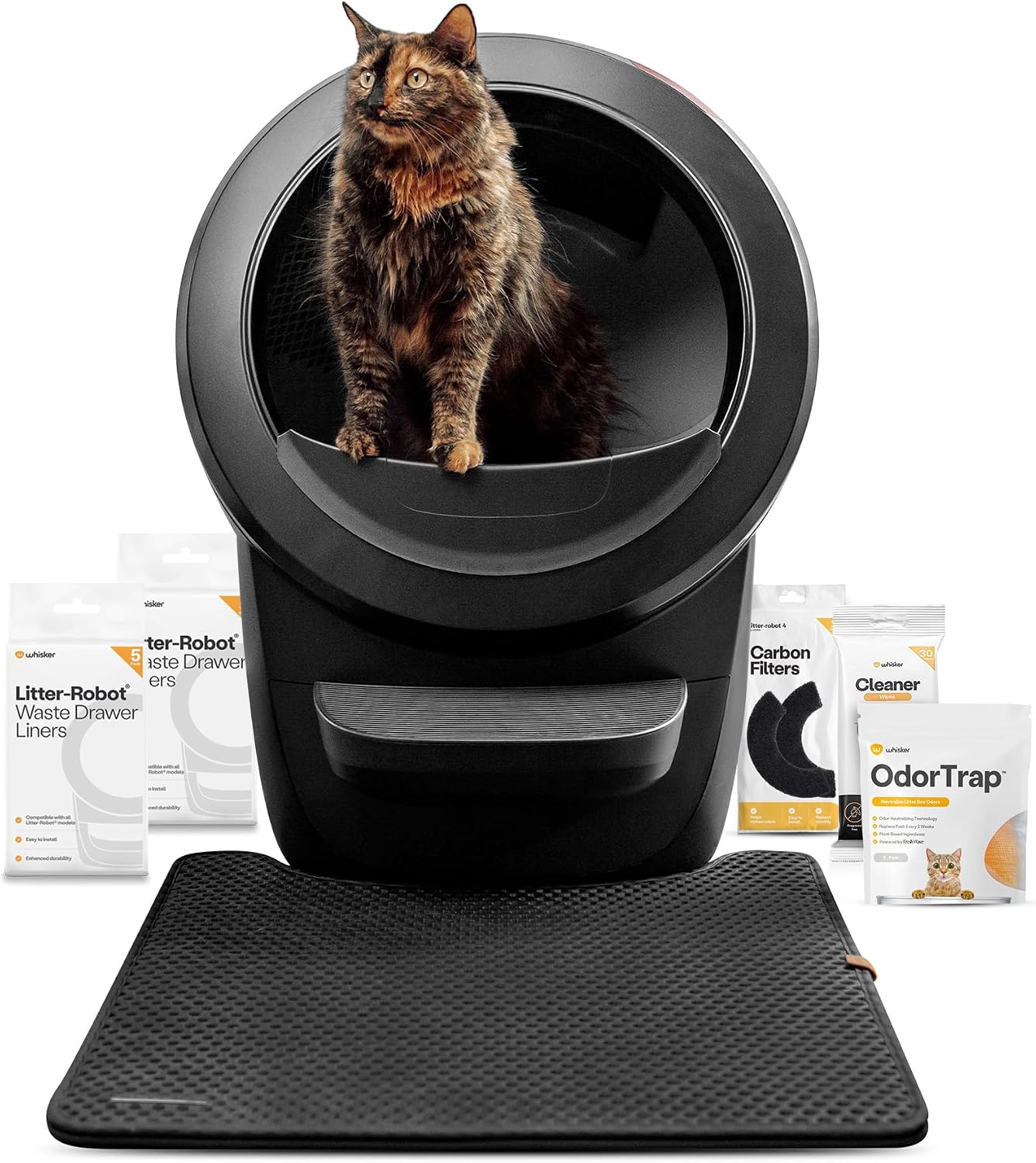
The Litter-Robot 4 is the litter box everyone else is compared to, and after using and researching the whole category, it earns the top spot for good reason. Whisker has been building self-cleaning litter boxes longer than almost anyone, and the 4th generation is the most refined version yet. This Amazon bundle includes the Litter-Robot 4 itself plus a mat, three OdorTrap packs, ten drawer liners, thirty cleaning wipes, and two carbon filters — so you’re set up out of the box.
The core design is a slow-rotating globe. After your cat finishes and steps out, the globe rotates and sifts clumps through a screen, dropping waste into a carbon-filtered drawer below while leaving clean litter behind. Because the sifting is gentle and gravity-based, it handles clumping litter reliably and runs quietly.
Where the Litter-Robot 4 pulls ahead is the sensing and the app. It uses laser and weight sensors to detect your cat with more precision than earlier models, which means it knows not just that the box was used but which cat used it and how much they weigh. Through the Whisker app, you get real weight tracking, per-cat usage logs, and trend data over time — the kind of information that actually helps you catch a health issue early. The OdorTrap system combined with the carbon filter does a genuinely good job on smell, better than most sealed-drawer competitors.
The catch is the price. At around $799 for this bundle, it’s the most expensive box here by a wide margin, and it’s a big unit that needs real floor space. But if you want the most reliable, best-supported smart litter box with the deepest health tracking, this is it. Whisker’s app and customer support are the best in the category, and the resale value stays high.
Why it stands out: The most accurate weight and health tracking, best-in-class odor control, and a proven track record — the benchmark everything else is measured against.
Pros:
- Laser + weight sensors for accurate per-cat detection
- Real weight and health tracking in the Whisker app
- Excellent OdorTrap + carbon filter odor control
- Large globe fits big cats comfortably
- Bundle includes mat, liners, filters, and wipes
- Best app and customer support in the category
Cons:
- Around $799 — by far the priciest pick
- Large footprint needs dedicated floor space
- Clumping litter only
- App requires a Whisker account
Casa Leo Automatic Self-Cleaning Cat Litter Box (Leo’s Loo Too) — Best for Health Monitoring
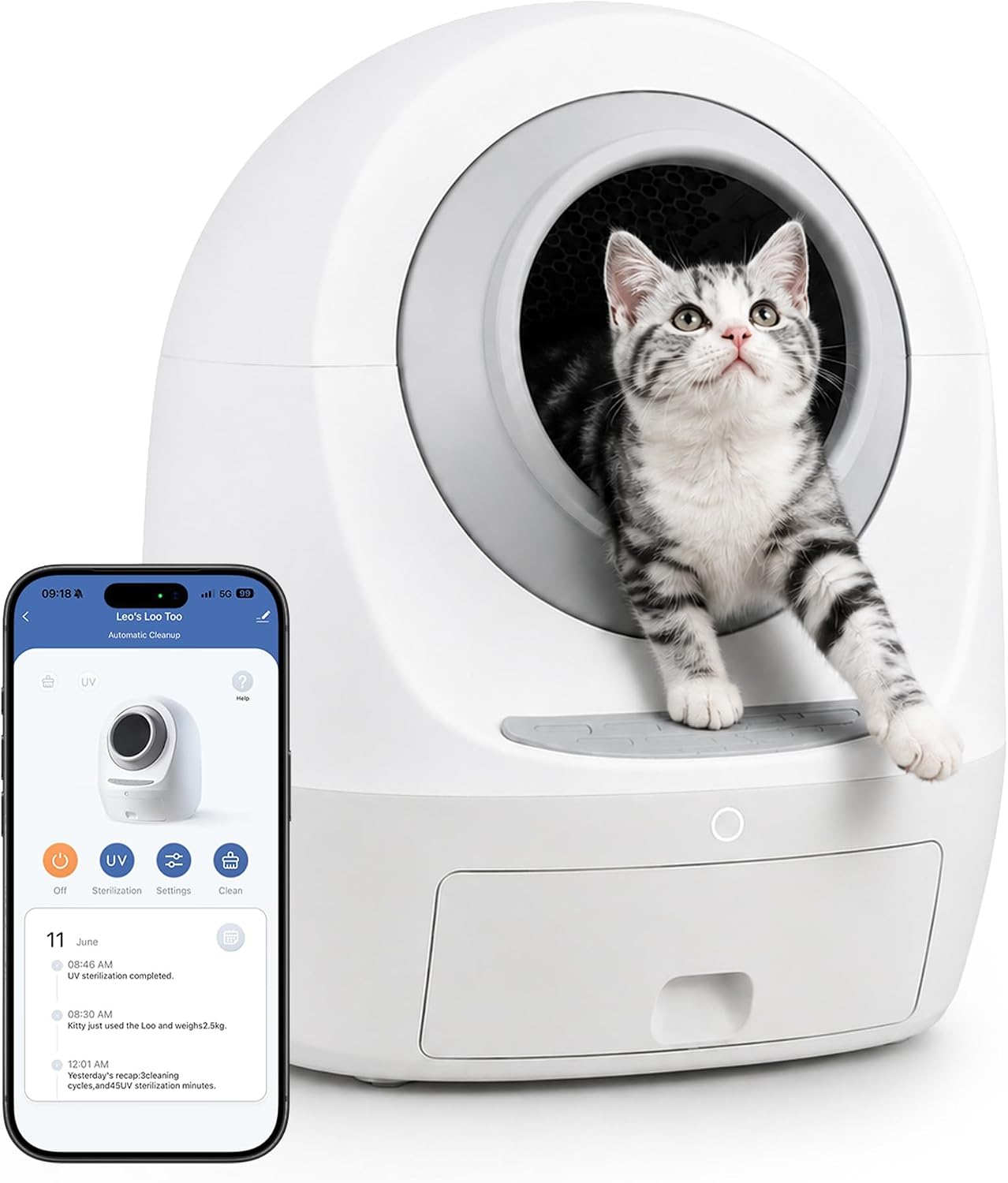
The Casa Leo Leo’s Loo Too is the closest thing to a Litter-Robot rival at a lower price, and it beats the flagship in one specific area: it runs seriously quiet. Casa Leo rates it at under 30 dB, quiet enough that a skittish cat won’t be scared off mid-cycle and you won’t hear it clean from the next room. That matters more than you’d think — the number one reason cats reject an automatic box is noise.
Like the Litter-Robot, it uses a rotating globe that sifts clumps into a sealed drawer after each use. Setup is app-driven over WiFi, and the Casa Leo app is where this box shines for health-conscious owners. It logs every visit and tracks your cat’s weight, building a history you can scroll through to spot changes. Casa Leo leans hard into the health angle in its marketing, and the tracking genuinely works — plenty of owners credit it with catching early signs of illness.
Odor control uses a combination of a carbon-filtered sealed drawer and a UV sterilization cycle that runs between uses to cut bacteria and smell. There are three layers of safety sensors that stop the globe instantly if your cat climbs back in mid-cleaning, and it supports Alexa and Google Assistant voice control for starting a cycle hands-free. The large interior (about 24 x 22 x 27.6 inches) fits big cats and works for multi-cat homes.
At around $599 it’s still a premium purchase, but it undercuts the Litter-Robot by a couple hundred dollars while matching most of what makes it good. If health monitoring is your main reason for going smart and you don’t need the Whisker name, this is the value-conscious flagship.
Why it stands out: Whisper-quiet operation, strong app-based health tracking, and UV odor control at a few hundred dollars less than the Litter-Robot.
Pros:
- Very quiet (under 30 dB) — great for nervous cats
- WiFi app tracks weight and every litter box visit
- UV sterilization + carbon filter for odor
- Three-layer safety sensors
- Alexa and Google Assistant voice control
- Large interior fits big cats and multi-cat homes
Cons:
- Around $599 is still a premium price
- Clumping litter only
- Globe design takes up floor space
- App tracking works best with a single cat per box
Neakasa M1 Plus Open-Top Self-Cleaning Cat Litter Box — Best Open-Top for Big Cats
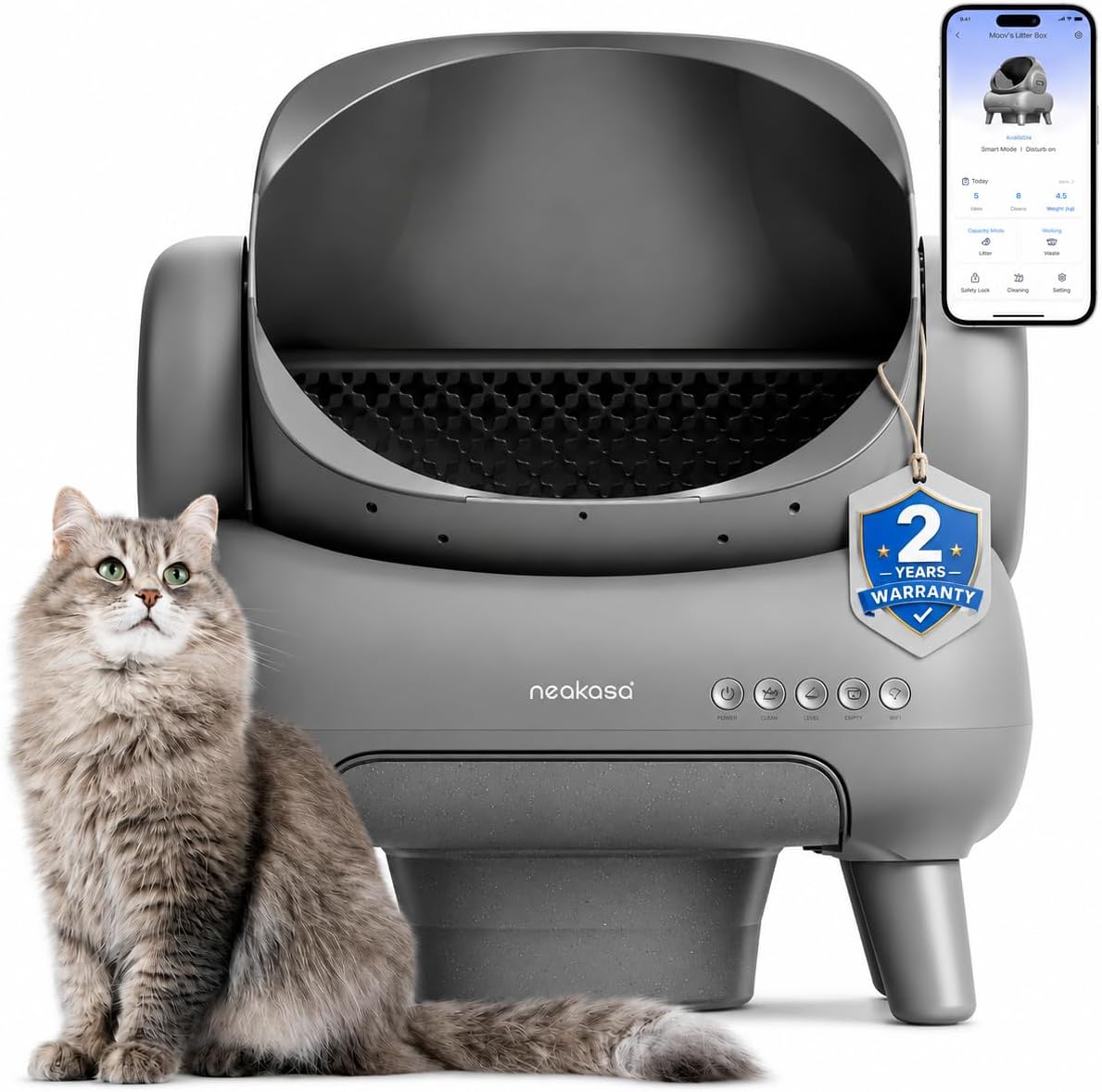
Not every cat will walk into an enclosed globe. Some are too big, some are anxious about the tunnel entrance, and some just refuse. The Neakasa M1 Plus solves that with an open-top design — there’s no hood or tunnel, so your cat steps in from above into a wide, open basin. For large cats, senior cats, and any cat that’s rejected a globe-style box before, this is the one to try first.
Instead of a rotating globe, the M1 Plus uses a rake mechanism that combs through the litter after your cat leaves, pushing clumps into a sealed waste compartment below. The waste is enclosed in an odor-blocking bag you pull and wrap to remove — no scooping, and the smell stays contained during disposal. It automatically stores waste for up to about 14 days per cat before you need to empty it.
Safety is a strong point: the M1 Plus has five pairs of infrared sensors and four weight sensors that detect a cat inside or even pressing on the base, pausing instantly if there’s any contact during a cycle. Over WiFi, the Neakasa app (2.4GHz only) lets you track daily litter box activity, adjust cleaning modes remotely, and watch your cat’s habits over time. It’s not the deep weight-history tracking of the Litter-Robot, but you get usage logging and remote control.
At around $379 it sits comfortably in the mid-range, and the open design plus generous interior makes it the best pick for cats that big-and-boxy globe designs don’t suit. Just note the app is 2.4GHz WiFi only, so if your router pushes everything to 5GHz you may need to set up a 2.4GHz band.
Why it stands out: The open-top layout works for big, senior, and box-shy cats that reject enclosed globes, with solid safety sensors and app tracking.
Pros:
- Open-top design fits large and box-shy cats
- Rake mechanism with pull-and-wrap odor-blocking waste bags
- Five IR sensor pairs + four weight sensors for safety
- App tracks daily activity and allows remote control
- Holds up to ~14 days of waste per cat
- Mid-range price with a roomy interior
Cons:
- 2.4GHz WiFi only — no 5GHz support
- Tracking is lighter than Whisker or Casa Leo
- Open top offers less odor containment than a sealed globe
- Rake designs can occasionally miss soft stool
PETKIT PuraMax 2 Automatic Self-Cleaning Cat Litter Box — Best Value
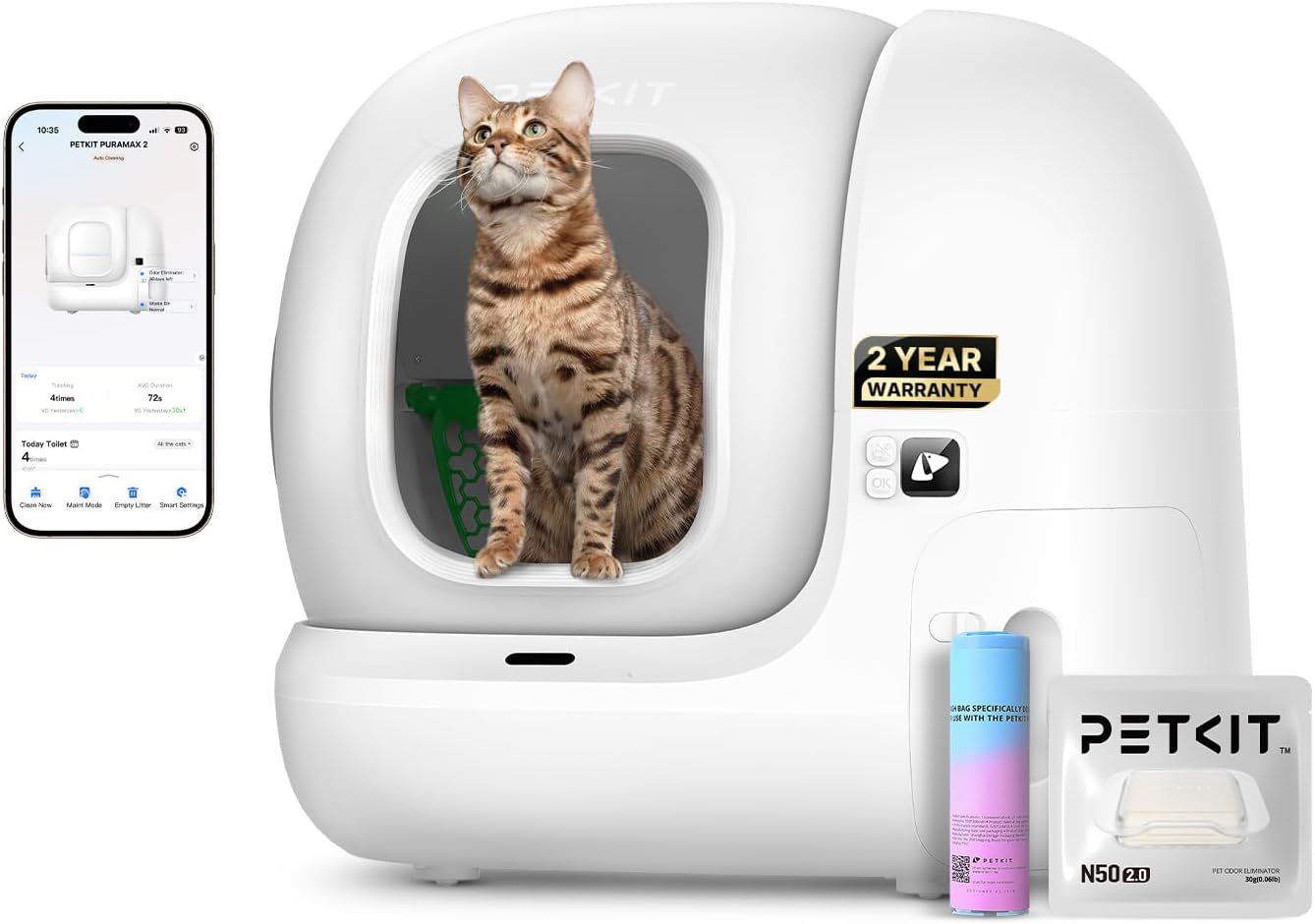
The PETKIT PuraMax 2 is the sweet spot for most buyers: it does the important smart-box things well and costs around $296, roughly a third of the Litter-Robot’s price. This basic bundle includes trash bags and PETKIT’s N50 2.0 odor eliminator to get you started.
It’s a globe-style box with a large 76-liter interior that fits cats from about 3.3 to 22 pounds, so it handles big cats and multi-cat households without feeling cramped. The PETKIT app (2.4GHz WiFi) is genuinely useful here: the box automatically identifies each cat by weight and logs that cat’s weight, how often they use the box, and how long they stay — per cat, in the app. That per-cat breakdown is a feature you usually pay much more for, and it’s the reason this box punches above its price.
Odor control comes from a patented sealed ShieldBase that gives a 360-degree seal to trap smell, plus the included N50 2.0 eliminator that PETKIT rates at removing 98%+ of ammonia for about a month per refill. Safety sensors stop the cleaning cycle if a cat enters mid-clean. The app also handles remote cleaning, maintenance mode, and status alerts when the waste bin is full.
The trade-offs are the usual mid-range ones: it’s 2.4GHz WiFi only, PETKIT’s app has occasionally needed re-pairing after firmware updates, and PETKIT sells consumables (odor packs, bags) you’ll want to keep stocked. But for per-cat health tracking and a big interior at under $300, the PuraMax 2 is the best all-around value on this list.
Why it stands out: Per-cat weight and usage tracking plus a large interior at well under half the flagship’s price.
Pros:
- Per-cat identification with weight, frequency, and duration logging
- Large 76L interior fits big cats and multi-cat homes
- Sealed ShieldBase + N50 odor eliminator for smell control
- App handles remote cleaning, alerts, and maintenance
- Safety sensors pause the cycle when a cat enters
- Excellent value at around $296
Cons:
- 2.4GHz WiFi only
- App can need re-pairing after firmware updates
- Ongoing cost of PETKIT odor packs and bags
- Clumping litter only
MeoWant Self-Cleaning Cat Litter Box — Best for Multi-Cat Weight Tracking
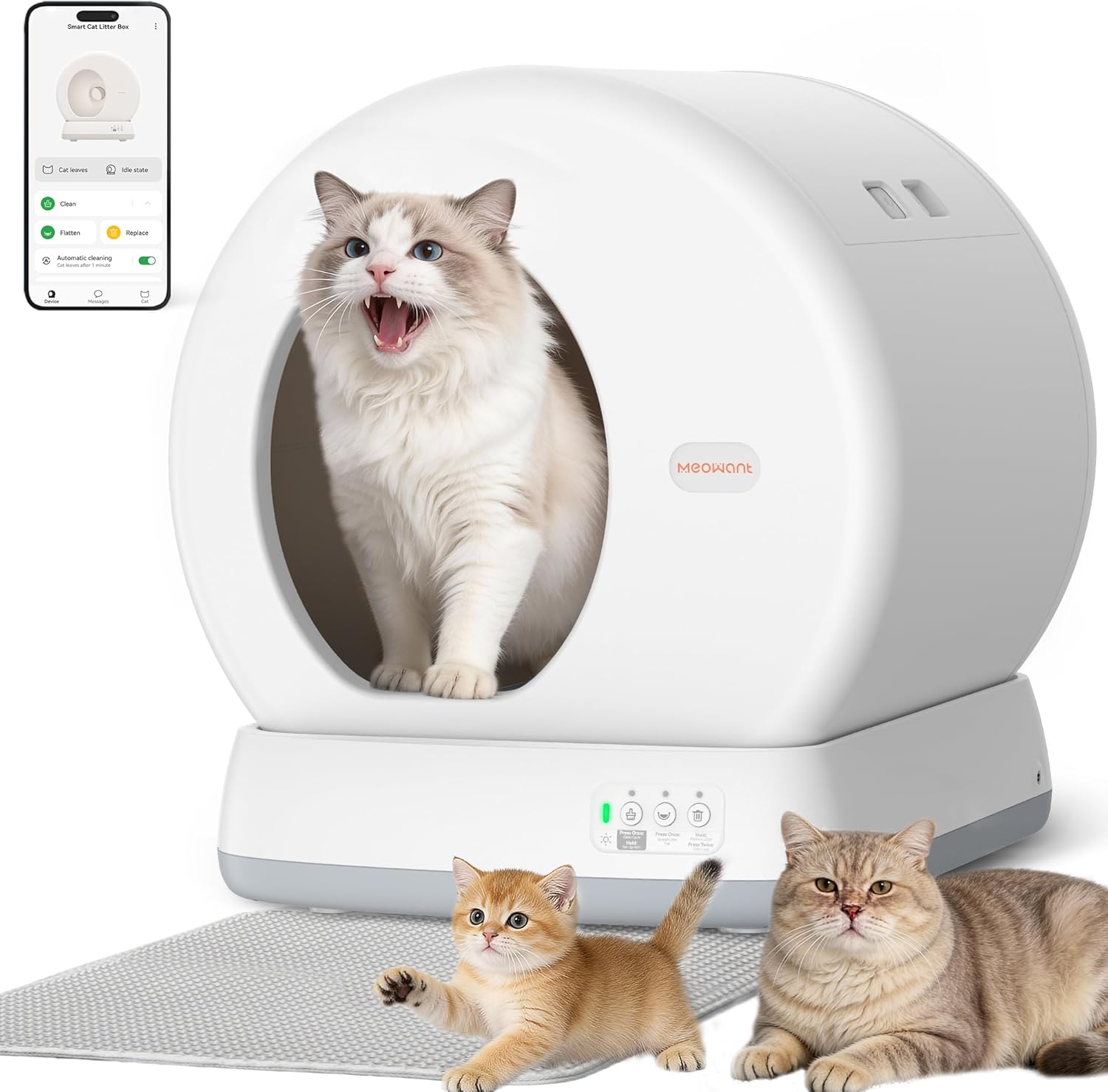
If you’ve got a full house of cats, the MeoWant Self-Cleaning Cat Litter Box is built for exactly that. Its standout feature is that the weight sensors recognize up to six individual cats and track each one’s bathroom habits separately through the app. For a multi-cat home where you’re trying to keep tabs on everyone’s health, that per-cat resolution at around $299 is hard to beat.
Through the AIRPET app over 2.4GHz WiFi, you can monitor each cat’s weight, time of use, and duration of use, with data pushed to your phone periodically. Because it identifies cats by weight, you can actually tell which cat is going more or less often — the early-warning signal that’s easy to miss when several cats share one box. This bundle also ships with a mat and liner.
Safety is layered: the MeoWant combines an infrared sensor, weight sensor, remote alarm, and an accident-protection system that stops the mechanism immediately when a cat is detected approaching or a weight change registers mid-cycle. An automatic opening-and-closing odor-control cover isolates smell between uses, and the motor runs at a quiet ~40 dB. The roughly 57.6L interior suits cats in the 3.3-18 pound range.
The honest caveats: like most boxes in this tier it’s 2.4GHz WiFi only, the AIRPET app is functional but not as polished as Whisker’s, and weight-based cat identification gets less reliable if you have two cats of nearly identical weight. But for tracking a whole household of cats individually at a mid-range price, MeoWant delivers what pricier boxes charge a premium for.
Why it stands out: Recognizes and tracks up to six cats individually by weight — the best per-cat health picture for busy multi-cat homes at this price.
Pros:
- Tracks up to six cats individually by weight
- Logs weight, usage time, and duration per cat in the app
- Layered safety: IR + weight sensors + accident protection
- Automatic odor-control cover, quiet ~40 dB motor
- Includes mat and liner
- Around $299 for genuine multi-cat tracking
Cons:
- 2.4GHz WiFi only
- AIRPET app is less polished than premium rivals
- Weight ID struggles with same-weight cats
- Interior is smaller than the PuraMax 2’s
PetSafe ScoopFree Complete Smart Self-Cleaning Cat Litter Box — Best Budget WiFi Pick
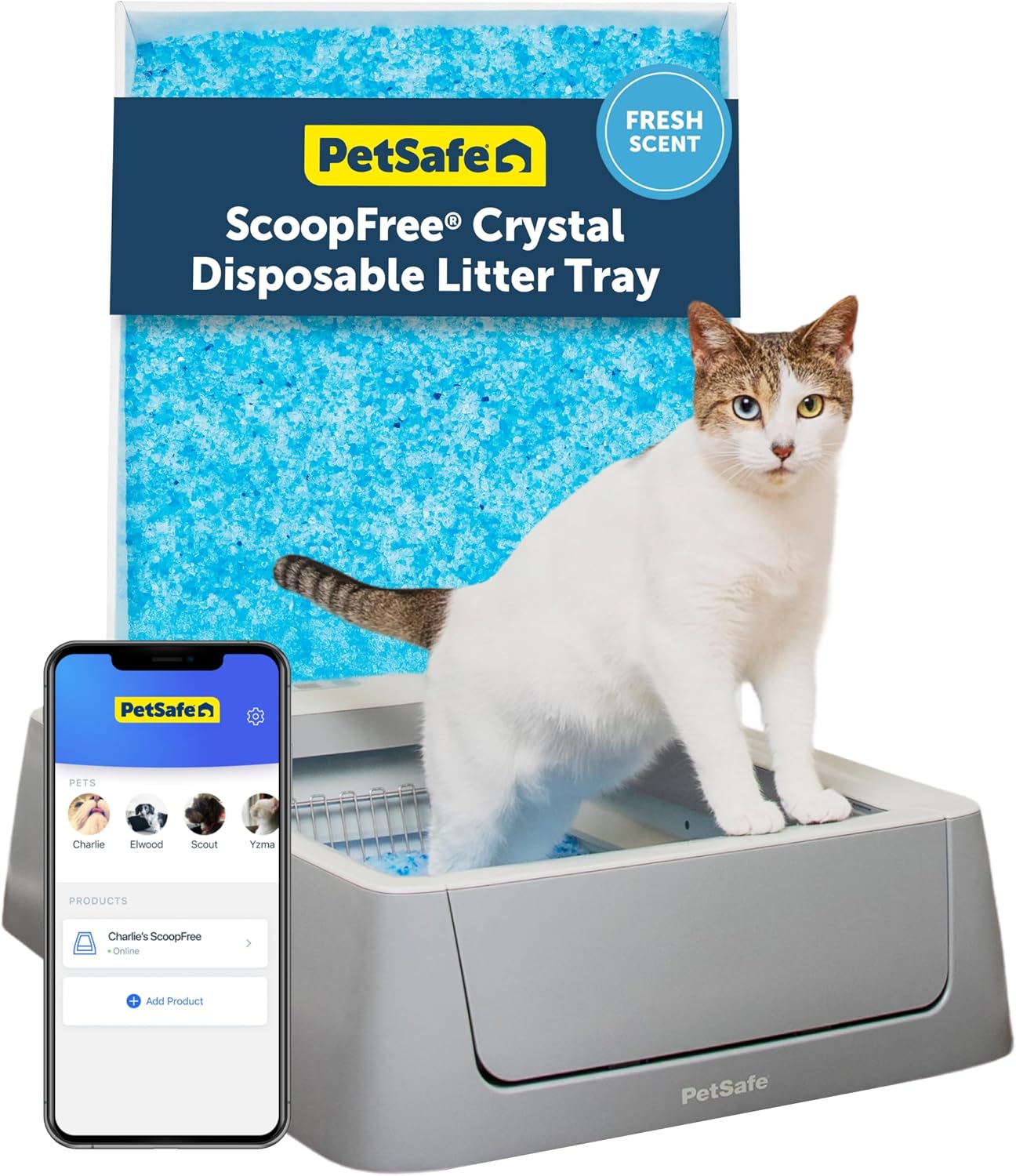
If you want a genuinely WiFi-connected, app-enabled smart litter box without spending several hundred dollars, the PetSafe ScoopFree Complete Smart is the entry point. At around $175 it’s the most affordable box here, and it’s still truly smart — WiFi and app-enabled, not a dumb timer box wearing a smart badge.
The ScoopFree works differently from the globe and rake boxes above. It uses disposable crystal litter trays: silica crystal litter that absorbs urine and dehydrates solid waste to cut odor, sitting in a tray you swap out whole. A rake automatically sweeps waste into a covered compartment at the front of the tray after your cat leaves, on a schedule you can adjust. Because the whole tray is disposable, there’s no scooping and minimal hands-on cleaning — you just replace the tray every few weeks depending on how many cats use it.
Over WiFi, the My PetSafe app connects the box and includes a health counter that logs how often the box is being used, so you can keep an eye on your cat’s habits from your phone and get low-tray and maintenance reminders. It’s lighter on data than the weight-tracking premium boxes — it counts uses rather than tracking per-cat weight — but for a budget box, having any real usage logging and app connectivity is a genuine step up from a basic automatic tray.
The trade-off to understand up front is the ongoing cost of disposable crystal trays. This is a refill-based system, so your running cost is higher than boxes that use regular clumping litter you buy in bulk. It’s also less suited to multi-cat homes for that reason. But if you want the cheapest real WiFi smart box, hate scooping, and have one or two cats, the ScoopFree Complete Smart is the honest budget answer.
Why it stands out: A genuinely WiFi and app-connected smart litter box at the lowest price here, with truly hands-off disposable-tray cleaning.
Pros:
- Most affordable real WiFi smart box (~$175)
- My PetSafe app with health counter and usage logging
- Disposable crystal trays mean almost no hands-on cleaning
- Crystals dehydrate waste for strong odor control
- Low-maintenance rake with adjustable schedule
- Trusted PetSafe brand and support
Cons:
- Ongoing cost of disposable crystal litter trays
- Locked into PetSafe’s crystal system, not standard litter
- Counts uses rather than tracking per-cat weight
- Less ideal for multi-cat households
Comparison Table
| Feature | Litter-Robot 4 | Leo’s Loo Too | Neakasa M1 Plus | PETKIT PuraMax 2 | MeoWant | PetSafe ScoopFree |
|---|---|---|---|---|---|---|
| Price | ~$799 | ~$599 | ~$379 | ~$296 | ~$299 | ~$175 |
| Best For | Overall | Health monitoring | Big / box-shy cats | Value | Multi-cat tracking | Budget WiFi |
| Design | Globe | Globe | Open-top | Globe | Globe | Disposable tray + rake |
| Cleaning | Rotating sift | Rotating sift | Rake | Rotating sift | Rake | Rake |
| WiFi App | Yes (Whisker) | Yes (Casa Leo) | Yes (Neakasa) | Yes (PETKIT) | Yes (AIRPET) | Yes (My PetSafe) |
| Weight Tracking | Yes (per cat) | Yes | Usage only | Yes (per cat) | Yes (up to 6 cats) | Usage count only |
| Voice Control | No | Alexa + Google | No | No | No | No |
| Litter Type | Clumping | Clumping | Clumping | Clumping | Clumping | Crystal (disposable) |
| Multi-Cat | Good | Good | Good | Good | Best | Limited |
| Odor Control | OdorTrap + carbon | UV + carbon | Sealed bag | ShieldBase seal | Sealed cover | Crystal dehydration |
How to Choose the Right Smart Litter Box
Picking the right smart litter box comes down to your cat, your home, and your budget. Here’s how to think it through.
Self-cleaning mechanism: globe vs. rake vs. disposable tray. There are three main designs. Globe (rotating) boxes like the Litter-Robot 4, Leo’s Loo Too, and PuraMax 2 slowly rotate to sift clumps into a sealed drawer — quiet, thorough, and great at containing odor, but bulky and enclosed. Rake boxes like the Neakasa M1 Plus comb through the litter with a bar — often more open and better for big cats, though rakes can occasionally miss soft stool. Disposable-tray boxes like the PetSafe ScoopFree use crystal litter in a swap-out tray with a rake — the least hands-on but with ongoing refill costs. There’s no single best design; match it to your cat’s comfort.
App and WiFi vs. timer-only. This is the line between a real smart box and a fake one. A genuinely smart box connects to WiFi and lets you control it and read its data from your phone. A timer-only box just cleans on a schedule with no app, no alerts, and no tracking — some are marketed as “smart” when they aren’t. Every box on this list is truly app-connected. If you’re comparing against something not on this list, confirm it has an actual smartphone app and WiFi, not just a cleaning timer. Note that most boxes here (except the Litter-Robot) use 2.4GHz WiFi only — if your router auto-combines bands, you may need to expose a 2.4GHz network. A solid mesh setup helps.
Multi-cat homes and weight tracking. If you have more than one cat, weight-based per-cat tracking is the killer feature. The MeoWant identifies up to six cats individually, and the PuraMax 2 and Litter-Robot 4 track per cat by weight too. This lets you spot when one specific cat starts going more or less often — an early health signal that’s invisible with a shared basic box. The main limitation is that weight-based ID gets shaky when two cats weigh almost the same.
Odor control. Sealed-globe boxes with carbon filters (Litter-Robot 4) and UV sterilization (Leo’s Loo Too) do the best job overall. Sealed bases (PuraMax 2’s ShieldBase) and crystal dehydration (ScoopFree) also work well. Open-top boxes like the Neakasa contain odor less by design, though the pull-and-wrap waste bags help at disposal. If odor is your top concern and the box is in a living area, lean toward a sealed globe.
Size for large cats. Big cats (Maine Coons, Ragdolls, large tabbies) need room to turn around. The Neakasa M1 Plus open-top and the large-interior globes (Litter-Robot 4, Leo’s Loo Too, PuraMax 2’s 76L) all fit big cats. Avoid narrow entries and cramped globes if your cat is over about 12-14 pounds — a box that’s too small is the fastest way to get a cat to boycott it.
Safety. Automatic boxes have moving parts, so safety sensors are non-negotiable. Look for infrared and weight sensors that stop the mechanism instantly if a cat enters mid-cycle — every box here has them, with the Neakasa and MeoWant offering especially layered systems. If you have a curious kitten, prioritize the boxes with multiple sensor types.
Cleaning and maintenance. “Self-cleaning” still means some upkeep. You’ll empty the waste drawer every few days to two weeks depending on cat count, wipe down the interior periodically, and replace carbon filters or odor packs. Globe boxes generally need a full litter change and wash every few weeks. The ScoopFree is the lowest-touch day to day but you’re swapping whole trays.
Subscription and refill costs. Factor the running cost, not just the sticker price. Boxes that use standard clumping litter (Litter-Robot 4, Leo’s Loo Too, Neakasa, PuraMax 2, MeoWant) let you buy litter in bulk cheaply — your ongoing costs are mostly optional odor packs, bags, and filters. The ScoopFree’s disposable crystal trays are convenient but a recurring expense that adds up, especially with multiple cats. A cheaper box with pricey refills can cost more over two years than a pricier box that uses regular litter, so run the math for your household.
Once your litter box is handling itself, the litter that inevitably gets tracked around the house is the next problem — a robot vacuum built for pet hair keeps the floor around the box clean automatically. And if litter box odor or dust in the room is a concern, an indoor air quality monitor lets you actually see when the air needs attention.
FAQ
Are smart litter boxes actually worth it? For most cat owners, yes — especially if you value the daily time saved and the health tracking. The self-cleaning alone means you’re not scooping every morning, and the app-based weight and usage tracking on boxes like the Litter-Robot 4, PuraMax 2, and MeoWant can flag health problems early, which is genuinely valuable given how well cats hide illness. The main reasons to skip one are a tight budget (they start around $175 and climb fast) or a cat that flatly refuses enclosed automatic boxes.
Will my cat actually use an automatic litter box? Most cats adapt within a week or two, but some are wary at first — usually because of the noise or the enclosed shape. To make the switch easier, place the automatic box next to the old one for a while, keep the same litter, and let your cat get used to it before removing the old box. For nervous or large cats, a quiet model (Leo’s Loo Too, under 30 dB) or an open-top design (Neakasa M1 Plus) has the best odds of acceptance.
Do smart litter boxes really track my cat’s health? The better ones track it meaningfully. Boxes with weight sensors — the Litter-Robot 4, Leo’s Loo Too, PuraMax 2, and MeoWant — log each cat’s weight and how often and long they use the box, then chart the trend in the app. A sudden change in frequency or weight is one of the earliest signs of urinary, kidney, or thyroid issues, so this data can prompt a vet visit weeks sooner than you’d otherwise notice. Budget boxes like the ScoopFree count uses rather than tracking weight, which is less detailed but still useful.
How much does it cost to run a smart litter box each month? It depends on the litter system. Boxes that use standard clumping litter (most on this list) cost roughly what a normal litter box costs — mostly litter plus the occasional carbon filter or odor pack, often $10-25 a month for one cat. The PetSafe ScoopFree uses disposable crystal trays that run higher per month since you replace the whole tray, and the cost scales up with more cats. Always factor refills into the total, not just the purchase price.
Can one smart litter box handle multiple cats? Yes, but with caveats. Vets generally recommend one box per cat plus one extra, so a single automatic box may not be enough for a multi-cat home no matter how large it is. That said, a big-interior box with per-cat weight tracking — the MeoWant (up to six cats), PuraMax 2, or Litter-Robot 4 — can serve a couple of cats well and still tell you which cat is using it. Just make sure it cleans quickly enough between uses so it’s ready for the next cat, and watch the app data to confirm everyone is actually using it.
Are automatic litter boxes safe for cats and kittens? The ones on this list are — they all use infrared and weight sensors that immediately stop the cleaning mechanism if a cat enters mid-cycle, and the Neakasa and MeoWant have especially layered safety systems. That said, most manufacturers advise waiting until kittens are around six months old before using an automatic box, since very small kittens may not reliably trigger the sensors. For a young kitten, stick with a manual box until they’re big enough.