Quick Picks
Short on time? Here are our top recommendations:
- Midea Cube 50 Pint with Built-in Pump (~$320) — Best overall
- GE Smart 50-Pint WiFi Dehumidifier (~$280) — Best for large basements
- Midea Cube 20 Pint (~$210) — Best for bedrooms and small rooms
Why Buy a Smart Dehumidifier?
A regular dehumidifier hums away in the corner and dumps water into a bucket you have to remember to empty. A smart dehumidifier does something more useful: it tracks the actual humidity in your space, adjusts itself to hit your target, and tells your phone when something needs attention. Most also let you set schedules, drain water automatically through a hose or pump, and check the room’s relative humidity from anywhere.
Nearly every dehumidifier above $200 now ships with Wi-Fi and an app, so the “smart” framing is no longer marketing fluff — it’s the new baseline. The real question is which app actually works, which pump won’t clog, and which unit can handle 4,500 square feet of damp basement without sounding like a jet engine.
We sized up the leading models from Midea, GE, Frigidaire, hOmeLabs, and Honeywell, and narrowed it to 6 that we’d actually buy. Every pick here is ENERGY STAR-rated, connects to Wi-Fi, and has either a built-in pump or a continuous gravity-drain option so you can set it and forget it.
If you also need to handle airborne particles, our best smart air purifier guide is a good companion read — dehumidifiers and purifiers solve different problems (water in the air vs. particles in the air), and most homes benefit from both.
The 6 Best Smart Dehumidifiers
1. Midea Cube 50 Pint Dehumidifier for Basement and Rooms at Home for up to 4,500 Sq. Ft., Built-in Pump, Drain Hose Included, Smart Control, Works with Alexa (White), ENERGY STAR Most Efficient 2022 — Best Overall
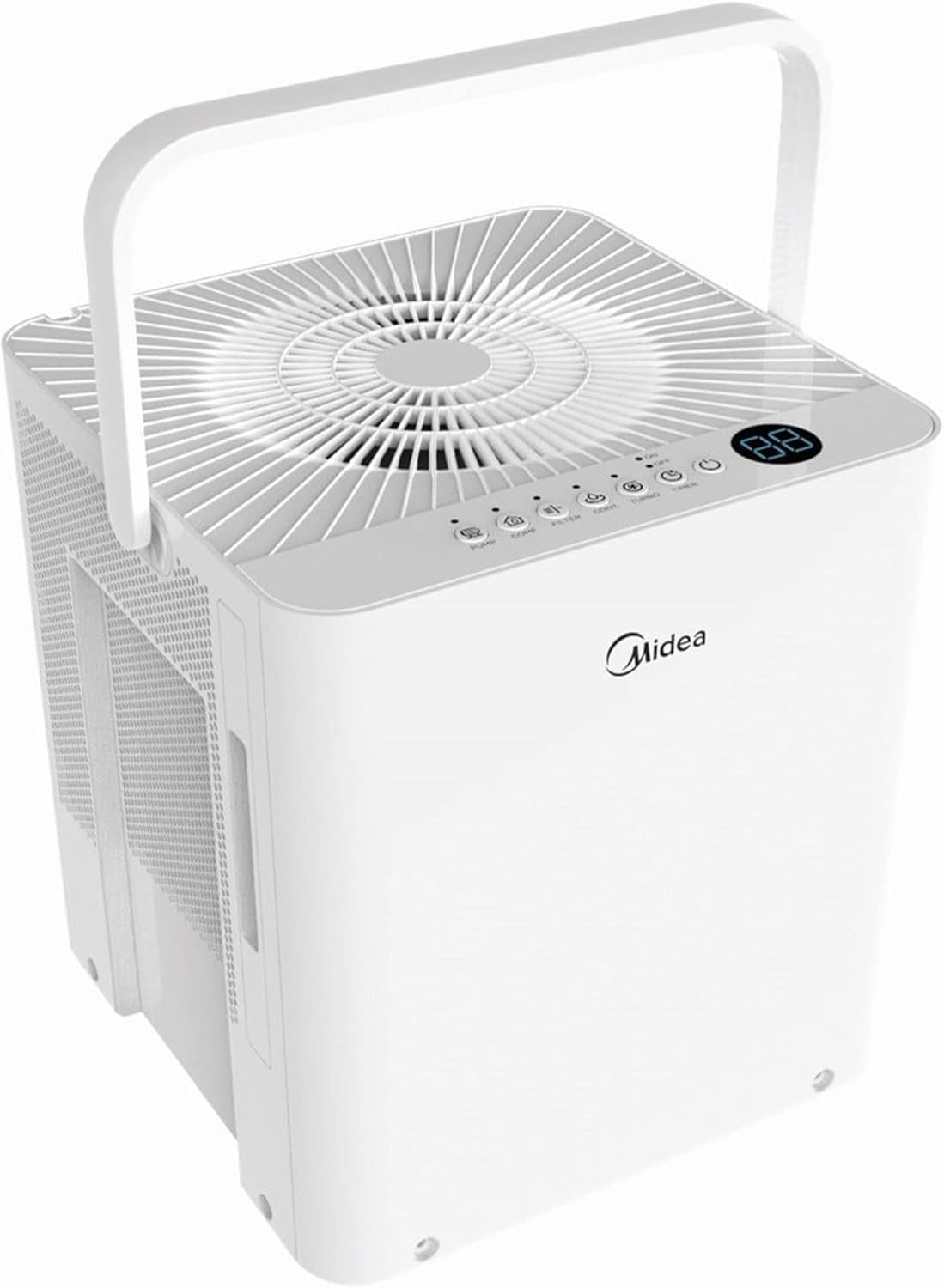
The Midea Cube is the most interesting design in dehumidifiers right now, and it happens to also be the best smart unit you can buy. It splits into a top section (the dehumidifier itself) and a bottom section (a 21-pint reservoir) that twists out for huge water storage — about 3x what a normal bucket holds. When you don’t need that capacity, it nests down into a compact cube that hides under a workbench.
For continuous use, the built-in pump is the real selling point. It lifts water up to 16 feet so you can drain into a utility sink or out a basement window without relying on gravity. The Midea Air app gives you real-time humidity readings, lets you set a target RH, and works with Alexa for voice control. ENERGY STAR Most Efficient certification means it draws noticeably less power than non-rated 50-pint units running 24/7 — which adds up over a humid summer.
It handles up to 4,500 sq ft, which covers most basements, and the auto-defrost lets it keep running in cooler spaces where lesser units would freeze up. Setup takes about 10 minutes including the Wi-Fi pairing.
Specs: 4,500 sq ft coverage | 50 pint/day | Built-in pump (16 ft lift) | Midea Air app | Alexa | ENERGY STAR Most Efficient | ~$320
Pros:
- Clever twist-apart design with massive 21-pint reservoir
- Built-in pump handles vertical drainage out of windows or up to a sink
- ENERGY STAR Most Efficient — lowest operating cost in this class
- Auto-defrost keeps it running in cool basements
- Solid Midea Air app with scheduling and remote control
Cons:
- Bigger footprint than traditional dehumidifiers when fully extended
- Alexa-only voice support (no Google Home or HomeKit)
2. GE Smart Energy Star Portable Dehumidifier w/WiFi for Basement, Bedroom, Bathroom, Garage, Large Rooms up to 4500 Sq Ft, 50Pint w/Removable Bucket & Continuous Drain Connect for Auto/Manual Drainage — Best for Large Basements
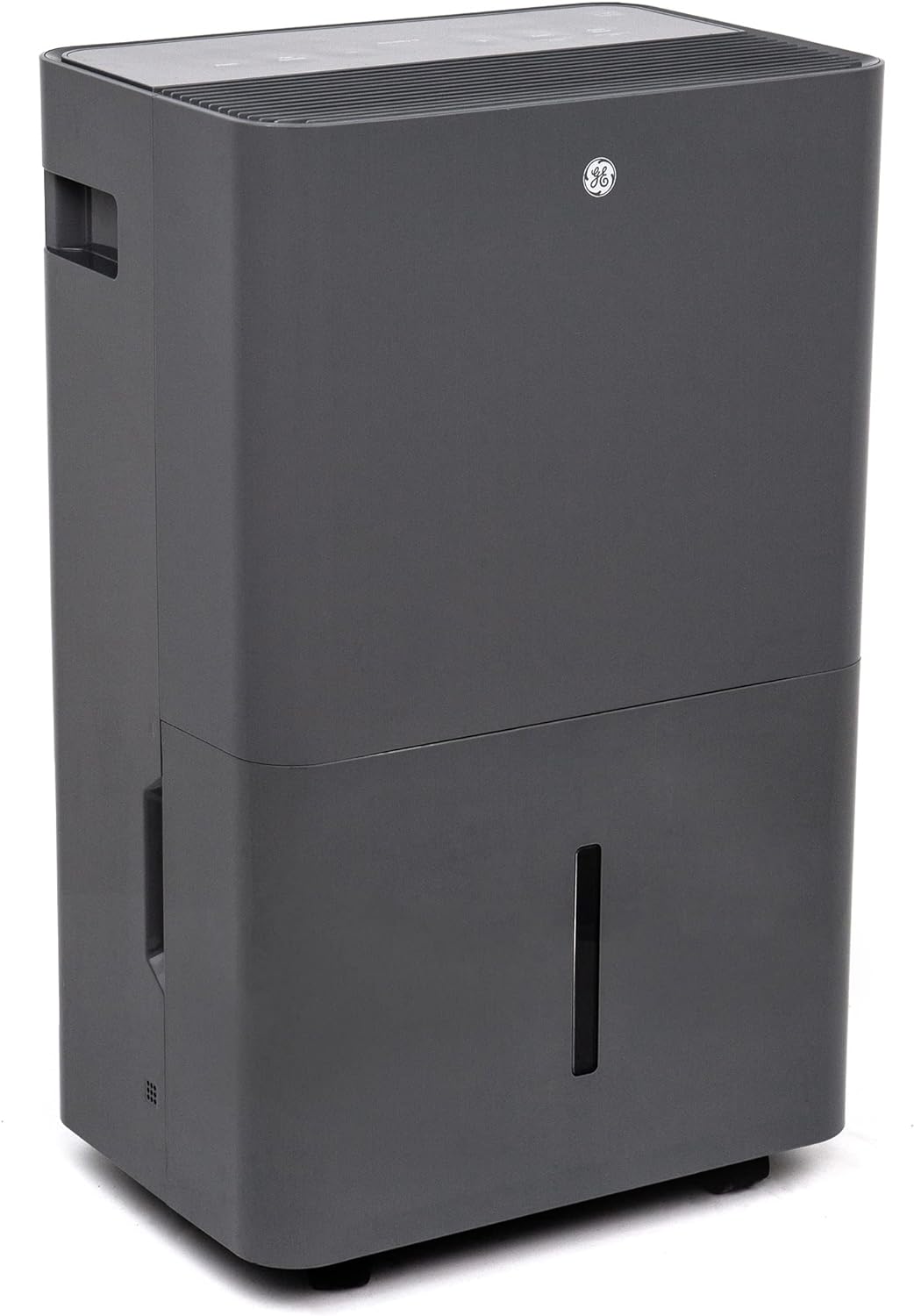
GE has been making dehumidifiers for decades, and this Smart 50-Pint model is what you want if you have a big finished basement or a damp crawlspace under a large house. It pulls 50 pints of water per day, covers up to 4,500 sq ft, and connects to the SmartHQ app for remote monitoring, scheduling, and energy usage tracking.
The Smart Dry mode is the headline feature: it watches the room’s humidity and automatically adjusts fan speed to keep things at your target RH without you babysitting it. You can choose three manual fan speeds if you prefer, and the empty-bucket alarm beeps for 10 seconds when the 1.9-gallon tank fills up so you don’t get a flooded basement.
The continuous drain port lets you connect a standard garden hose for gravity drainage to a floor drain, which is the simplest setup if you have one nearby. SmartHQ also works with Alexa and Google Assistant for voice control, and the energy tracking inside the app is genuinely useful — it shows you exactly what you’re spending to keep things dry.
Specs: 4,500 sq ft coverage | 50 pint/day | Continuous gravity drain | SmartHQ app | Alexa & Google | ENERGY STAR | ~$280
Pros:
- GE build quality and a 1-year warranty backed by a major brand
- SmartHQ app tracks energy usage, not just humidity
- Works with both Alexa and Google Home
- Large 1.9-gallon bucket means fewer trips to empty it
- Smart Dry auto mode actually works
Cons:
- No built-in pump (gravity drain only)
- SmartHQ app can be slow on first launch
3. Frigidaire 50-Pint Smart Dehumidifier for Basement, Garage, Attic, 115V, Energy Star Moisture Absorber with Timer, Wi-Fi, App Control and Amazon Alexa & Google Home Compatibility in White — Best App Experience
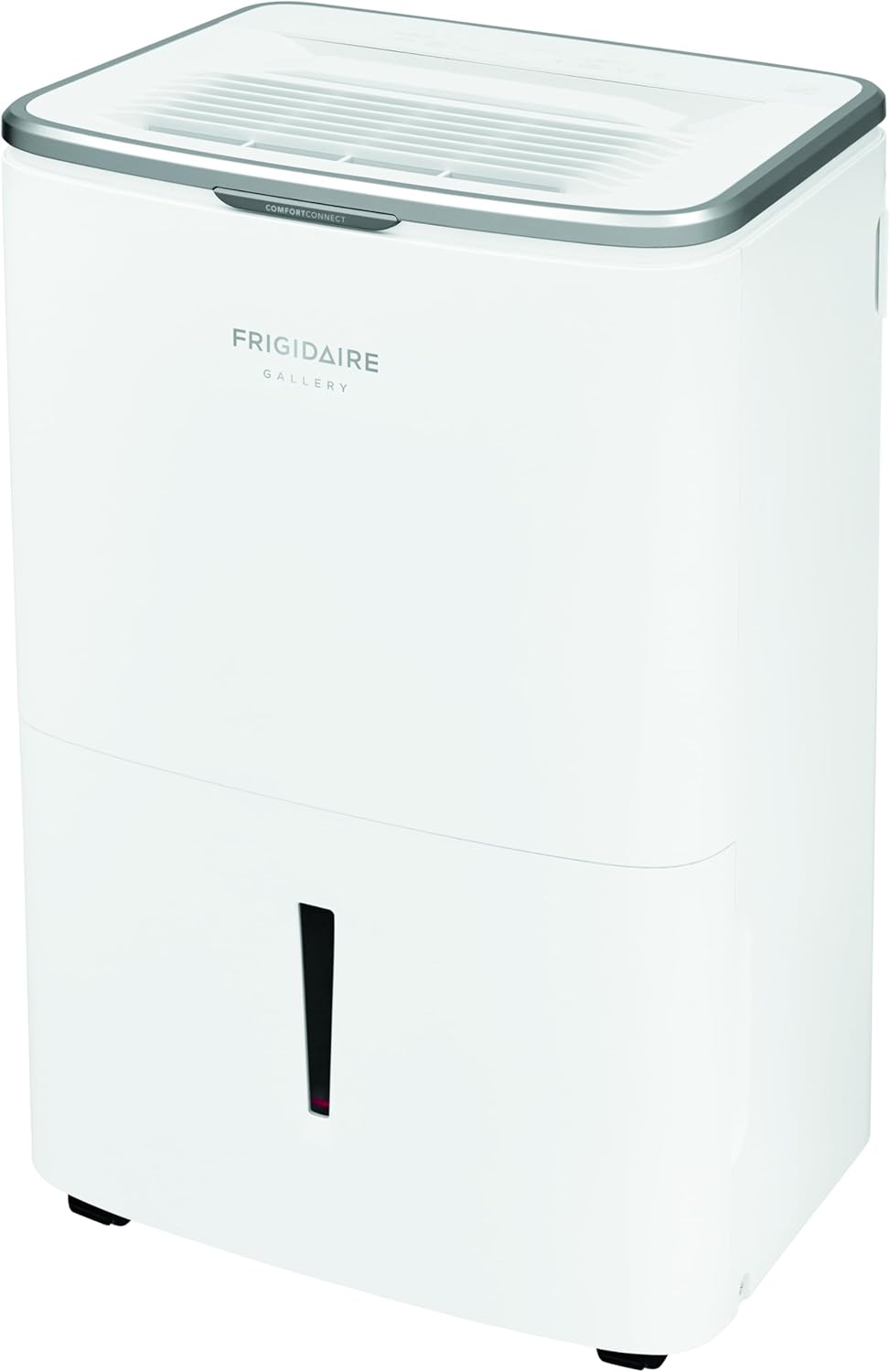
Frigidaire’s smart 50-pint model is the one to get if you want polished app control and broad voice assistant support. The Frigidaire app handles humidity targeting, fan speed, mode switching, and scheduling — all from your phone — and it works with both Alexa and Google Home for voice commands like “set the dehumidifier to 45 percent.”
The unit itself is a clean traditional design with castor wheels for moving between rooms, a 13.1-pint internal tank with an integrated handle, and a continuous drain port for hose-based gravity drainage. The included antibacterial mesh filter helps with mold spores and dust mites, and the auto-restart kicks the unit back on at your last setting after a power outage — handy if your basement loses power during summer storms.
In real-world use, the app is more responsive and reliable than what you get from cheaper brands, and Frigidaire’s customer support is much easier to reach if something breaks. ENERGY STAR-certified, so it sips less power than non-rated competitors.
Specs: 50 pint/day | Continuous gravity drain | Frigidaire app | Alexa & Google | ENERGY STAR | Castor wheels | ~$300
Pros:
- Best app on this list — fast, reliable, well-designed
- Both Alexa and Google Home voice control
- Antibacterial filter helps with mold and dust mites
- Auto-restart after power outages
- Castor wheels and integrated handle for easy moving
Cons:
- No built-in pump option at this price point
- Slightly noisier than the Midea Cube on high
4. hOmeLabs Dehumidifier 7,500 Sq Ft Wi-Fi with Pump (50 Pint MAX 120 Pint at 95°F, 90% RH) for Home, Office, Basements with Powerful Moisture Removal, Humidity Control, Auto Shut-off, Quiet Operation — Best for Whole-House
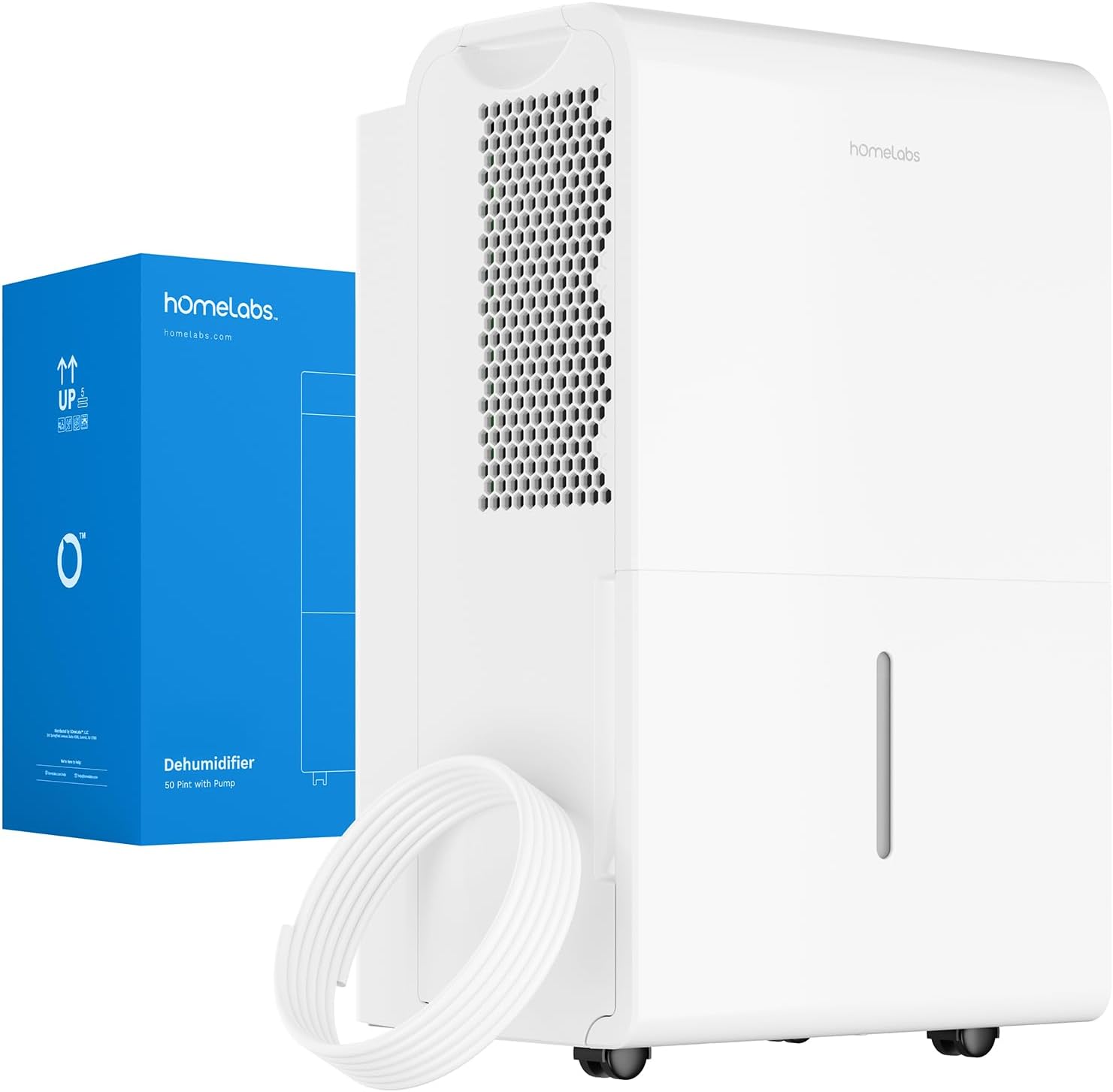
If you need to dehumidify a really big space — think open-floor-plan basement, finished attic, or a small commercial space — the hOmeLabs 7,500 sq ft unit is the brute-force option that still has good smart features. It removes up to 50 pints under the 2019 DOE standard (and up to 120 pints under saturation conditions of 95°F and 90% RH), which is genuinely a lot of water.
The built-in pump can move water up to 16.4 feet vertically through the included drain hose, so you can park this in a basement corner and drain straight to a utility sink, washing machine standpipe, or out a window. The Wi-Fi app gives you remote control, real-time humidity readings, scheduling, and a target-humidity setting that the unit will work to maintain automatically.
It’s noticeably louder than the Midea Cube on high — this is a workhorse, not a bedroom unit — but it has a quieter low-speed mode for overnight runs. Auto shut-off prevents flooding if the pump fails and the tank fills up, and the unit auto-restarts at your last setting after a power blip.
Specs: Up to 7,500 sq ft | 50 pint/day (DOE 2019) | Built-in pump (16.4 ft lift) | Wi-Fi app | Auto shut-off | ~$300
Pros:
- Massive coverage area for whole-house or commercial use
- Built-in pump with 16.4 ft of vertical lift
- Better moisture removal under saturated conditions than most competitors
- Auto shut-off and auto-restart for unattended operation
Cons:
- Louder on high than the Midea or GE
- Bulkier physical footprint
- App is functional but less polished than Frigidaire’s
5. Honeywell Smart WiFi Energy Star Dehumidifier for Basements & Large Rooms Up to 4000 Sq. Ft. with Alexa Voice Control & Anti-Spill Design, White — Best Mid-Range
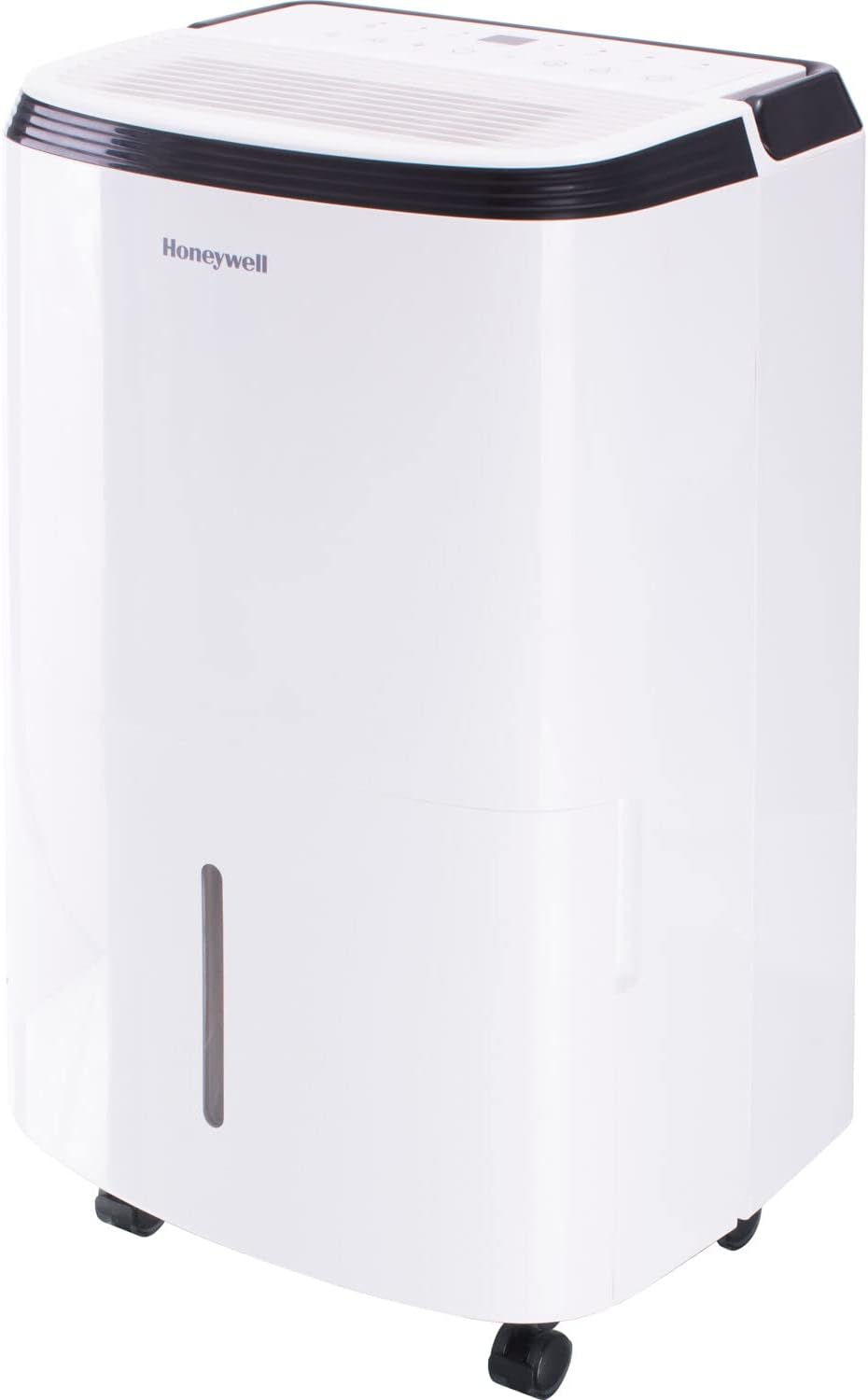
Honeywell’s smart dehumidifier hits the sweet spot for finished basements, large living rooms, and home offices up to 4,000 sq ft. It connects to the Honeywell Smart Dehumidifier app and Alexa for voice control, and the smart digital humidistat automatically kicks dehumidification on and off based on your pre-set room conditions.
The anti-spill design on the tank is a small but genuinely useful touch — anyone who’s ever sloshed a full bucket on the way to the sink knows why. The detachable tank has a comfort-grip handle, and you can connect the included drain tube to the continuous-drain outlet for set-and-forget operation. The washable dust filter rinses under the faucet, so you never need to buy replacement filters.
What makes this stand out at this price is Honeywell’s 5-year limited warranty with US-based customer support — most competitors offer 1 year. The smart features are basic (no Google Home, no built-in pump), but it does the core job well and the build quality is noticeably above the budget brands.
Specs: 4,000 sq ft coverage | 50 pint/day | Continuous gravity drain | Honeywell app | Alexa | Washable filter | 5-year warranty | ~$280
Pros:
- 5-year warranty is the best in this group
- Anti-spill tank design prevents floor messes
- Washable filter means no replacement-filter costs
- Solid build quality from a name brand
- US-based customer support
Cons:
- No Google Home support (Alexa only)
- No built-in pump
- App is functional but plain
6. Midea Cube 20 Pint Dehumidifier for Basement, Up to 1,500 Sq. Ft. dehumidifier with drain hose, ENERGY STAR Certificated, Smart Control, Compatible with Alexa, White — Best for Small Rooms
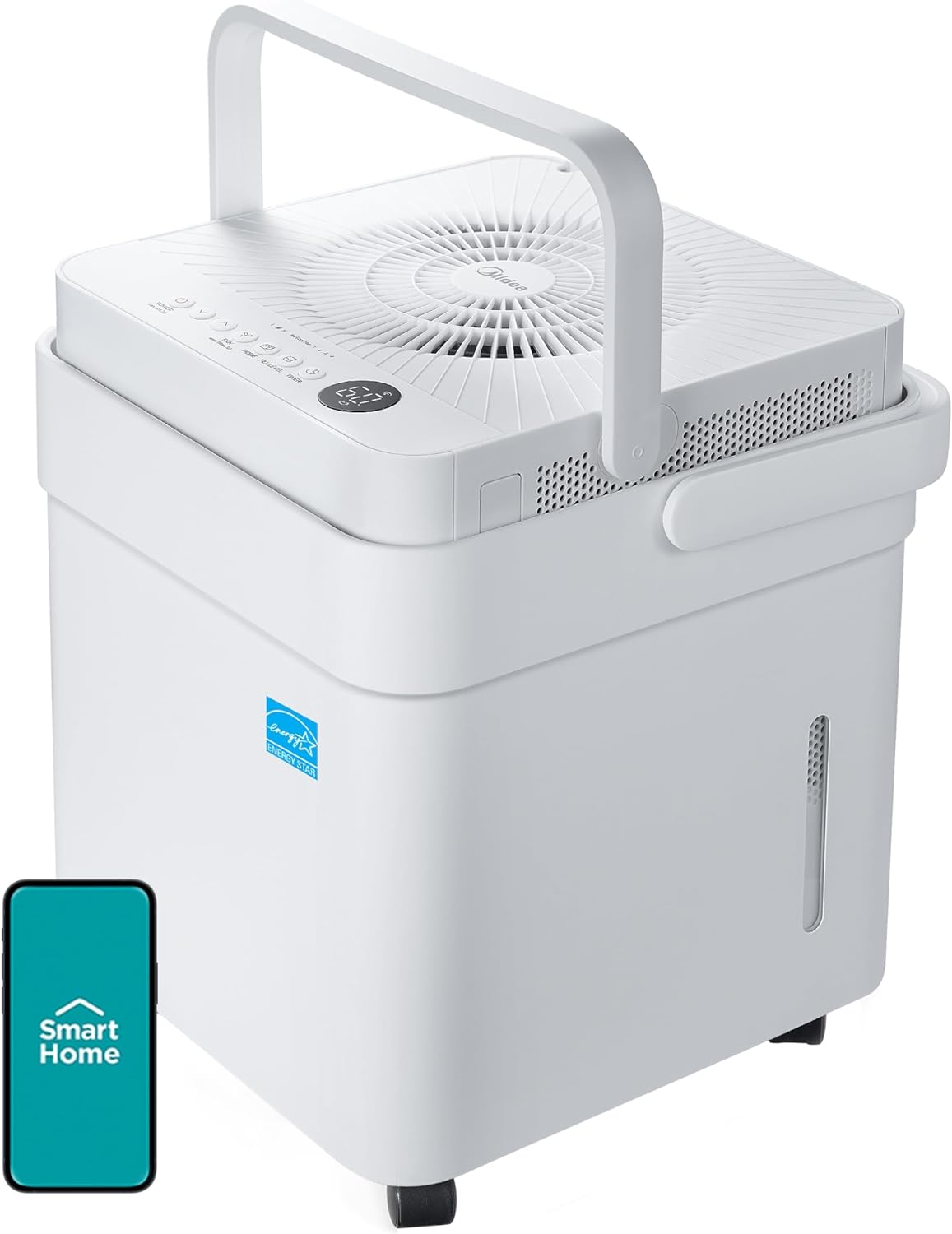
You don’t always need a 50-pint behemoth — for a bedroom, a small finished basement, or a humid bathroom, a 20-pint unit moves the right amount of water without overcooling the room or wasting energy. The Midea Cube 20 Pint is the same clever design as our top pick, scaled down: it twists apart into a tall configuration with a big reservoir or nests down into a compact cube about half the size for storage.
It covers up to 1,500 sq ft and adjusts humidity from 35% to 85% RH, so you can dial in exactly what’s comfortable for the space. The Midea Air app handles remote control, scheduling, and humidity targets, and Alexa voice control is built in. The included drain hose plugs into the continuous drain port if you want to skip emptying the reservoir entirely — useful for a crawlspace setup.
ENERGY STAR certification means it sips power, which matters when a small unit runs continuously through a humid summer. Sleep mode dims the LEDs and runs the fan at low for quiet overnight operation — quieter than most floor fans.
Specs: 1,500 sq ft coverage | 20 pint/day | Continuous drain hose | Midea Air app | Alexa | ENERGY STAR | ~$210
Pros:
- Same clever twist-apart design as the 50-pint Cube
- Right-sized for bedrooms and small basements
- Sleep mode is genuinely quiet
- Compact nested footprint for storage
- ENERGY STAR certified
Cons:
- No built-in pump (gravity drain only)
- Pricey for a 20-pint unit (you pay for the design)
Comparison Table
| Model | Coverage | Capacity | Pump | App | Voice | Price |
|---|---|---|---|---|---|---|
| Midea Cube 50 Pint w/Pump | 4,500 sq ft | 50 pint/day | Built-in (16 ft) | Midea Air | Alexa | ~$320 |
| GE Smart 50-Pint WiFi | 4,500 sq ft | 50 pint/day | Gravity drain | SmartHQ | Alexa, Google | ~$280 |
| Frigidaire 50-Pint Smart | Large rooms | 50 pint/day | Gravity drain | Frigidaire | Alexa, Google | ~$300 |
| hOmeLabs 7,500 sq ft Wi-Fi | 7,500 sq ft | 50 pint/day | Built-in (16.4 ft) | hOmeLabs | Alexa | ~$300 |
| Honeywell Smart WiFi | 4,000 sq ft | 50 pint/day | Gravity drain | Honeywell | Alexa | ~$280 |
| Midea Cube 20 Pint | 1,500 sq ft | 20 pint/day | Gravity drain | Midea Air | Alexa | ~$210 |
How to Choose the Right Smart Dehumidifier
Pint Capacity vs. Room Size
The single most important spec is daily pint capacity matched to your space. Under the current 2019 DOE testing standard, here’s a rough sizing guide:
- 20 pint/day: Bedrooms, small basements, single damp rooms up to 1,500 sq ft
- 30-35 pint/day: Medium basements, large bedrooms, finished attics up to 2,500 sq ft
- 50 pint/day: Large or full basements, open-floor-plan main floors, very damp spaces up to 4,500 sq ft
- 50+ pint with extreme rating: Whole-house or commercial use up to 7,500 sq ft
If you live in a humid climate (Southeast US, Pacific Northwest, anywhere near the coast) or have a chronically damp basement, size up rather than down. An oversized unit cycles less, runs quieter, and lasts longer than a small unit that’s pegged at full capacity 24/7.
Built-In Pump vs. Gravity Drain
This is the single biggest quality-of-life decision.
- Gravity drain uses a hose that runs from the unit downhill to a floor drain. Free, no moving parts to fail, but requires a drain that’s lower than the unit. Won’t work in most basements where the unit sits below the nearest sink.
- Built-in pump actively pushes water vertically through a hose — typically up to 16 feet of lift. Lets you drain into a utility sink, washing machine standpipe, or out a basement window. Costs an extra $40-80 but eliminates the bucket-emptying chore entirely.
If you plan to run the unit unattended for weeks (vacation, second home, crawlspace), get the pump. If you have a floor drain right next to where the unit will sit, gravity works fine and saves money.
Energy Efficiency
Dehumidifiers run a lot — often hundreds of hours per summer — so the efficiency rating matters more than for most appliances. ENERGY STAR certification is the baseline; ENERGY STAR Most Efficient (like the Midea Cube 50) uses meaningfully less power for the same moisture removal. Over a humid summer, that gap can be $40-60 in electricity costs.
If you want to see exactly what any appliance is drawing, a smart plug with energy monitoring plugged in upstream tells you the real number rather than the spec-sheet estimate.
App Features That Actually Matter
Most dehumidifier apps look similar — humidity readouts, scheduling, fan speed, target RH. The features worth actually using are:
- Target humidity with auto mode so the unit cycles on and off automatically (most people want 45-50% RH)
- Schedules to ramp up during the day and run quieter at night
- Filter or full-tank notifications to your phone so you don’t come home to a stopped unit
- Voice control through Alexa or Google for quick “turn the dehumidifier off” commands without opening the app
What’s not worth paying for: “AI” comfort modes, fancy charts of historical humidity, anything called “smart heating.” Stick to the basics and they all work.
Dehumidifier vs. AC
These solve overlapping but different problems. An air conditioner removes humidity as a side effect of cooling, but if your basement is already cool (65-70°F) and damp, an AC won’t run enough to do real dehumidifying. A dedicated dehumidifier runs whenever humidity is above target regardless of temperature, which is exactly what you want for basements, crawlspaces, and shoulder seasons (spring and fall).
If your main floor is hot AND humid in summer, a smart window or portable AC does both jobs at once. For basements and damp cool spaces, you want a real dehumidifier. For some homes, the right answer is a smart AC controller for upstairs cooling plus a dedicated dehumidifier for the basement.
Don’t Forget Air Quality Monitoring
If you’re spending $200-300 on a smart dehumidifier, it’s worth pairing it with a smart indoor air quality monitor to actually see what’s happening — humidity, PM2.5, CO2, VOCs. That way you can verify the dehumidifier is hitting your target RH and catch other air quality issues (mold spores, off-gassing from new furniture, high CO2 from a tight bedroom) before they become problems.
FAQ
What size dehumidifier do I need for a basement?
For most home basements, a 50 pint/day unit is the right size. If your basement is under 1,500 sq ft and not extremely damp, a 20-pint unit works. If you have a very large or extremely damp basement (smells musty, visible condensation on pipes, water stains on walls), get a unit rated for more square footage than your actual space — like the hOmeLabs 7,500 sq ft model — so it cycles less and recovers humidity faster after rainstorms.
Will a dehumidifier work in a crawl space?
Yes, but with caveats. Crawlspaces are often cool (below 65°F) and a standard dehumidifier may frost up and shut down in cold conditions. Look for units with an auto-defrost feature (the Midea Cube and GE Smart 50-Pint both have this) and consider a model with a built-in pump so you can drain water out of the crawlspace without manual buckets. For very cold crawlspaces, you may need a specialty low-temperature dehumidifier — those run $500-1,200 and aren’t on this list.
Why does my dehumidifier ice up?
Standard refrigerant-based dehumidifiers can frost over when the room temperature drops below about 65°F because the cold coil freezes ambient moisture instead of condensing it as liquid water. Units with auto-defrost periodically pause compression and let the coil thaw. If you’re using a non-defrost dehumidifier in a cool space, the coil ices up, airflow drops, and the unit eventually shuts down on its safety. Either move it to a warmer space or upgrade to an auto-defrost model.
Will a dehumidifier prevent mold and mildew?
Yes, as long as you keep relative humidity below about 60% (most building science guidance recommends 45-55%). Mold and mildew need moisture to grow, so dehumidifying to 50% RH and keeping it there is the most effective prevention. A smart dehumidifier with a target-humidity setting makes this easy — set it to 50%, let it run, check the app once a week to make sure it’s holding. If you already have visible mold, dehumidification alone won’t fix it; you need to remediate the existing mold first.
Should I get an ENERGY STAR-certified dehumidifier?
Yes — almost always. The price difference between ENERGY STAR and non-rated units is small (often $20-40), and the energy savings over a typical dehumidifier’s 5-10 year lifespan more than pays it back. ENERGY STAR Most Efficient models (like the Midea Cube 50 Pint) save even more. Given that dehumidifiers can run 1,000+ hours per year in damp climates, the efficiency rating compounds fast.
Can I leave a smart dehumidifier running unattended?
Yes, especially with a built-in pump or continuous gravity drain so the tank never fills up. All six units on this list have auto shut-off if something goes wrong and auto-restart after power outages. The smart features add another layer of confidence — push notifications to your phone if the tank fills, if the filter needs cleaning, or if the unit loses Wi-Fi. For a second home, vacation property, or summer rental, a smart dehumidifier with a pump is the right setup.
Do smart dehumidifiers use more electricity than regular ones?
No. The “smart” Wi-Fi radio draws less than 1 watt — totally negligible compared to the 400-700 watts the compressor uses when running. ENERGY STAR certification matters far more than smart features for actual electricity cost. The smart features can actually save power because target-humidity auto mode cycles the unit off when not needed, instead of running at a fixed setting.
The Bottom Line
For most basements, the Midea Cube 50 Pint with Built-in Pump is the best smart dehumidifier you can buy in 2026 — the twist-apart reservoir design, vertical pump, and ENERGY STAR Most Efficient rating are all genuinely useful, and the Midea Air app does what it should without getting in the way. If you have a really big space, step up to the hOmeLabs 7,500 sq ft model. For bedrooms and small rooms, the Midea Cube 20 Pint is the right size at the right price.
Whatever you pick, get the smart features actually working — pair it to Wi-Fi, set a target humidity around 50% RH, and put it on a schedule that matches your day. That’s where the smart part actually pays off.